

Before a single foundation is poured or a steel beam is erected, the success of a self-storage facility is decided. It’s won or lost in the planning stages. The most profitable ventures aren’t built on hope; they’re built on hard data, a strategic location, and a business model that fits the local market like a glove.
This is all about de-risking your investment. It’s about doing the homework upfront to ensure that when you do break ground, you’re building on a solid foundation of validated demand.
Laying the Groundwork for a Profitable Self-Storage Business
Getting the early stages right is everything. This initial phase boils down to a clear, logical process: digging into the local market, securing the perfect site, and then deciding on the core design of your facility.
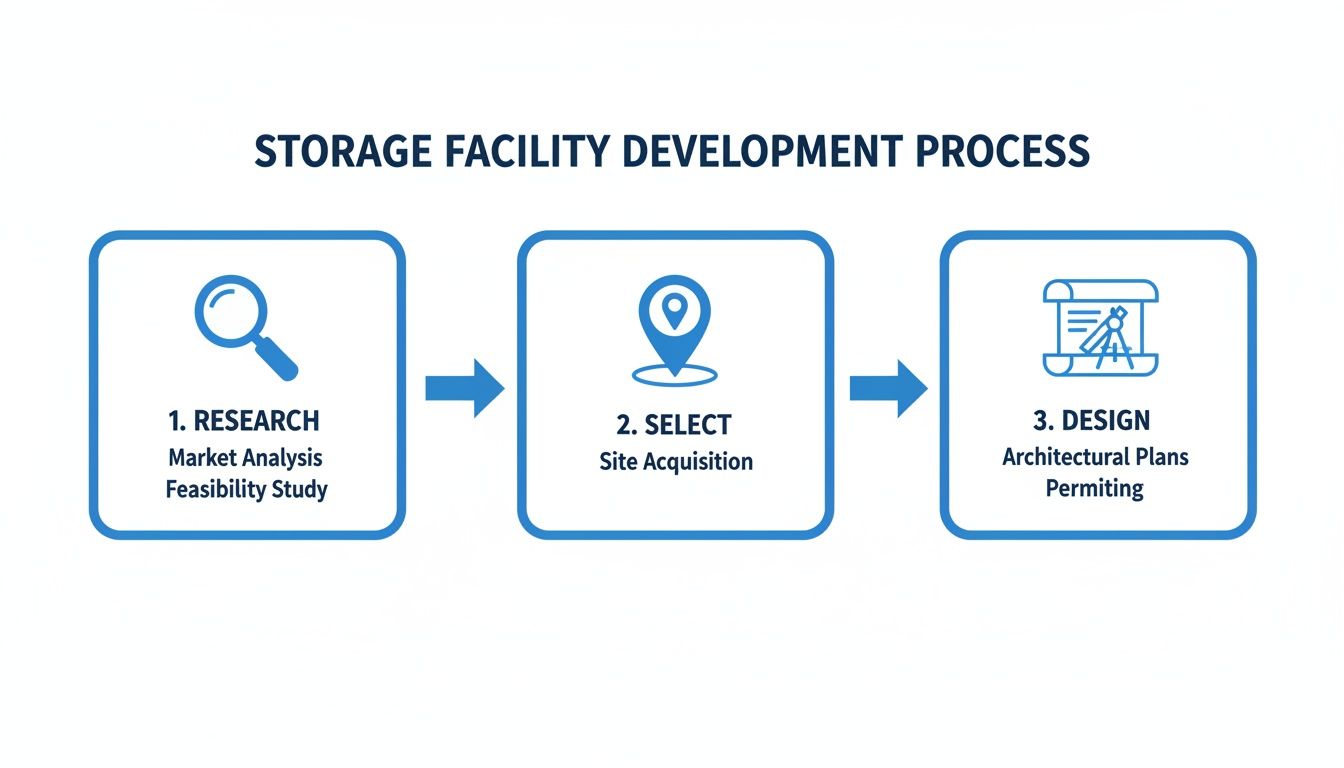
Each step flows directly into the next. Get the research right, and the site selection becomes clearer. Nail the site, and the design almost suggests itself. It's a progression that systematically reduces risk.
Hyper-Local Market Analysis
Forget national trends for a moment; self-storage is an intensely local game. You need to become the leading expert on your target area. That means getting granular with the data—population density, new housing developments, and the number of local businesses or students who are your bread-and-butter customers.
It's a common mistake to see a competitor down the road and write off an area as saturated. The real question is, how full are they? If existing facilities are running consistently over 90% occupancy, that’s a massive green flag. It often points to powerful, unmet demand just waiting for a new supply.
To get the full picture, you need to answer a few key questions:
- Who lives here? Are you looking at young families caught between house moves, or small e-commerce businesses desperate for stockroom space? Your unit mix depends on this.
- What’s the competition really like? Map out every competitor in a three-to-five-mile radius. Don't just look at their signs; analyse their pricing, their unit mix, and what customers are saying about them online.
- Where is the demand coming from? Keep an eye out for catalysts. New housing estates, a university expansion, or a new business park can create waves of new customers overnight.
Strategic Site Selection
Location, location, location. It’s a cliché for a reason. Your facility’s site is arguably the single most critical factor in its long-term success. Great visibility from a busy road isn't just a perk; it's a permanent billboard that will slash your marketing budget for years to come.
Accessibility is just as vital. Customers need to feel safe and be able to easily manoeuvre a van in and out of the site. A tricky entrance or poor lighting can be a deal-breaker.
Before you get too attached to a piece of land, do a preliminary check on zoning and planning regulations with the local council. There's nothing worse than finding the perfect spot only to discover it’s not zoned for the right commercial or industrial use. To dig deeper into the commercial side of things, our guide on self-storage as a business is a great resource.
A prime location is a three-legged stool: visibility, accessibility, and the right zoning. If one leg is weak, the whole operation becomes unstable and you'll be fighting an uphill battle from day one.
Choosing Your Business Model
Today, you generally have two main paths when building a new facility: the classic multi-storey building or the increasingly popular container-based setup. Each has its own playbook and is suited to different market conditions, land types, and investment levels.
Facility Type Comparison: Traditional vs Container Storage
Deciding between a purpose-built facility and a container park is one of the first major forks in the road. This isn't just an aesthetic choice; it fundamentally shapes your budget, timeline, and operational model.
| Feature | Traditional Multi-Storey Facility | Container-Based Facility |
|---|---|---|
| Initial Cost | Higher capital investment in construction | Lower initial outlay; buy containers as needed |
| Land Usage | Maximises vertical space on smaller, urban plots | Requires more land; best for larger, cheaper sites |
| Flexibility | Layout is largely fixed post-construction | Highly flexible; add or remove units as demand shifts |
| Speed to Market | Longer construction timeline | Much faster deployment; can be operational quickly |
| Customer Appeal | Appeals to clients needing climate control & high security | Popular for drive-up access and commercial storage |
| Environment | Internal, climate-controlled, premium feel | Outdoor, drive-up convenience |
Both models can be incredibly profitable, but they serve slightly different needs and require different strategies. Your market analysis should give you a strong indication of which direction to take.
Traditional Multi-Storey Facilities
This is what most people imagine when they think of self-storage: a large, secure building with internal corridors leading to units of all shapes and sizes. They shine in dense urban areas where land is eye-wateringly expensive because they allow you to stack units and maximise your lettable area on a compact footprint. They also provide a premium environment, often with climate control, which is a major draw for customers storing valuable antiques, electronics, or business documents.
Container-Based Facilities
This model has exploded in popularity for good reason—it offers incredible flexibility and a much lower barrier to entry. It’s a perfect fit for larger, more affordable plots of land. With the UK self-storage industry now turning over £1.2 billion, it's telling that container sites now make up nearly 40% of all locations. They allow for a phased rollout, meaning you can start with a small number of containers and add more as your occupancy grows. This is a fantastic way to manage cash flow and scale your business in line with actual demand.
Navigating the Design and Planning Permission Maze
You’ve found a promising site, which is a huge step. But now the real work begins. This is where your vision for a new self-storage facility collides with the hard realities of design, regulation, and ultimately, profitability. The challenge is to turn your concept into a tangible, compliant, and highly efficient plan that local authorities will actually sign off on.
It’s a delicate balancing act. You need to squeeze every last square foot of net rentable area out of the building while also making sure the layout is seamless and secure for your future customers. Remember, you’re creating a profitable asset, not just putting up a building.
Crafting a Winning Site Layout
The layout of your facility will make or break its operational efficiency and customer appeal. Get it wrong, and you’re looking at traffic jams, frustrated customers, and wasted space. The key is to design for flow, security, and maximum rental income right from the start.
Think about the customer’s journey from the second they drive onto the property. Is the entrance obvious? Is there enough room for a big removal van to turn around without a twenty-point turn? Can two cars pass each other comfortably in the main lanes? These aren't minor details; they make a massive difference to the customer experience.
Your design must also have modern security features baked in from the beginning. This isn’t an optional extra; it’s a core part of what you’re selling.
- CCTV Placement: Cameras need to cover all entry and exit points, loading bays, and main corridors. No blind spots.
- Access Control: You need a robust system that logs who comes and goes from the site, and ideally, from individual floors or zones.
- Lighting: Well-lit corridors and outdoor areas are non-negotiable. They make customers feel safe and are a brilliant deterrent to thieves.
The Planning Permission Process in the UK
Let’s be honest: securing planning permission is often the biggest and most unpredictable hurdle you’ll face. Every local council has its own quirks and interpretations of planning law, which can make it a real headache to manage. Submitting a comprehensive, professionally prepared application isn’t just a good idea—it’s essential.
Your application will need detailed architectural drawings, a site plan, a design and access statement, and often a whole host of specialist reports covering everything from traffic impact to drainage. The more thorough you are, the smoother things are likely to go.
A really smart move is to engage with the local planning authority early on, even before you submit the formal application. This "pre-app" advice can highlight potential red flags and give you a much clearer idea of what the council wants to see, saving you a lot of time and money down the line. As this guide to Navigating Building Codes And Regulations points out, understanding the local rulebook is critical.
Don't treat planning permission as a simple box-ticking exercise. It's more of a negotiation. Your job is to show that your facility is a well-considered, low-impact development that will be a genuine asset to the local commercial landscape.
Demystifying Building Regulations and Fire Safety
Once planning permission is in the bag, you hit the next layer of compliance: the UK's strict building regulations. These are totally separate from planning rules. They focus on the technical side of the construction, making sure the building is safe, accessible, and energy-efficient.
Fire safety is a massive part of this. Self-storage facilities have their own unique fire risks, and your design must incorporate the right fire detection systems, fire-resistant partitioning, and clear, accessible escape routes.
For anyone building a storage facility, getting your head around these codes is vital. You can find more detail on our dedicated page covering the essentials of building regulations. Honestly, the best way to get this right is to work with architects and contractors who live and breathe this stuff. They’ll make sure every detail is covered.
Designing a Profitable Unit Mix
Your market research from the initial stages should be the blueprint for your unit mix—that is, the variety and number of different-sized units you offer. Getting this right is fundamental to maximising your revenue. One of the most common mistakes we see is operators creating a generic mix that completely ignores the specific needs of the local area.
For instance, a site near a university will probably need a lot of small, locker-style units for students. A facility in a leafy suburb full of families, on the other hand, will likely see strong demand for bigger 100-150 sq ft units—perfect for storing the contents of a three-bedroom house.
The physical partitioning system you choose also has a big impact here. Modern systems are incredibly flexible, allowing you to tweak unit sizes over time as the market changes. A high-quality, durable partitioning system isn’t an expense; it’s a long-term investment in your facility’s success.
Getting Your Self-Storage Project Funded and Built
This is where the rubber meets the road. Securing the capital and managing the build are often the most intimidating parts of launching a storage facility, but it's here that your detailed plans start turning into a real, revenue-generating asset. Your success hinges on having a rock-solid financial strategy and a clear vision for the construction journey you’re about to take.
Your business plan is the single most important document you'll create. Don't think of it as a formality; it's your roadmap and your primary sales tool for convincing lenders and partners that your project is a winner. It needs to be meticulously detailed, packed with realistic financial projections grounded in the hard data from your market analysis.
Securing the Right Capital
Forget the idea that your local high-street bank is your only port of call. While they're a decent starting point, the world of commercial finance has far more specialised avenues for a project like this. I've seen many developers find much greater success with lenders who have a dedicated portfolio in commercial property or, even better, direct experience with the self-storage sector. They just get it.
Exploring these alternative routes can lead to more favourable terms and a much smoother approval process. It's worth looking into:
- Specialist Commercial Mortgages: Lenders who understand the self-storage model are better equipped to evaluate its unique cash flow potential. They often look beyond the simple property value, which is a massive advantage.
- Joint Venture (JV) Partnerships: Teaming up with an experienced property investor or a development firm can inject not just cash but also invaluable expertise into your project. Don't underestimate the value of having a seasoned pro in your corner.
- Challenger Banks and Private Lenders: These institutions can sometimes offer more flexible criteria and faster decisions than their larger, more traditional counterparts.
Crafting a bulletproof budget is central to all these conversations. This is not a back-of-the-envelope calculation. Your budget must account for every conceivable cost, from the land acquisition and professional fees to the cost of steel, partitioning, and even the initial marketing spend needed to get those first customers through the door. You can explore a variety of structured financing solutions for self-storage that are designed to help manage these hefty upfront costs.
Your financial projections aren't just numbers on a spreadsheet. They tell a story about your facility's future. A compelling narrative, backed by solid data on local demand and projected occupancy rates, is what convinces investors to back your vision.
Choosing Your Construction Approach
Once your funding is in the bag, you’re faced with a critical decision on how to manage the build itself. This choice will directly impact your budget, timeline, and the amount of hands-on involvement required from you. The two main paths are the all-inclusive 'supply-and-fit' model and the more hands-on 'labour-only' contract.
The market you're stepping into is substantial. General warehousing and storage in the UK recently hit £38.2 billion in revenue, and constructing new facilities aligns perfectly with growth opportunities within the UK’s wider £168.6 billion construction market. If you're interested in the bigger picture, you can read more about the UK construction industry growth forecasts to understand the sheer scale of this opportunity.
The Turn-Key Supply-and-Fit Model
Think of this as the all-in-one package. With a supply-and-fit contract, you bring in a single specialist company to handle everything—from manufacturing the components like partitioning and mezzanine floors to delivering and installing them on your site.
For first-time developers or those who don't have time to juggle a complex build, this approach offers some serious advantages.
- One Point of Contact: You have one company to hold accountable for the entire internal fit-out. This simplifies communication and accountability massively.
- Budget Certainty: Costs are typically agreed upon upfront, which gives you a high degree of financial predictability and minimises the risk of nasty surprises.
- Guaranteed Quality: The manufacturer is on the hook for the quality of both the products and the installation, ensuring you get a consistent, professional finish.
- Faster Completion: Because one supplier controls the entire chain from factory to site, scheduling is often far more efficient, leading to a quicker project turnaround.
This model is perfect for developers who value peace of mind and a predictable timeline above all else. The trade-off is often a slightly higher initial cost, but what you're paying for is reduced management burden and less risk.
The Hands-On Labour-Only Contract
The alternative is a labour-only contract, which is a more fragmented approach where you (or your main contractor) take a much more active role. In this scenario, you source and buy all the materials yourself—the steel partitions, doors, corridor systems—and then hire a specialist team purely to handle the installation.
This route can be more cost-effective if you know what you’re doing, but it demands significantly more of your time and expertise. You become the project manager, responsible for coordinating deliveries, ensuring every last nut and bolt is on-site when needed, and managing the installation team.
It’s a great option for experienced developers who already have established supply chains and are confident managing multiple moving parts. But be warned: any delays in material delivery or coordination issues fall squarely on your shoulders. If not handled with precision, this can easily lead to budget overruns and frustrating delays. Your choice between these two paths will fundamentally shape your experience of building a storage facility.
Getting Your Facility Commissioned and Ready for Launch Day
The last lick of paint is dry, the construction dust is finally settling, and your project is about to shift gears. This is where you transform it from a building site into a living, breathing business. Commissioning is that final, methodical quality check before you open the doors to your first customer. It's about making sure every single system works—not just on its own, but in harmony with everything else.

This stage is all about meticulous, hands-on testing. It’s your chance to catch and fix any snags, from a dodgy security sensor to a glitch in the billing software, before they have a chance to damage your reputation or hit your revenue. Think of it as a full dress rehearsal, but without an audience.
The Essential Commissioning Checklist
Don’t even think about winging it here; a systematic approach is non-negotiable. A proper checklist ensures nothing gets missed as you move towards the official handover from your contractors. This isn't just about flicking a few switches on and off. It's about running real-world scenarios to see how your systems hold up under pressure.
Your checklist needs to be exhaustive, covering every nut and bolt of the facility. Key areas to hammer on include:
- Security and Access Control: Test every single gate, keypad, and electronic lock. Does the system log entries and exits correctly? Do individual tenant codes work exactly as they should, granting access only where they’re supposed to?
- Lighting Systems: Check all the lights, inside and out. That includes motion sensors and, crucially, the emergency backup lights. Make sure your pathways, corridors, and loading bays are consistently bright. No dark corners.
- Fire Safety and Alarms: Coordinate with your installer to run a full test of the fire detection and alarm system. Verify that every smoke detector, heat sensor, and manual call point is online and reporting back as it should.
- Management Software Integration: This one is absolutely vital. Does your property management software talk to your access control system without any hiccups? Try running a new customer sign-up from start to finish. Can you assign a unit and grant them access, all from the platform?
The whole point of commissioning is to get from "construction complete" to "customer ready." This is where you prove that every promise you're about to make—security, accessibility, safety—is backed by fully tested, functional systems.
Finalising the Operational Handover
Once you’re completely satisfied that every system is running like a well-oiled machine, it's time for the formal handover from your contractors. This is more than just getting the keys; it’s a transfer of knowledge. Insist on a complete handover pack from your build team.
This pack of documents is your facility’s bible for the long haul. It should contain all the essentials: operating manuals for every piece of equipment, warranty information for everything from the roller doors to the HVAC, and the final as-built drawings that show exactly how the facility was constructed. Just as important is getting hands-on training for you and your staff on how to operate it all day-to-day.
Implementing Your Management and Pricing Strategy
With the physical building sorted, your focus now pivots to your digital and commercial setup. That means getting your facility management platform fully configured. This software is the central nervous system of your business, handling everything from online bookings and automated billing to tracking occupancy and managing customer emails.
At the same time, you need to lock in your pricing strategy. You probably roughed this out in your business plan, but now is the time to fine-tune it based on the final unit mix and what the local market is doing right now. Consider using a dynamic pricing model, where you can adjust rates for specific unit sizes in real-time based on demand. It's a great way to maximise revenue—you can offer a deal to fill up less popular units while bumping the price on the ones everyone wants.
Building Momentum with Pre-Launch Marketing
Waiting until opening day to start marketing is the single biggest mistake you can make. A smart pre-launch campaign can mean having a waiting list of paying customers before you even cut the ribbon. Building a storage facility is a serious investment, so getting revenue flowing from day one is a massive advantage.
Start with a simple "coming soon" landing page, complete with some professional-looking renderings of the finished facility. Use targeted local ads on platforms like Facebook and Google to drive traffic there, and make sure you capture email addresses from anyone who shows interest. This gives you a ready-made audience to market to directly, allowing you to offer exclusive early-bird discounts to lock in those first crucial bookings and hit the ground running.
Right, the doors are open, and your first customers are moving in. This is where the real work begins. The construction phase is over, and now your focus pivots entirely to the commercial side of the operation. Long-term success now boils down to the day-to-day grind of driving revenue, managing costs, and creating an experience that keeps those units full.
This part of the journey is all about smart, data-driven decisions. While a gut feeling can get you started, sustainable growth is built on a solid foundation of Key Performance Indicators (KPIs) and a relentless push for efficiency.
Mastering Your Key Performance Indicators
To get a real pulse on the health of your business, you need to track a few core metrics almost obsessively. Think of these KPIs as the vital signs of your facility—they tell you what’s working, what’s not, and what needs your immediate attention.
- Occupancy Rate: This is the big one, but it has two crucial sides: unit occupancy and economic occupancy. Unit occupancy is simple—it’s how many units are rented. But economic occupancy is where the real story is. It reveals the revenue you're actually collecting compared to your total potential income, highlighting the true cost of discounts and late payments.
- Revenue Per Available Square Foot (RevPAF): This is a powerhouse metric. It blends occupancy and rental rates to give you a crystal-clear picture of your revenue efficiency, helping you compare performance across different unit sizes and against market benchmarks.
- Average Length of Stay: How long do your customers stick around? Knowing this is vital for forecasting revenue and managing churn. A longer average stay directly translates to lower marketing costs and a more stable, predictable income stream.
- Delinquency Rate: This tracks the percentage of tenants behind on their payments. Keeping this number as low as humanly possible is absolutely essential for maintaining healthy cash flow.
A high unit occupancy rate can easily hide underlying problems. If you're celebrating 95% unit occupancy but your economic occupancy is languishing at 80% because of deep, long-term discounts, you're leaving a serious amount of money on the table.
Leveraging Technology for a Lean Operation
Modern self-storage facilities are becoming more and more automated, and for good reason. The right tech lets you offer a top-tier customer experience while keeping your overheads impressively lean. Your facility management software is the heart of this ecosystem, but it doesn't stop there.
Online rental platforms are no longer a "nice-to-have"; they're the standard. Customers today expect to find a unit, sign the lease, and set up payments right from their phone, at any time of day. This level of convenience is a massive competitive advantage.
This move toward automation isn't just happening in self-storage. The wider industrial construction sector is seeing similar shifts. Since 2020, for instance, the operational capacity for battery energy storage systems has shot up by a staggering 509%, with a huge pipeline still under construction. This boom relies heavily on modular, automated solutions to navigate workforce shortages—a trend that mirrors the self-storage industry’s own push towards remote management. You can see more on these parallel trends in the UK battery market report.
To lock in that long-term profitability and operational excellence, implementing a robust preventive maintenance schedule is completely non-negotiable. This proactive approach uses technology to keep an eye on the health of your gates, lifts, and HVAC systems, preventing expensive downtime before it ever happens.
Unlocking Ancillary Revenue Streams
Rental income is your bread and butter, but it shouldn't be your only source of revenue. Ancillary streams can give your bottom line a significant boost, often with very high profit margins. These small additions can make a huge difference to your overall return on investment.
Here are a few proven income boosters to consider:
- Retail Sales: Selling packing materials like boxes, bubble wrap, and tape is an easy win. You have a captive audience of customers who will almost certainly need these items right when they're at your facility.
- Tenant Insurance: Offering a specialised insurance policy gives your customers peace of mind and creates a reliable, recurring monthly revenue stream for your business.
- Van Hire Partnerships: Why not team up with a local vehicle rental company? You can earn a commission on every referral, providing a valuable service to your customers without taking on any of the overheads yourself.
- Premium Services: Think about offering extra services like parcel acceptance or shelving rental for your business clients. These can command higher prices and help you attract more valuable, long-term tenants.
By focusing on these core areas—tracking the right numbers, embracing automation, and diversifying your income—you can ensure your new facility doesn't just get through its first year, but actually thrives for decades to come.
Got Questions About Building a Storage Facility? We’ve Got Answers.
Jumping into the world of self-storage development is a massive undertaking, and it's completely normal to have a long list of questions. Here, we'll tackle some of the most common queries we hear from aspiring developers, giving you the straightforward answers you need to move forward with clarity and confidence.
What’s the Real Cost of Building a Storage Facility in the UK?
There’s no magic number here, as the final bill is massively influenced by where you build, the spec you choose, and of course, the price of the land itself. For a decent-sized, purpose-built facility, you could be looking at anything from £2 million to over £5 million.
That broad range has to cover everything: land acquisition, all the construction and materials, high-spec security systems, and enough working capital to see you through the first few months.
Remember, the type of build you go for is a huge factor. A container-based setup will almost always have a lower barrier to entry compared to a traditional multi-storey building, which demands more significant foundations and a far more complex construction process.
How Long Does it Actually Take from Planning to Opening Day?
Patience is more than a virtue in this game; it’s a necessity. From finding the perfect site to finally cutting the ribbon, a realistic timeline for a new self-storage facility is typically between 18 and 36 months.
This journey usually unfolds in stages:
- Finding a Site & Checking Feasibility: 3-6 months
- Securing Planning & Finance: 6-12 months
- Construction & Fit-Out: 6-12 months
- Commissioning & Pre-Launch Marketing: 1-3 months
The biggest wildcard? Planning permission. It’s almost always the single most significant variable. Delays at this stage are incredibly common, so it's smart to build a healthy buffer into your project schedule right from the start.
If there’s one thing to be ready for, it's the planning process. It's often the longest and most unpredictable part of the entire build. Getting in front of the local authorities early with a meticulous application can smooth things out, but a quick approval is rare.
What Are the Biggest Pitfalls I Should Avoid?
Plenty of first-time developers stumble into the same predictable traps. Learning from their missteps can save you a world of time, money, and headaches.
One of the most common blunders is seriously underestimating the planning permission timeline and all the costs that come with it. Another classic mistake is picking a site with terrible visibility or tricky access. A cheap bit of land is no bargain if your customers can't find you or can't get a van onto the site without a twenty-point turn.
Beyond the physical location, a fatal flaw is getting the unit mix wrong for the local market. For example, filling your facility with huge units in a dense city centre full of students and apartment dwellers is a surefire way to end up with high vacancy rates.
Lastly, failing to budget properly for modern tech and a powerful pre-launch marketing push will have you playing catch-up from day one. Sidestepping these common mistakes is crucial if you want to build a storage facility that’s profitable right out of the gate.
At Partitioning Services Limited, we’re experts in turning a self-storage vision into a high-performing reality. From the initial designs and manufacturing right through to the final installation, our end-to-end solutions are designed to ensure your project is built for maximum profitability and long-term success.
Ready to get your project off the ground? Explore our turn-key self-storage solutions at https://psllimited.co.uk.