

So, you want to put a shipping container on your land. The big question is, do you need planning permission? The short answer is: it depends.
A small container tucked away in your garden for storage might be fine. But one you plan to use as a home office, a workshop, or any kind of permanent structure? That’s almost certainly going to need a chat with the council. It all boils down to its size, what you’re using it for, and how permanent it really is.
The Simple Answer to Shipping Container Planning Permission
Figuring out if your container needs planning permission can feel like navigating a maze, but it’s actually simpler than you think. The planning system doesn't really care that it's a shipping container; it cares about the impact and use of the structure. Just because it can be moved doesn't mean it gets a free pass.
Think of it like this: pop a small tent in your garden for the kids over a weekend, and no one bats an eye. It’s temporary. But if you decide to build a permanent wooden gazebo, complete with foundations and electricity, you’ve created a structure that needs to be assessed. A shipping container follows the exact same logic.
The two most important questions you need to answer are: what’s it for, and how long is it staying?
Key Deciding Factors
There are a few key things that will determine whether your container is just a simple storage box or a full-blown development project in the eyes of the local council. Getting your head around these will give you a pretty good idea of where you stand.
- Size and Scale: A single, standard-sized container is one thing. Multiple containers stacked together or an unusually large one? That’s much more likely to catch an officer’s attention.
- Permanence: Have you bolted it to concrete foundations? Hooked it up to the mains for water and electricity? Actions like these send a clear signal that this isn't just a temporary fixture.
- Change of Use: This is a big one. Let's say you drop a container on a patch of agricultural land to run a small repair shop. You’ve just changed the land’s use from farming to commercial, and that always requires planning permission.
This little flowchart breaks down the initial thought process based on what you’re planning to do with it.
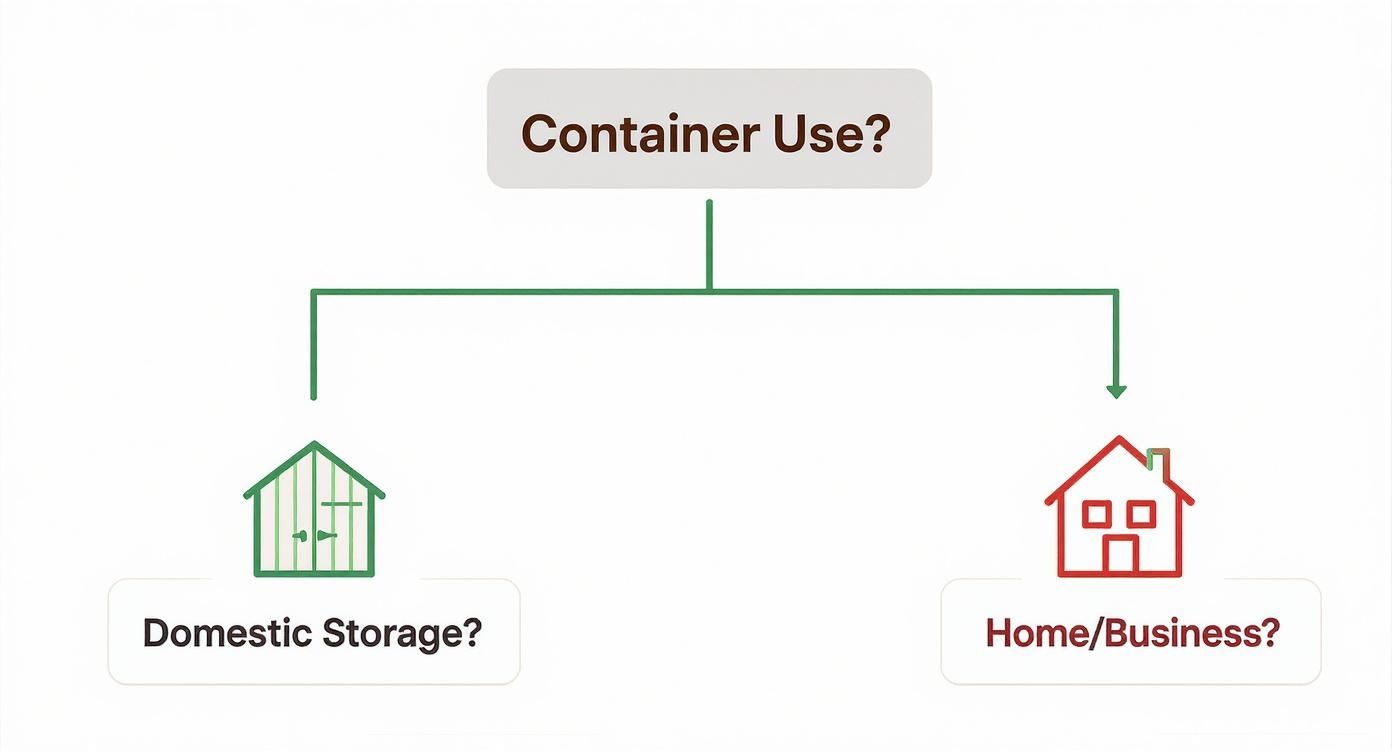
As you can see, the moment your plans go beyond simple garden storage, you’re heading straight into planning permission territory.
The Risk of Getting It Wrong
Thinking you can get away with calling a container a 'temporary' structure is a common and often expensive mistake. This is especially true on agricultural land, where containers frequently appear without consent.
A Planning Inspectorate analysis found that between 2018 and 2021, over 35% of enforcement notices for illegal buildings on farms involved shipping containers. It's a real issue. You can learn more about the specific rules for agricultural container use and how to steer clear of enforcement action.
The crucial takeaway is this: 'temporary' in planning law does not mean 'movable'. It relates to the nature and duration of the use. If the container serves a permanent function, it will likely be treated as a permanent building.
Quick Guide to Shipping Container Planning Rules
To make things even clearer, here's a quick reference table. It summarises a few common scenarios to help you gauge whether your project is likely to need planning permission from the get-go.
| Container Use Case | Planning Permission Likely Required? | Primary Factor |
|---|---|---|
| Garden Shed/Storage | No (usually) | Incidental to the enjoyment of the dwelling house. |
| Home Office/Gym | Yes | Creates a separate use from the main house. |
| On-site Farm Storage | Maybe | Depends on whether it's for agricultural use. |
| Commercial Unit/Shop | Yes | Constitutes a 'Change of Use' for the land. |
| Permanent Housing | Yes | Considered a new dwelling and a permanent building. |
| Temporary Site Office | No (often) | Permitted for the duration of approved building works. |
This table should give you a solid starting point, but remember, every site is different. If you're in any doubt, it’s always best to check with your local planning authority before you do anything else.
Understanding Permitted Development Rights
Think of planning permission as asking your local council for the green light before you build something. Permitted Development Rights (PDR), on the other hand, are like a set of pre-approved permissions from the government for common, small-scale projects. It’s the reason you can usually pop up a garden shed or a fence without getting bogged down in paperwork.
For a shipping container, this is your most likely ticket to avoiding a full-blown planning application. If you can successfully argue that your container is an ‘outbuilding’ and it ticks all the PDR boxes, you might be in the clear. It’s like having a guest pass that lets you skip the main queue—but only if you meet every single condition printed on the back.
But these rights aren't a free-for-all. They come with a strict rulebook covering size, height, and where you can put things. Before we get into the nitty-gritty of PDR, it's worth getting a handle on how broader local policies could affect your project. A good starting point is understanding zoning regulations, as this wider context can shape how PDR is interpreted in your area.
When a Container Acts Like a Garden Shed
Under PDR, an outbuilding—which a shipping container could be classed as—is generally allowed without planning permission if its use is ‘incidental to the enjoyment of the dwellinghouse’. This is the key phrase to remember. It means the container has to be used for domestic hobbies or storage, like stashing your lawnmower, bikes, or old furniture. Basically, things you’d normally keep in a shed or garage.
The moment you start using it as your main workshop, a home office for client meetings, or a makeshift bedroom for a teenager, it’s no longer ‘incidental’. At that point, it’s serving a primary function, just like your house, and you’ll need to go down the full planning permission route.
To qualify under these rights, your container typically has to meet several conditions:
- Single Storey: It can’t have more than one floor.
- Height Restrictions: The eaves can't be higher than 2.5 metres. The total height is capped at 4 metres for a pitched roof or 3 metres for any other roof type.
- Location Rules: You can't place it in front of the main face of your original house.
- Coverage Limit: All your outbuildings combined (including the container) can't cover more than 50% of the total land around your original house.
These are the general rules, but they can get even tighter in places like National Parks, Conservation Areas, or Areas of Outstanding Natural Beauty.
The Misunderstood 28-Day Rule
There’s a popular myth that you can plonk a container anywhere for 28 days without needing permission. This is a risky misinterpretation of planning law that could land you in hot water. The '28-day rule' actually applies to the temporary use of land, not the permanent or semi-permanent installation of a structure.
It’s the rule that lets a farmer host a music festival in a field or run a car boot sale for up to 28 days a year. It absolutely does not give you a 28-day grace period to install a shipping container and hope for the best.
A local council won’t judge your container's permanence by looking at a calendar. They’ll look at how fixed it is to the ground and what you're using it for. A container brought in for long-term storage, even if it’s just sitting on the grass, is not seen as a 'temporary use of land'.
Relying on this rule is one of the quickest ways to get an enforcement notice from the council demanding you remove it. The intention behind placing the container is far more important than how many days it's been there. If its purpose is ongoing, it's not temporary in the eyes of the law, and you need to figure out if you need planning permission from day one. This is the crucial distinction that catches so many people out.
When Your Container Becomes a Building
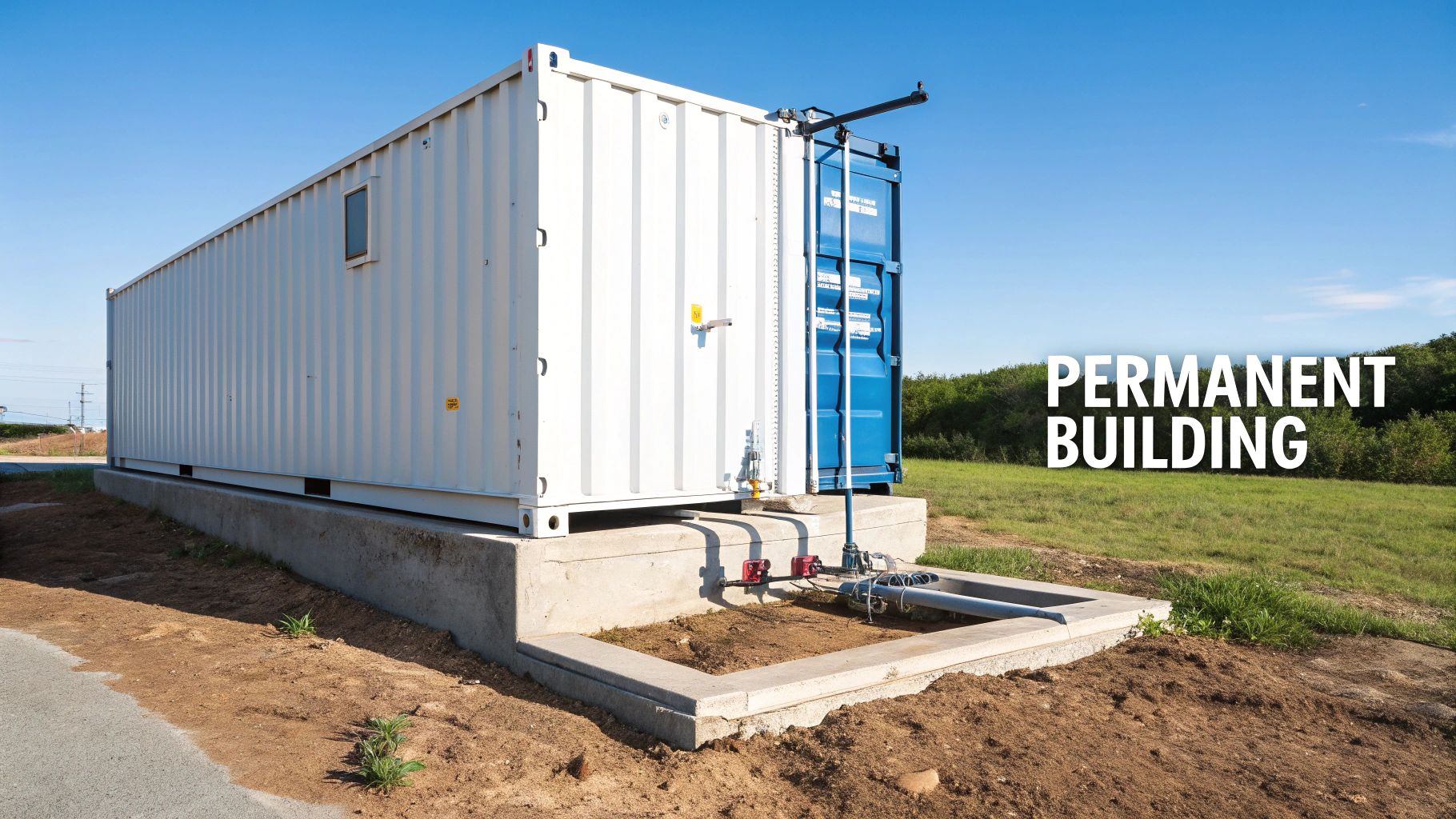
In the world of UK planning law, there’s an invisible line where a simple steel box stops being an object and starts being a permanent building. It’s this distinction that catches so many projects out and leads to council enforcement notices. The issue isn't what the container is made of; it's all about how it’s used on the land.
Just because a crane can lift it doesn't automatically make it temporary. Planners don't really care about its potential for movement. Instead, they apply a series of tests to figure out its true nature on your site.
The Three Tests of Permanence
To decide if your container needs planning permission, local authorities will essentially ask three key questions. Think of it as their checklist for permanence. The more times you answer 'yes', the more likely it is that you’re dealing with a building.
- Size: Is it big enough to be considered a building? A single 20-foot container might sit in a grey area, but stacking multiple units or bringing in a 40-foot model almost certainly pushes it into 'building' territory.
- Physical Attachment: How is it fixed to the land? If you bolt it to a concrete slab, connect it to the mains, or run plumbing to it, you’re sending clear signals of permanence.
- Functional Permanence: Does its purpose suggest it's there for the long haul? A container serving as a site office for a six-month construction job is one thing. One being used as a permanent farm shop or workshop is something else entirely.
If you just drop a container onto some railway sleepers in a field for storage, you’re in a bit of a grey area. The moment you pour a concrete base and hook it up to a power supply, however, you've fundamentally changed its character in the eyes of the law.
What Is Material Change of Use?
This is a critical planning concept that often trips people up. A material change of use happens when you alter the main purpose of your land, and that almost always requires planning permission. Placing a shipping container can trigger this, even if it’s not physically bolted down.
Let’s say you have a field designated for agricultural use. Its primary function is farming. If you place a container there and start running a bike repair business from it, the container itself isn’t the only problem. You’ve changed the land’s use from agricultural to commercial.
This is a vital point: The act of changing the land's function is a form of development in itself. Your local authority will see this as a breach of planning control, regardless of whether the container has foundations or not.
The container is simply the tool that allows this unauthorised change to happen. This rule applies to any type of land, from a residential garden to an industrial estate.
Examples That Cross the Line
To make this crystal clear, let's look at a few real-world scenarios that show the tipping point between a temporary object and a permanent building.
| Scenario | Why it becomes a 'building' |
|---|---|
| Garden Office Container | It’s connected to electricity and WiFi, sits on a permanent base, and serves a primary business function, not just incidental storage. |
| Farm Shop Container | It’s open to the public, requires services like power for refrigeration, and represents a material change of use from agriculture to retail. |
| Stacked Storage Units | The sheer size and scale of multiple containers create a significant visual impact and imply a permanent, organised storage operation. |
| Holiday Let Container | It is equipped for human habitation with plumbing and insulation, making it a functional dwelling that must adhere to strict regulations. |
In every case, the container’s installation and purpose create a degree of permanence that will attract the attention of the planning department. The structure might also need to comply with specific construction standards. To get a handle on what’s needed for habitable structures, it’s worth understanding the fundamentals of UK building regulations, which are a separate but equally important hurdle.
Planning Rules for Container Homes and Offices
Once you start thinking beyond simple storage and picture a shipping container as a place for people, the planning landscape shifts entirely. Turning a steel box into a home, a granny annexe, or even a garden office is a serious project, and the rules are completely non-negotiable.
The moment a container is meant for people to live or work in, it's automatically classed as a new building. There are no grey areas or loopholes to exploit here. It requires full planning permission and must also satisfy a separate, rigorous set of Building Regulations.
Why Habitation Changes Everything
A local authority doesn’t see a trendy, eco-friendly container home; it sees a new-build house that just happens to be made of steel. This means your project will be judged against the exact same standards as a traditionally built brick-and-mortar home. It's a fundamental shift, moving the focus from simple land use to ensuring the structure is safe, healthy, and comfortable for anyone inside.
The planning process will scrutinise every detail of your proposal, from its visual impact on the neighbourhood to whether you have proper access and parking. You can't just drop it in a back garden and call it a day.
The core principle is straightforward: if you can sleep in it, work in it, or use it as a primary living space, it is a building requiring full planning consent. This is the clearest red line in shipping container planning.
This strict approach is reflected in the data. According to a 2023 study on non-traditional housing, there were 1,842 planning applications in England between 2019 and 2022 that explicitly mentioned container homes. Of these, only 58% were granted permission, which really highlights the detailed examination these projects face.
The Crucial Role of Building Regulations
Getting planning permission is only the first hurdle. For any structure intended for people, you must also secure Building Regulations approval. This is a completely separate legal requirement that deals with the nuts and bolts of construction, making sure the building is safe, healthy, and energy-efficient.
Think of it this way:
- Planning Permission decides if you can build it in that specific location.
- Building Regulations decide how you must build it to meet national standards.
For a container home or office, this means proving you’ve met the technical standards in several key areas.
Essential Standards for Container Conversions
To turn a metal box designed for cargo into a safe and comfortable space, you have to address some critical construction standards. A building control inspector will need to see detailed plans showing that your conversion meets requirements for:
- Structural Stability: You’ll need to prove the container has been properly reinforced, especially after cutting openings for windows and doors, and is secured to suitable foundations.
- Fire Safety: This includes fitting appropriate fire-resistant linings, smoke alarms, and ensuring there are safe escape routes.
- Insulation and Energy Efficiency: A bare steel container is an oven in summer and a freezer in winter. You must add high-performance insulation to the walls, floor, and roof to meet strict thermal efficiency targets.
- Ventilation: Proper ventilation is vital to prevent damp and condensation and to ensure good air quality for the occupants.
If you fail to meet these standards, your project won't get signed off, making it legally uninhabitable. When weighing up options for your property, it's worth comparing different structures, such as purpose-built external garage units, which are designed from the ground up to meet specific regulations. This can sometimes be a more straightforward path than converting a container for a purpose it was never intended for.
How to Navigate the Planning Application Process
So, you’ve worked through the checklist and it looks like you need planning permission. This is the part where many people feel a bit overwhelmed, but there’s no need to be. With a clear strategy, the whole process becomes a series of manageable steps.
Think of it less like a battle against the council and more like a negotiation. You’re simply presenting a well-reasoned case for why your container is needed. The most successful applications I’ve seen are always built on solid preparation and good communication with the local planning authority (LPA) right from the start.
Your First Step: Pre-Application Advice
Before you even think about filling in a form, your best move is to get some pre-application advice from your local council. This is basically an informal chat or meeting with a planning officer who will give you their initial thoughts on your project.
Honestly, this step is gold. It gives you a direct line into the council's specific policies and what they’re likely to worry about—things like visual impact or access issues—before you’ve sunk any real time or money into the application. An officer might suggest a small tweak, like shifting the container’s position or adding some cladding, that could be the difference between a yes and a no.
Taking the time for pre-application advice can save you months of delays. It allows you to address potential problems upfront and tailor your final submission to meet the council's expectations, dramatically increasing your chances of success.
Assembling Your Application Documents
Once you have a better feel for the council's stance, it’s time to get your formal application ready. In the UK, this is usually handled online through the Planning Portal. A strong application is a detailed one; you want to give the planning officer everything they need to make a decision without having to chase you for information.
You’ll need a specific set of documents to back up your case. Miss just one, and your application could be deemed invalid, sending you right back to the start.
Your Core Document Checklist:
- Completed Application Form: The standard form outlining what you’re proposing.
- Location Plan: A map showing the site in relation to its surroundings, with your property boundary clearly marked in red.
- Site Plan (or Block Plan): A more detailed drawing showing exactly where the container will go, along with access points and any other buildings on the site.
- Design and Access Statement: This is your chance to explain the thinking behind the project. It needs to justify why you need the container and how you’ve designed the scheme to minimise its impact on the local area.
- Correct Fee: The application fee will vary depending on the project’s type and scale.
If you're involved in larger projects, it’s worth reading through a practical guide on erecting metal buildings, covering planning and permits to get a sense of the wider context for similar structures.
Framing Your Project for Success
How you frame your project is everything. When you write your Design and Access Statement, you need to show how your proposal fits in with local planning policies. Use positive language and focus on the benefits, but don’t shy away from potential downsides—address them head-on.
Will the container be visible from a public road? Explain your plan to screen it with landscaping or paint it a colour that blends into the background. Worried about noise? Detail the hours of operation. Tackling these points proactively shows the planning officer you’ve really thought it through.
Following best practices for container placement is also crucial for strengthening your application. For some practical tips, you can find detailed information on external storage units installation best practices. By approaching the process methodically, you turn a bureaucratic hurdle into a clear path forward.
Common Questions About Shipping Container Planning
Even when you think you have a handle on the rules, specific situations can still be confusing. The line between a simple storage box and a full-blown development project isn't always clear-cut. This section gives you straight answers to the questions we hear most often about shipping container planning permission.
We'll get into the specifics of using them in gardens, how long they can stay on-site, and the serious consequences of getting it wrong. Think of it as a quick-reference guide to help you find what you need without the waffle.
Can I Put a Shipping Container in My Garden Without Permission?
Sometimes, but it's always a risk to assume you're in the clear. If the container is a reasonable size and used for purposes 'incidental' to your home—much like a garden shed—it might fall under your Permitted Development Rights. This means it’s strictly for domestic storage, like keeping your lawnmower and bikes safe, not for running a business or as a place to live.
However, the moment its purpose changes, the rules change with it. If the container is unusually large, you’re using it as a home office for your business, or you plan to convert it into a living space, you will absolutely need planning permission. The rules get even tighter in protected areas.
If your home is in a Conservation Area, an Area of Outstanding Natural Beauty (AONB), a National Park, or The Broads, your Permitted Development Rights will be severely limited or even non-existent. In these spots, it’s almost guaranteed you'll need permission for any container.
The safest bet? Always have a quick chat with your local council's duty planning officer first. A five-minute phone call can save you from a massive headache down the line.
How Long Can a Container Stay Before Needing Permission?
This is one of the biggest and most dangerous myths in planning law. There is no magic number of days a container can sit on your land before the rules suddenly apply. The infamous '28-day rule' is constantly misunderstood; it relates to temporary changes in the use of land, not the indefinite placement of structures.
A local authority doesn't just look at a calendar. They assess a container's 'permanence' based on its character, its purpose, and whether it's physically attached to the land. A container that’s been on-site for a few months is highly likely to be considered a permanent structure needing permission, even if it's just sitting on the ground with no foundations.
The key question a planner will ask is: "What is its function?" If a container is being used for ongoing storage that serves a permanent need of the property, it isn't temporary—whether it's been there for two weeks or two years.
What Happens If I Don’t Get Planning Permission?
Skipping the planning permission process is a huge gamble with serious consequences. If the local authority discovers an unauthorised container, their first move is to investigate. If they find a breach of planning control has occurred, they can issue an enforcement notice.
An enforcement notice isn't a friendly suggestion; it's a legal demand to fix the problem. In almost every case, this means removing the container from your land by a set deadline. Ignoring this notice is a criminal offence.
Failure to comply can lead to:
- Hefty Fines: The courts can impose very large fines for non-compliance, which can grow the longer the container stays put.
- Court Action: The council can prosecute you, which could result in a criminal record.
- Direct Action: In the most extreme cases, the council may get the authority to enter your land, remove the container themselves, and then bill you for all the costs involved.
While you do have the right to appeal an enforcement notice, the process is often long, expensive, and rarely successful. It is far, far better to get the right permissions upfront than to find yourself fighting an enforcement battle.
Do I Also Need Building Regulations Approval?
This is another critical point of confusion. Planning permission and Building Regulations are two completely separate legal hurdles. Whether you need Building Regulations approval depends entirely on how you intend to use the container.
For simple, unoccupied storage—basically using it as a big metal shed—you won't need Building Regulations approval. The structure isn't meant for people, so the standards for habitation don't apply.
However, if you convert the container for any kind of human use, you absolutely will need to get Building Regulations approval. This applies to:
- Homes or annexes
- Offices or workshops
- Garden rooms or gyms
- Holiday lets
This approval is entirely separate from planning permission and exists to make sure the structure is safe, warm, and habitable. A building control inspector will check everything from insulation and fire safety to ventilation and structural integrity to ensure it meets national construction standards. Without this approval, the space is not legally fit for anyone to use.
At Partitioning Services Limited, we specialise in designing and installing compliant, high-quality storage solutions for commercial developers and operators. If you are planning a self-storage project and need expert guidance on design, layout optimisation, and regulatory compliance, we are here to help. Explore our end-to-end services at https://psllimited.co.uk.