

Installing a mezzanine floor is a project won in the planning phase, long before any steel arrives on site. A successful installation really comes down to a detailed needs analysis, a thorough structural check of your building, and smart design choices that maximise your return. Get these fundamentals right, and you're set up for a seamless, valuable expansion.
Your Blueprint for a Successful Mezzanine Installation
Before a single bolt is tightened, the success of your mezzanine project is determined by the quality of your blueprint. For self-storage developers and facility managers, this initial planning stage is non-negotiable. It’s where you translate day-to-day operational needs into a physical structure, heading off costly overhauls and ensuring the final build perfectly aligns with your business goals.
This isn't just about drawing up a quick sketch. It’s about diving deep into the technical and practical details that define a high-value installation.
The whole process kicks off with a comprehensive needs analysis. This is more than just adding square footage; it's about defining the purpose of that new space.
- Load Capacity Requirements: What's this floor actually holding? Will it support heavy pallets, light-duty storage units, or office space? A floor designed for archives (around 3.5 kilonewtons per square metre) has vastly different structural needs than one supporting heavy machinery or high-turnover goods (7.2 kN/m² or more).
- Layout and Workflow: Think about how staff and customers will get to the new level. The placement of staircases, pallet gates, and lifts must optimise flow, not create frustrating bottlenecks. An inefficient layout can completely wipe out the benefits of having the extra space.
- Future Flexibility: What does your five-year plan look like? Designing a mezzanine with a slightly higher load capacity or a more adaptable column grid can give you crucial flexibility for future changes without having to rip everything out and start again.
Assessing Your Building's Structural Integrity
Once you’ve figured out what you need, you have to confirm your building can actually support it. A mezzanine floor adds a significant load, and your existing structure—specifically the concrete floor slab—must be able to handle the point loads from the new columns.
A structural engineer will need to conduct a thorough site survey. This often includes core sampling your concrete slab to test its depth and compressive strength. Don't even think about skipping this. An inadequate slab can lead to catastrophic failure, making this assessment an absolutely non-negotiable part of your due diligence.
"Many facility managers underestimate the importance of the floor slab survey. The entire stability of the mezzanine rests on the foundation it’s bolted to. Assuming your existing floor is adequate without professional verification is the single biggest risk in the entire project."
Establishing a robust safety foundation from the very beginning is paramount. Using a practical guide to health and safety management systems can provide the comprehensive framework needed to keep your project on track and everyone safe.
Making Critical Design and Material Choices
With a clear picture of your needs and your building's capacity, you can get into the design specifics. The key decisions you make here will directly impact both your budget and the final functionality.
Column Grid Optimisation
The spacing of your support columns is a balancing act. Wider spans create more unobstructed, usable floor space below but require heavier, more expensive steel beams. A typical grid might be around 5m x 5m, but this should be tailored to your specific layout, like aligning columns with planned storage unit corridors to keep things neat and tidy.
This detailed plan shows the careful layout of columns and beams required for a stable mezzanine structure.
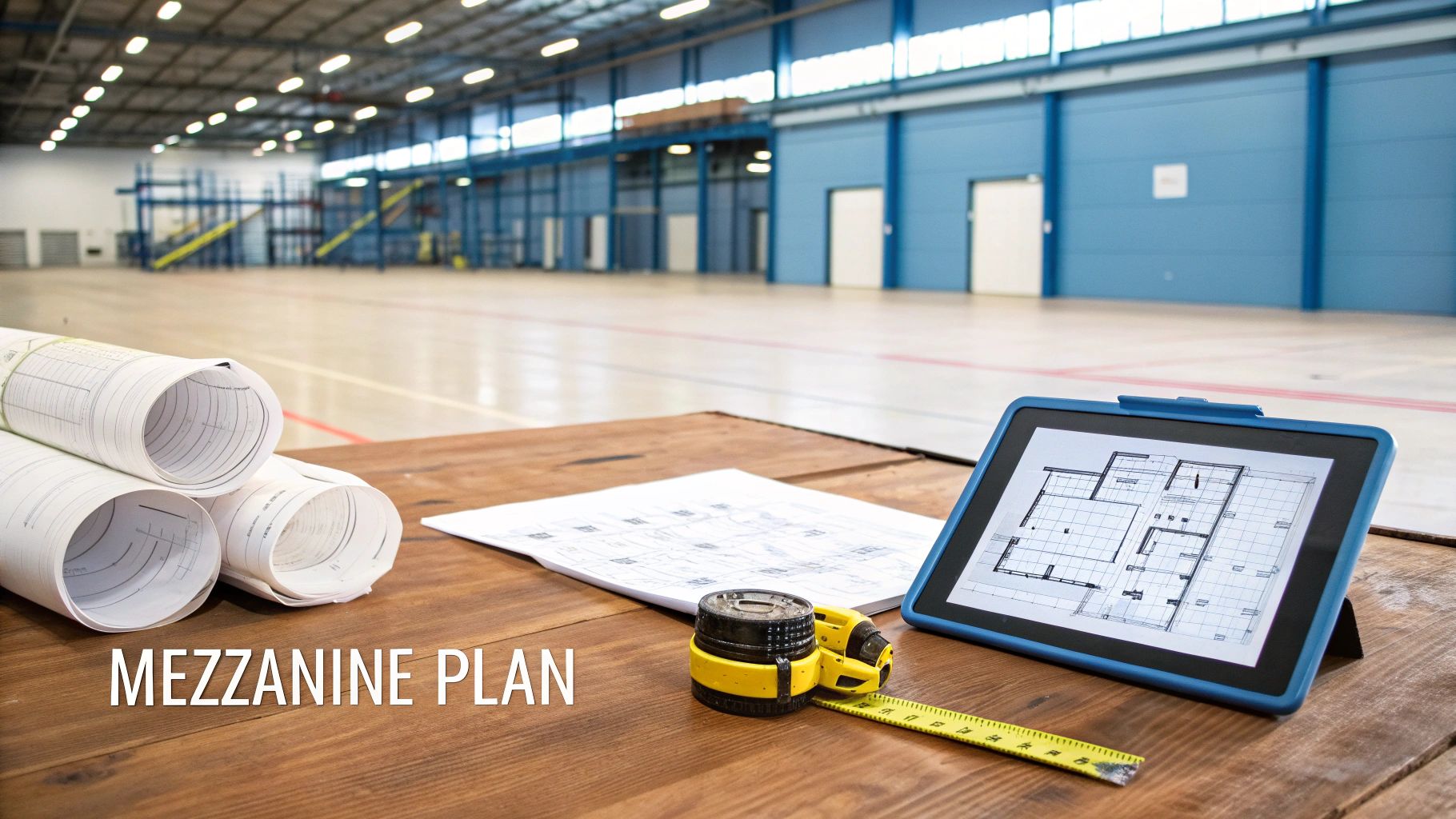
As you can see, every component, from the main beams down to the secondary joists, is meticulously mapped out. This is what ensures total structural integrity and makes the most of the space you have.
Decking Material Selection
The surface of your mezzanine floor is another crucial choice with a couple of main options:
- 38mm Particle Board: This is the most common and cost-effective choice, perfectly suitable for standard storage and light foot traffic.
- Composite Decking: If you need something more robust, a steel deck with a concrete screed top offers superior durability, fire resistance, and sound insulation. It's the ideal choice for office spaces or heavy-duty applications.
The demand for these kinds of installations has exploded. According to the Office for National Statistics (ONS), the number of UK business premises for storage and transport shot up by a staggering 88% between 2010 and 2020. This boom is fuelling the need for space-maximising solutions like mezzanines more than ever before.
Navigating UK Building Regulations and Compliance
Getting to grips with UK Building Regulations isn't just a box-ticking exercise when you're installing a mezzanine floor—it's the absolute foundation of a safe, legal, and insurable project. For self-storage developers, pushing compliance down the to-do list is a surefire way to hit costly delays, forced redesigns, and even serious legal trouble. This isn't just about paperwork; it's about the structural integrity of your facility and the safety of everyone inside it.
You can pretty much guarantee that any mezzanine floor installation will need a formal Building Regulations application. The second you add a new level into your building, a whole host of legal requirements kick in, and they have to be handled professionally. This is all managed through your local authority’s building control department or a private approved inspector.
Key Regulations You Cannot Ignore
The rulebook is thick, but for mezzanines, three specific Approved Documents are the ones you really need to focus on. These documents give you the practical guidance for meeting the legal standards.
- Approved Document A (Structure): This is all about the structural safety of the mezzanine itself. It demands detailed calculations from a qualified structural engineer to prove the steelwork can handle its intended loads. Crucially, it also verifies that the building’s existing foundation—especially the concrete slab—can support the new point loads from the columns.
- Approved Document B (Fire Safety): This is, without a doubt, the most critical and complex part of compliance. It sets the rules for everything from escape routes and the fire resistance of the structure to smoke detection systems.
- Approved Document M (Access and Use): This document ensures the new level is accessible. While a full lift isn’t always required for a storage mezzanine, the design of your staircases—their width, pitch, and handrail setup—all fall under its remit.
For any major construction project, it's also vital to be up to speed with legislation like the Building Safety Act 2022, which has put a much bigger focus on competence and accountability across the industry.
A classic mistake is assuming a mezzanine is a 'temporary' structure and therefore exempt. In the eyes of UK law, if people are using it and it’s fixed in place, it must comply. That one misunderstanding could land you with an enforcement notice from the council demanding you tear the whole thing down.
This regulatory landscape can feel like a minefield. To get a better handle on what’s involved, our detailed guide offers more specifics on UK building regulations for mezzanines.
Fire Safety: The Non-Negotiable Element
Fire safety compliance will shape a huge part of your mezzanine’s design—and its cost. The rules are driven primarily by the size of the floor and how it will be used.
One of the very first things your designer will calculate is travel distances. The path from any point on the mezzanine to the nearest protected escape route (like a fire-rated staircase) has to be within strict limits. Typically, that’s around 25 metres if there's only one way out, or 45 metres if there are multiple escape routes. If your floor plan exceeds these distances, you'll have no choice but to add more staircases.
Fire protection for the structure itself is the other piece of the puzzle.
- When is Fire Protection Needed? As a rule of thumb, if the mezzanine’s area is over 400 square metres, or if it takes up more than 50% of the room it’s in, the underside will need fire protection. It’s also often a requirement if people will be permanently working on or below the structure.
- What Does It Involve? This usually means wrapping the steel columns and beams in fire-rated materials, like a suspended ceiling or special intumescent paint. The goal is to achieve 60 minutes of fire resistance, which buys precious time for people to evacuate safely before the structure’s integrity is compromised.
Your application to building control needs to be watertight, complete with detailed architectural drawings, structural calculations, and a clear fire safety plan. An experienced mezzanine provider will manage this whole process for you, dealing directly with inspectors to make sure everything goes through smoothly. Nailing this from the very beginning is the key to a successful and fully compliant installation.
The On-Site Mezzanine Installation Process
Once the detailed plans are signed off and the steelwork is fabricated, your mezzanine project moves from paper to the physical world. This is where the real action happens—a carefully choreographed sequence on-site where precision, safety, and efficiency are everything. For facility managers, knowing what to expect helps manage the day-to-day and lets you coordinate with the installation team to keep any disruption to a minimum.
But the process doesn't just start when the lorries pull up. The groundwork for a smooth installation is laid long before that, starting with getting the site absolutely ready. Get this right, and the team can hit the ground running without a single delay.
Preparing the Site for Installation
A clean, clear site is the bedrock of a successful build. The entire installation footprint needs to be completely free of stock, machinery, and personnel. This isn't just about making room; it's a critical safety step to establish a secure work zone.
Our installation team will run final checks on the concrete slab, making sure it’s ready for the column baseplates. Any last-minute cleaning or minor remedial work should be done and dusted by this point. It’s also vital that access routes for delivery vehicles and lifting equipment are confirmed and kept clear.
A classic oversight we see is forgetting about what’s overhead. Before the team arrives, do a final sweep for any low-hanging light fixtures, trunking, or heating units inside the installation zone. Catching these early saves a world of headaches and costly delays when the steel columns are being lifted into position.
Component Delivery and Organisation
The day the materials arrive is a major milestone. All the mezzanine components—columns, main beams, secondary joists, decking, and fixings—are delivered on large flatbed lorries. An experienced crew coordinates this delivery to match the build sequence perfectly, so materials are offloaded and organised in a logical flow.
This strategic placement is what separates a slick operation from a chaotic one.
- Columns and Baseplates: These are usually the first things off the lorry, positioned around the installation area close to where they will be erected.
- Main Beams (Primary Beams): As the biggest and heaviest components, these are placed where lifting equipment can get to them easily.
- Secondary Joists and Decking: These are stacked neatly to one side, ready to be brought in once the main frame is up and secure.
Getting the material handling right at this stage speeds up the entire assembly process, cutting down the time everyone spends moving heavy components around the site.
The infographic below shows the core regulatory pillars that shape the entire installation, from the steel framework right through to fire safety and final access.
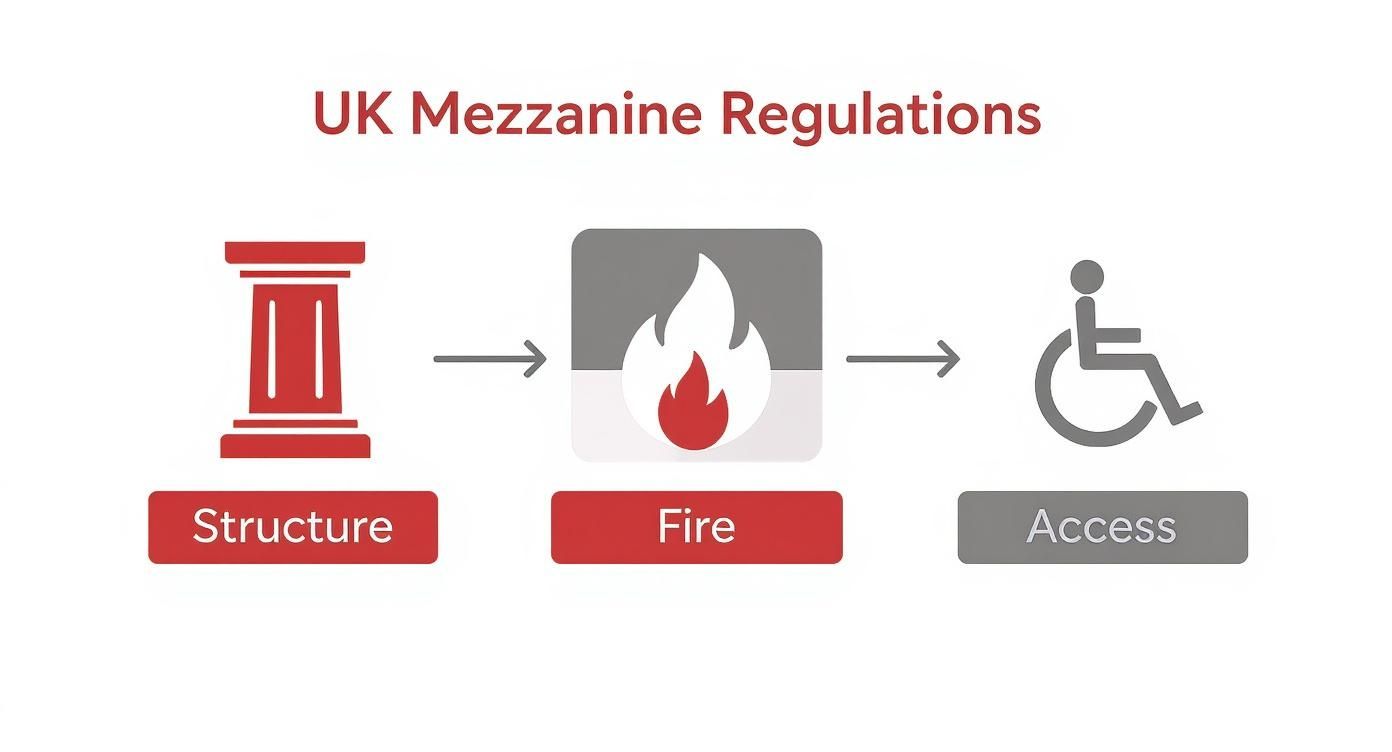
This visual really drives home how structural integrity, fire protection, and accessibility are all linked, guiding every single step of the on-site build to ensure you're fully compliant.
The Core Assembly Sequence
With the site prepped and materials laid out, the physical construction can kick off. This is where the skill of the installation team really comes to the fore, as they turn a collection of steel parts into a solid, robust structure.
It all starts with meticulously marking out the column positions on the floor, cross-referencing against the approved design drawings. Once every position is confirmed, the columns are raised vertically, set on their baseplates, and anchored to the concrete slab with heavy-duty bolts.
Next up, the main support beams are lifted into place and bolted to the column heads, creating the primary skeleton of the mezzanine. The team uses precision levelling tools to make sure the frame is perfectly square and level before tightening every connection to the specified torque. It has to be spot on.
Once that primary frame is established, the secondary joists are installed, running perpendicular to the main beams. These are bolted into place, creating a dense grid that will support the decking. This phase is done methodically, bay by bay, until the entire steel structure is assembled.
Finally, the decking panels—typically 38mm high-density particle board—are laid across the joists. The tongue-and-groove design creates a tight, secure fit, and the panels are screwed down to form a solid, stable floor surface ready for action.
Installing Staircases and Edge Protection
The last stage of the main construction is all about access and safety. This part is non-negotiable, ensuring the new level is safe and compliant from the moment we hand it over.
Staircases and any landings are assembled and fixed securely to both the main structure and the ground floor. The positioning and angle must match the design drawings to the millimetre to comply with Building Regulations Part M (Access and Use). For more dynamic environments, there are some really versatile options out there; you can learn more about rolling staircases that offer smooth and safe access in our dedicated guide.
At the same time, edge protection is installed around all exposed perimeters of the mezzanine. This involves fitting a robust handrail and kick plate system to prevent falls and stop items from being accidentally knocked off the edge. Any specified pallet gates are also fitted at this stage, providing a safe way to load goods onto the new level.
Throughout this entire on-site process, a proficient installation team will work to minimise disruption, using safety barriers and clear signage to segregate the work area, allowing your facility to remain operational where possible.
Budgeting Your Project and Calculating ROI
Let’s talk numbers. A successful mezzanine project lives and dies by its financials. It’s not just about the engineering or getting the paperwork signed off; the investment has to make solid business sense. Figuring out the costs and, just as importantly, how to calculate the return on that investment is what separates a good idea from a profitable reality for your self-storage facility.
Trying to pin down a budget for a mezzanine floor isn't like picking an item off a shelf. The final figure is a mix of several key variables, and each one plays a part in the total cost. Getting a grip on these factors early means you can build a realistic financial plan and dodge any nasty surprises later on.
Breaking Down the Key Cost Drivers
The price of a mezzanine isn't a one-size-fits-all number. A few crucial elements directly shape your quote, and knowing what they are helps you see exactly where your money is going.
- Size and Area: This one’s straightforward. The total square meterage is the biggest factor. A larger floor naturally needs more steel, more decking, and more labour, which all adds up.
- Load Rating: What are you putting on it? This is a massive cost driver. A mezzanine designed for lighter storage or a small office (around 4.8 kN/m²) will use lighter-gauge steel. But if it needs to support heavy-duty storage units (7.2 kN/m² or higher), the structure has to be much more robust—and therefore, more expensive.
- Design Complexity: A simple, square mezzanine with a standard column grid will always be the most cost-effective option. If you need a complex, multi-level design with funny shapes or wide, non-standard spans, it will require heavier, pricier beams to make it work.
- Decking Material: Your choice of flooring directly impacts the budget. The industry standard for most storage applications is 38mm particle board, which gets the job done well. However, if you need something tougher or with better fire resistance, like a composite concrete deck, expect the material and installation costs to climb.
Estimated Costs for Mezzanine Floor Installation in the UK
To give you a clearer picture, here’s a rough guide to what you might expect to pay for the decking, which is a major part of the overall cost. Remember, these are ballpark figures and don't include extras like fire protection, staircases, or specialist lifting gear.
| Decking Type | Typical Cost per m² (GBP) | Best Suited For |
|---|---|---|
| 38mm Particle Board | £100 – £150 | General self-storage units, light office use, standard load-bearing |
| Composite Concrete | £200 – £300 | Heavy-duty storage, high-traffic areas, enhanced fire resistance |
| Steel Chequer Plate | £180 – £250 | Industrial applications, workshops, areas with potential for liquid spills |
These figures show just how much the decking choice can influence your budget. For most self-storage operators, the standard particle board offers the best balance of performance and cost.
Calculating Your Return on Investment
For a self-storage business, calculating the ROI on a mezzanine is refreshingly direct. You’re not trying to measure abstract gains in efficiency; you’re adding new, rentable space that generates predictable monthly income. This clarity makes it much easier to build a powerful business case for the expansion.
First, you need to work out the total project cost. This isn’t just the mezzanine itself. Be sure to include all the associated expenses, like fire protection, lighting, and the partitioning you’ll need to create the new storage units.
Once you have your all-in investment figure, you can project the new revenue stream. It breaks down like this:
- Work out the new unit count: Based on your new floor plan, calculate exactly how many new storage units you can fit on the mezzanine level.
- Estimate your monthly rental income: Using your current rental rates for similar-sized units, figure out the total extra monthly revenue the new units will bring in.
- Project the annual revenue: Multiply that additional monthly income by 12. That’s your projected annual revenue boost.
By translating new square footage directly into rentable units, you turn a construction cost into a tangible, income-generating asset. The question quickly changes from ‘How much will it cost?’ to ‘How quickly will it pay for itself and start generating pure profit?’
With these figures in hand, calculating a clear payback period is simple. For example, if your total project cost is £150,000 and the new level generates an additional £5,000 in rental income per month (£60,000 per year), your payback period is just two and a half years. After that, every penny of that revenue stream goes straight to your bottom line. It’s a compelling argument for making the investment.
For a deeper dive into the types of floors available and their benefits, our guide to commercial mezzanine floors is a great place to start.
Final Checks, Commissioning and Handover
The final bolt has been tightened and the installation team is packing up, but the job isn't quite done yet. This last stage—commissioning and handover—is where you officially sign off on the project. It’s a critical step that transforms the structure from a building site into a fully operational, compliant, and safe part of your facility. Don't rush this part; it's your last chance to catch any issues before they become long-term headaches.
A thorough handover is your guarantee that the work meets the standards you agreed upon and that you have everything needed for ongoing management. Think of it as your final opportunity to have the contractor fix anything before you officially take ownership.
The Final Walkthrough and Snagging List
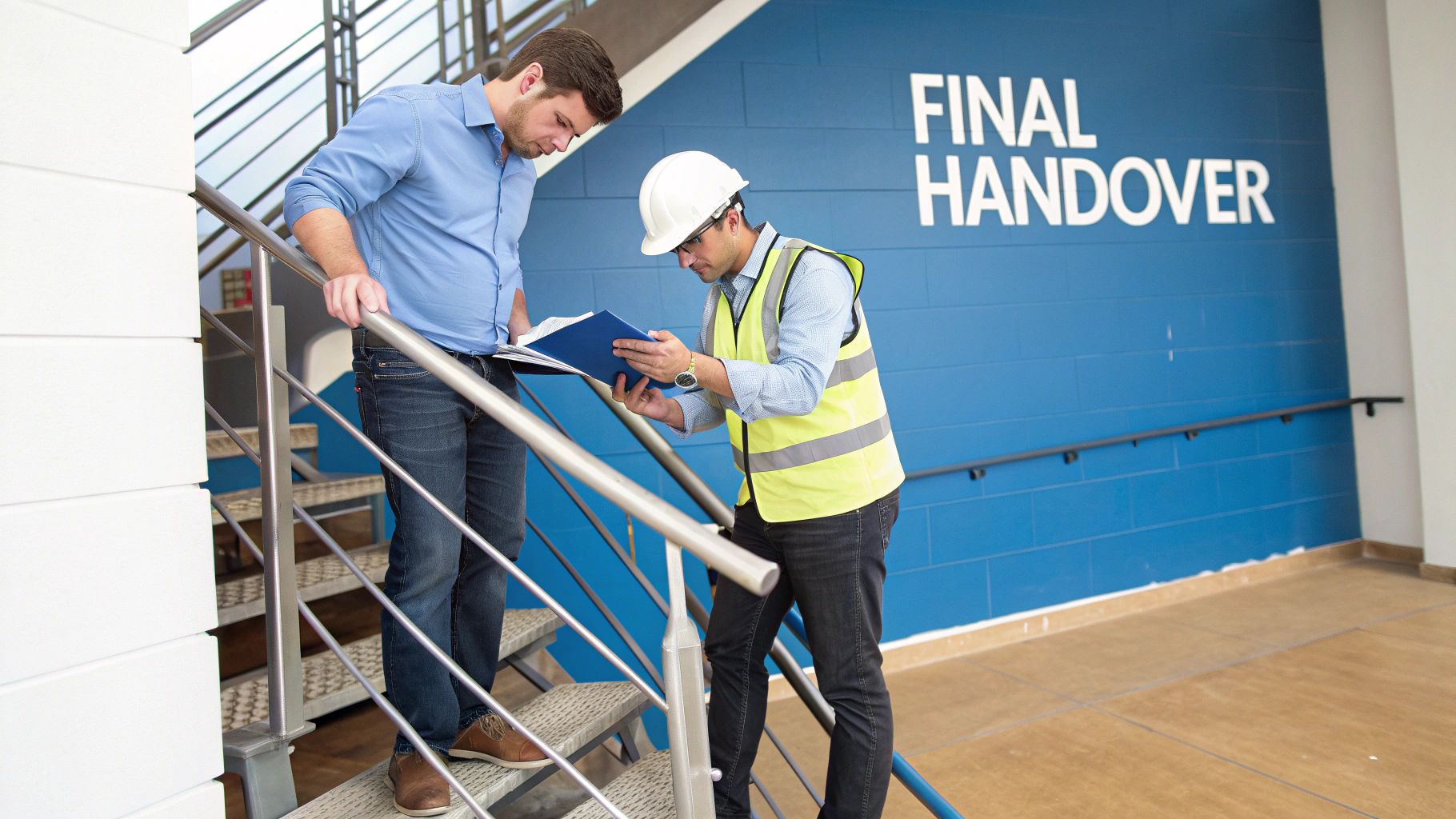
Before you even think about signing any completion forms, you need to do a detailed final walkthrough with your contractor’s project manager. This is your chance to get up close and inspect every single aspect of the installation. Be meticulous. Don't be afraid to point out even the smallest imperfections.
Here's what you should be looking for:
- Structural Integrity: Check all the bolted connections. Are the surfaces perfectly level? Give the staircases and handrails a good shake—there should be absolutely no movement or wobble.
- Surface Finishes: Scan the decking for any damage, scratches, or panels that don't sit flush. Check the paint finish on the steelwork to make sure it's consistent and complete.
- Safety Features: Confirm all edge protection, like handrails and kick plates, is securely fitted. If you have pallet gates, test them to make sure they operate smoothly and safely.
- General Tidiness: The site should be left clean and completely free of any construction debris. It sounds obvious, but you'd be surprised.
As you walk the site, create a "snagging list" documenting anything that needs to be put right. This could be anything from minor cosmetic touch-ups to more significant adjustments. A professional contractor will expect this and will work through your list until you are 100% satisfied.
Essential Documentation Handover
Getting the right paperwork is just as important as the physical build itself. These documents are your proof of compliance, and they’re essential for insurance, any future building work, and even the potential sale of the property. Without them, you're opening yourself up to serious legal and operational problems.
A common and costly oversight is accepting a mezzanine without the final Building Regulations completion certificate. This single document is your legal proof that the structure is compliant. Without it, your entire installation is technically not signed off by the local authority.
Your handover pack absolutely must include:
- Building Regulations Completion Certificate: This is the official document from the building control body, confirming the installation meets all legal standards. It's non-negotiable.
- Structural Calculations: The complete engineering report detailing load capacities and the structural design. You'll need this for your records.
- Operation and Maintenance (O&M) Manual: This gives you clear guidance on how to look after your mezzanine, including inspection schedules and maintenance tips.
Preparing Your Operations
Finally, before you open the new level for business, it's time for an internal readiness review. This is all about preparing your team and facility for the new layout.
Make sure load capacity signs are prominently displayed, both at the base of the stairs and near any loading points. Brief your staff on the new workflow, safety protocols, and, most importantly, the weight limits of the floor.
This careful prep work bridges the gap between construction and day-to-day operation. The global mezzanine floor market was valued at approximately $15.85 billion in 2024, and it's easy to see why. As businesses look to maximise their vertical space, demand is only growing. You can discover more insights about the mezzanine market on TechSci Research. A successful handover ensures your investment is ready to deliver value from day one.
Common Questions About Mezzanine Installations
Even with a rock-solid plan, you’re bound to have questions when it comes to installing a new mezzanine floor. Getting clear, straight answers demystifies the process and helps you move forward with confidence. We’ve pulled together the most common questions we hear from developers and facility managers to give you the practical insights you need.
How Long Does a Typical Mezzanine Installation Take?
It’s a common misconception that the on-site build is the longest part of the project. In reality, the physical installation is often surprisingly quick. An experienced team can usually get a standard 5,000 sq ft mezzanine assembled on-site in just 5-10 working days.
The real timeline, however, is shaped by the crucial prep work that happens beforehand. From the moment you place an order to the final handover, the entire project typically takes between 8 to 12 weeks. This window covers everything from detailed design work and structural calculations to fabricating the steelwork and securing Building Regulations approval.
The key takeaway? Factor in the full project lifecycle, not just the construction phase. Engaging with your provider early helps create a realistic timeline that aligns with your operational goals and prevents nasty surprises down the road.
Do I Always Need Planning Permission?
This one causes a lot of confusion, but the answer is usually quite simple. In most cases, you do not need planning permission for a mezzanine floor. Because they’re considered demountable, independent structures that don’t change the building’s external appearance, they typically fall outside the scope of planning consent.
What you almost certainly will need, though, is Building Regulations approval. This is a completely separate and non-negotiable process that ensures the structure is safe, sound, and compliant with fire safety standards. Never mistake the lack of a need for planning permission as a free pass—Building Regulations are mandatory. Always double-check the specifics with your local authority before starting any work.
Can a Mezzanine Be Installed in an Active Facility?
For a busy self-storage facility, shutting down operations for weeks on end just isn't an option. The good news is that professional installation teams are well-versed in working within live, active environments. The whole process is designed to cause minimal disruption from start to finish.
Installers use several smart strategies to keep your business running smoothly:
- Phased Work Schedules: Work can often be scheduled during your quieter periods, including nights or weekends, to avoid interrupting peak hours.
- Secure Work Zones: The installation area is safely cordoned off with barriers and clear signage to protect your staff and customers.
- Efficient Logistics: All materials are delivered and organised to streamline the build, reducing the amount of time equipment and components are moved around your site.
What Is the Minimum Ceiling Height Required?
Getting the headroom right is critical for both safety and legal compliance. As a general rule of thumb, you need a minimum clear ceiling height of around 4.5 to 5 metres to comfortably fit a mezzanine.
This measurement is vital because it allows for the required 2 metres of clear headroom both above and below the mezzanine deck. This isn't just a friendly suggestion; it's a key requirement under UK Building Regulations. Anything less creates an unsafe environment and simply won't get signed off by a building control inspector, which is why accurate site measurement is one of the very first and most important steps.
At Partitioning Services Limited, we manage every aspect of your mezzanine floor installation, from initial design and regulatory compliance to final handover, ensuring your project is delivered on time and on budget. Start your project with us today.