

A mini storage business is essentially a landlord for stuff. You rent out secure, individual units to people and businesses, usually on a flexible, short-term basis. It’s a remarkably resilient corner of the UK property market, buoyed by the constant demand that comes from major life events—moving house, downsizing, or the explosive growth of online businesses.
Why The UK Mini Storage Business Is Booming
The UK's mini storage sector isn't just getting by; it's actively thriving. Even when other commercial property sectors are feeling the squeeze, self-storage shows incredible strength. It's often called a "recession-resistant" asset because it provides a vital service for people and businesses going through change, making it a seriously attractive option for investors and developers chasing stable, long-term returns.
So, what's really lighting the fire under this sustained growth? It's a perfect storm of social and economic shifts happening right now.
- Our Changing Homes: Let's face it, UK homes are shrinking, but our collection of possessions isn't. This creates a "space gap" that mini storage fills perfectly. Big life events like moving, renovating, downsizing, or family changes like divorce and inheritance are the biggest triggers for someone needing a temporary storage fix.
- The Rise of Flexible Working: More of us are working from home or running our own small businesses, which blurs the line between home and office. A storage unit becomes a cost-effective stockroom, an archive for documents, or a hub for equipment, freeing up precious space in the spare room or garage.
- The E-commerce Explosion: The incredible boom in online retail has created a whole new wave of entrepreneurs who need flexible and scalable storage for their stock. For an online seller who's outgrown the spare bedroom but isn't quite ready for a full-blown warehouse lease, a mini storage unit is the ideal stepping stone.
The Numbers Behind The Boom
The data absolutely backs up this story of growth. The UK self-storage industry—often called mini storage—has seen some seriously robust expansion. Take a look at the industry's health in this quick summary.
UK Mini Storage Market At A Glance
Here’s a quick snapshot of the key performance indicators for the UK mini storage business, which highlights the industry's impressive scale and health.
| Metric | Figure | Annual Trend |
|---|---|---|
| Total Floorspace | 64.3 million sq ft | Growing |
| Annual Growth Rate | 7.2% | Increasing |
| Annual Turnover | £1.2 billion | Increasing |
These figures show a sector that is expanding not just in physical size but also in financial muscle, signalling strong confidence from investors. This infographic really brings the impressive growth metrics to life.
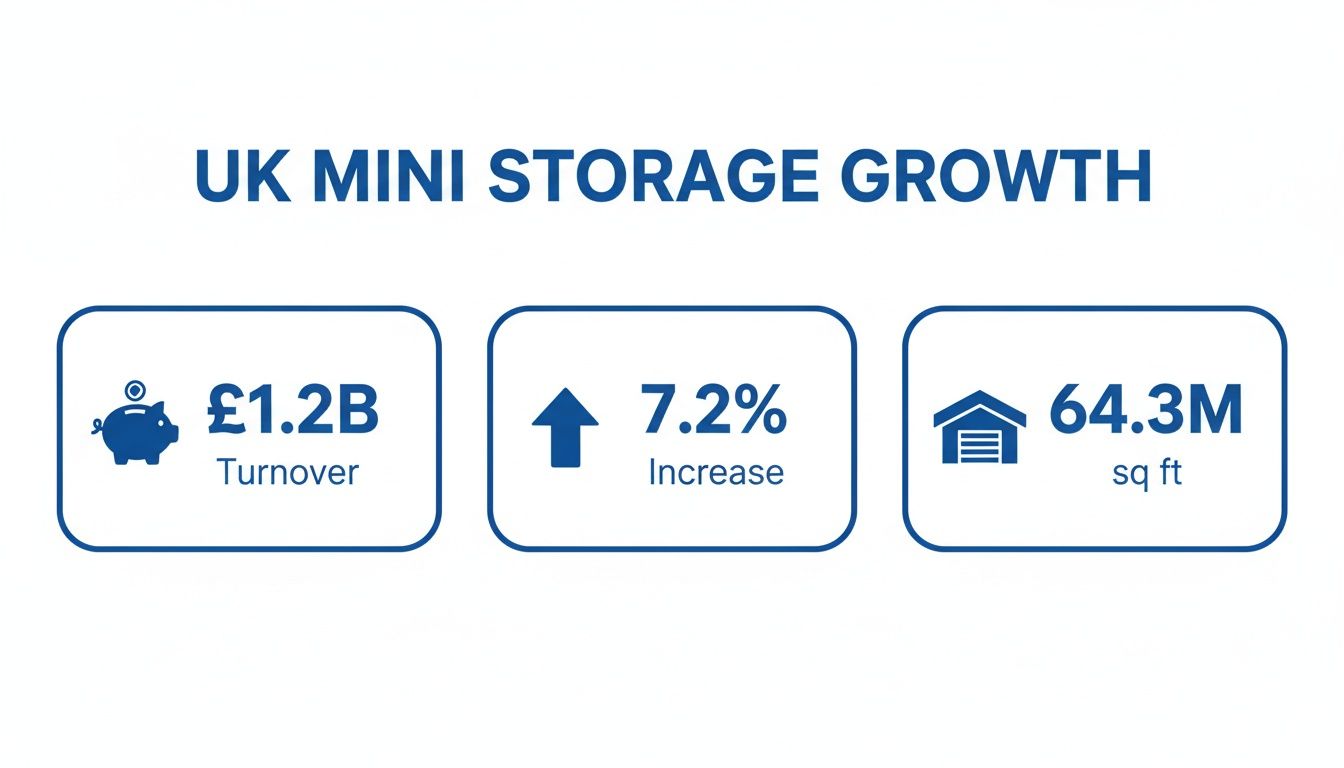
The takeaway here is crystal clear: the industry is rock-solid and growing, making it a compelling area for investment.
Understanding Customer Demand
To really get a feel for the market, you have to understand what drives customers to seek out storage. People aren't just storing old sofas; they're solving complex logistical problems. Getting familiar with the common customer needs for storage solutions, from the different unit sizes to the reasons behind renting, is a massive advantage for any potential investor.
For an investor, this consistent, multi-faceted demand is the cornerstone of a strong business model. Unlike other commercial properties tied to a single economic cycle, the need for storage persists through both economic booms and downturns, creating a stable and predictable revenue stream.
This unique mix of personal life events and commercial necessity is what keeps the engine of the mini storage business running. It's a sector built on a fundamental, ongoing need for space, making it a powerful and enduring opportunity in the UK property market.
Finding The Perfect Site For Your Facility
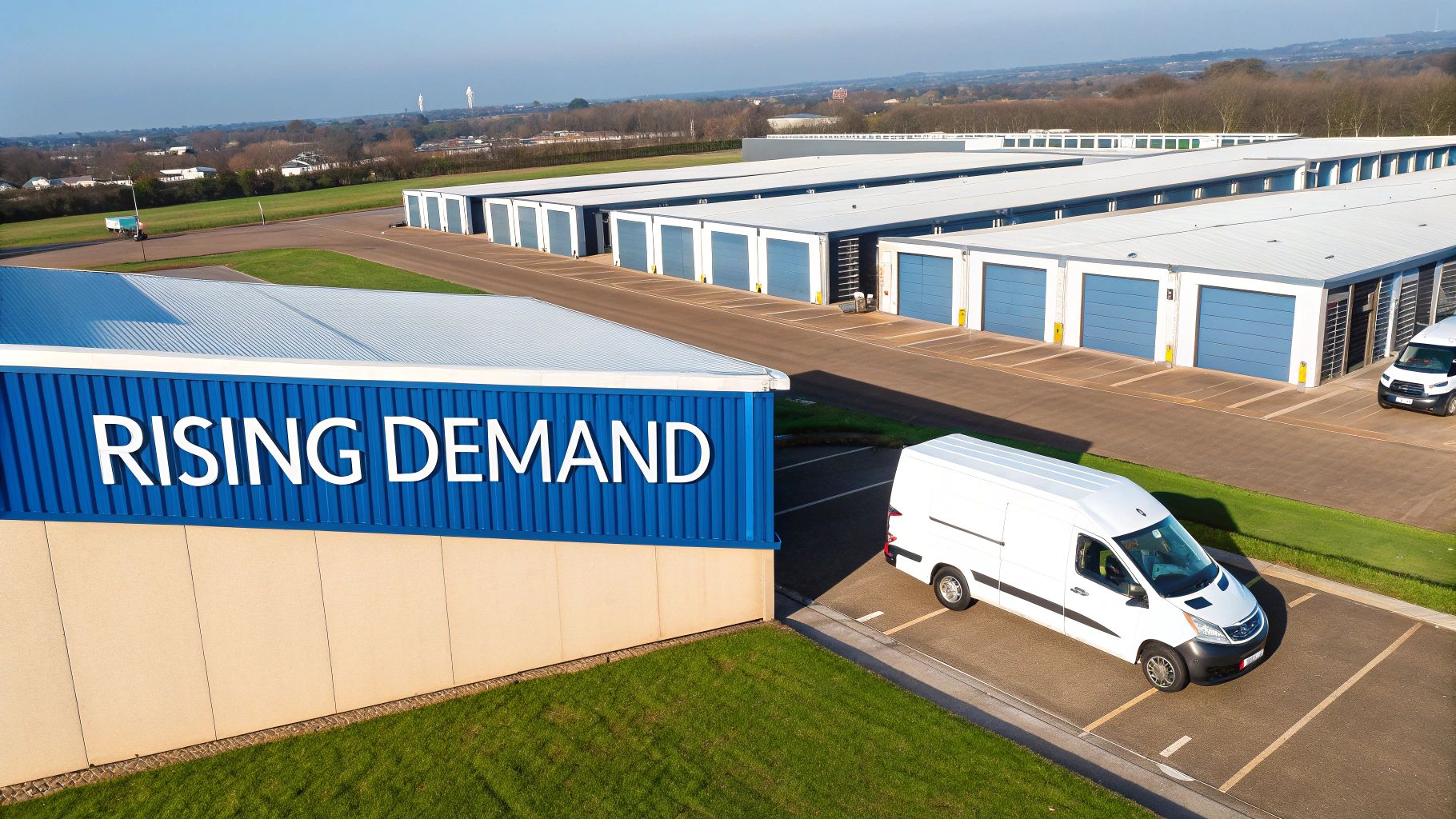
The success of your mini-storage business really boils down to one timeless principle: location, location, location. Think of your site selection as the very foundation of your investment. You can build a state-of-the-art facility, but if it's in the wrong area, it will struggle. On the flip side, even a basic setup in a prime spot can thrive. The goal is to find a site that’s not just big enough, but is right at the epicentre of customer demand.
This process is so much more than just finding an available plot of land. It’s a deep dive into the community you want to serve, how easy it is to get to your site, and what the local councils will actually let you build. Getting this right from day one saves you from incredibly costly mistakes and puts your business on track for high occupancy and healthy profits.
Decoding Local Demographics
Before you even glance at a property listing, you need to become an expert on the local market. Getting to grips with the demographic makeup of an area tells you if you have a ready-made customer base. What you're really looking for is a community experiencing change and transition, because that's what drives the need for storage.
Here are the key indicators to analyse:
- Population Density and Growth: Hunt for areas with a high population density—ideally 20,000 to 50,000 people within a three-mile radius—and a positive growth trend. Simply put, more people means more demand for space.
- Housing Mix: A blend of different housing types is your sweet spot. Renters, especially those in smaller flats, are a core customer base. Homeowners also drive demand, particularly in areas with smaller new-build properties or a busy property market full of people moving and renovating.
- Income Levels and Small Businesses: A healthy mix of middle-income households and a thriving small business community are strong positive signals. These groups have both the disposable income for storage and the commercial need for flexible inventory space.
A common rule of thumb in the industry is to aim for a location that can support 3.5 to 7 square feet of rentable storage space per person in the surrounding area. This metric is a great way to gauge whether a market is under-supplied or already saturated.
Visibility And Accessibility Are Non-Negotiable
Your facility has to be seen, and it has to be easy to get to. There’s no point hiding it away. High visibility on a main road acts as a constant, free advertisement. A potential customer driving past your site every day is far more likely to remember your brand when they suddenly need storage.
Accessibility is just as crucial. Picture a customer trying to manoeuvre a large van or lorry into a tight, awkward entrance—it's a frustrating experience that could be a deal-breaker. Your site needs clear, wide entrances and exits, plenty of turning space, and be easy to reach from major arterial roads or motorways. If customers struggle to find you or get onto your property, they’ll just go to a competitor down the road.
Navigating Zoning and Planning Permission
Once you’ve pinpointed a potential site, the next major hurdle is navigating UK planning and zoning regulations. Land is typically designated for specific uses, like residential, commercial, or industrial. Self-storage facilities usually fall into a category known as Class B8 (Storage and Distribution).
It is absolutely essential to do your homework on a site’s zoning status before you commit any money. This means getting in touch with the local council’s planning department to confirm that a mini-storage business is a permitted use for that piece of land. Skipping this step can lead to a rejected planning application, which is a massive waste of time and money. Seriously consider engaging a planning consultant with experience in self-storage developments at this stage—it can be an invaluable investment.
Designing A Profitable And Modern Facility
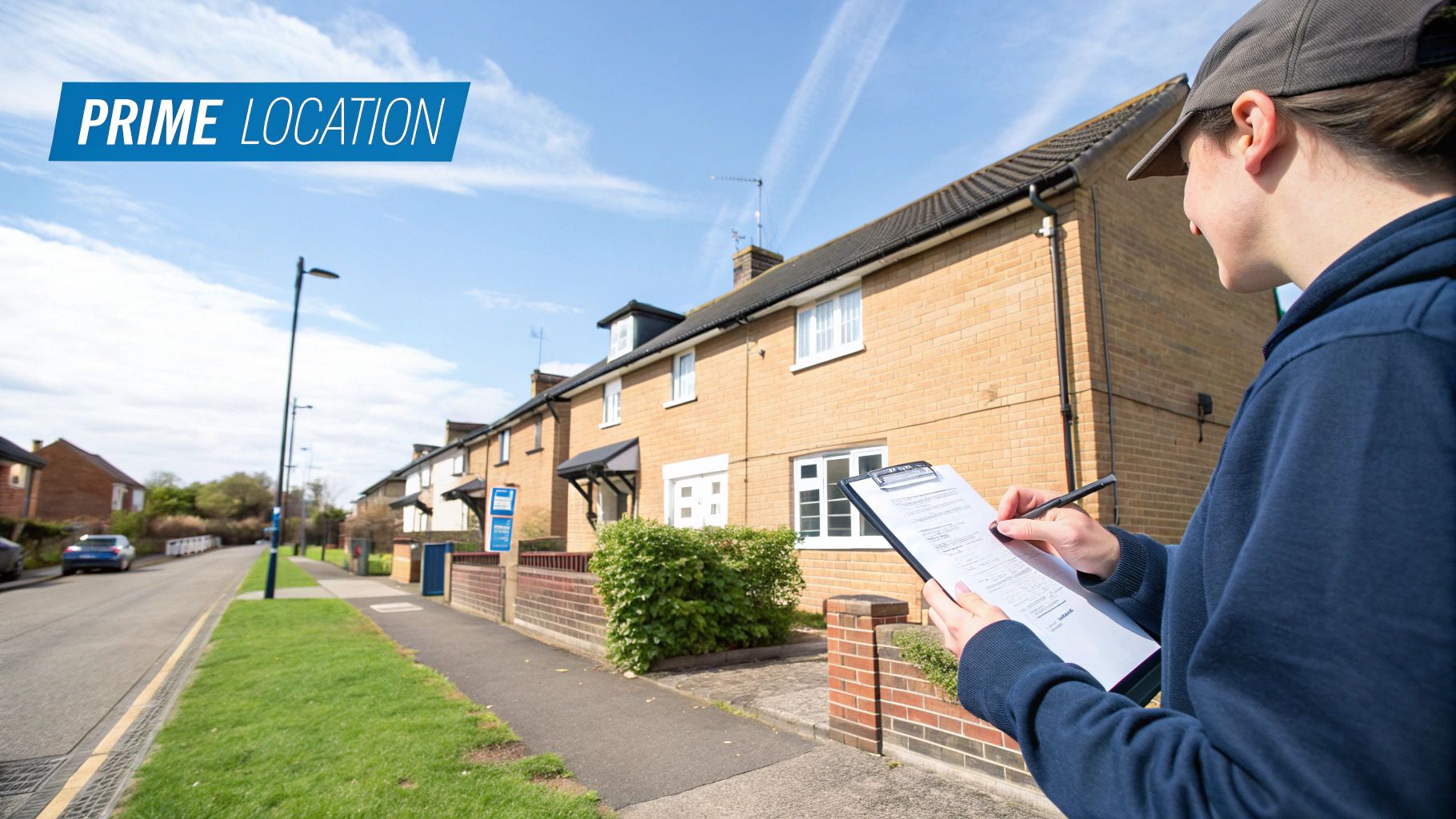
A well-chosen site sets the stage, but intelligent design is what truly transforms a plot of land into a profitable mini storage business. This isn't just about throwing up a building; it's about engineering a revenue-generating machine. Every single decision, from the overall layout to the choice of partition system, directly hits your bottom line.
The main goal of facility design is to maximise the Net Lettable Area (NLA). Think of your total site area as a whole pie. The NLA is the part you can actually rent out—the slices that generate income. Non-lettable areas like corridors, offices, and lifts are necessary evils, but they don't produce revenue. The real challenge is to keep them as small as possible without sacrificing usability.
A well-oiled design can push the NLA to 70-75% of the gross floor area, a critical benchmark for profitability.
Creating The Optimal Unit Mix
One of the most common rookie mistakes is simply guessing the unit mix. A successful facility needs to be a mirror image of its local market. That demographic research you did during site selection? It becomes pure gold right here, helping you build a unit mix that drives high occupancy and maximises revenue per square foot.
A versatile unit mix caters to a wide range of customers, from individuals decluttering their homes to commercial clients needing stock storage. Think of it in tiers:
- Small Lockers (1-2 sq m): These are perfect for students storing books, local residents needing just a bit of extra space, or businesses archiving a few boxes of documents.
- Medium Units (5-10 sq m): This is the bread and butter for most facilities. They’re a magnet for customers moving house, renovating, or needing to store the contents of a one or two-bedroom flat.
- Large Units (15+ sq m): Absolutely essential for attracting lucrative commercial clients, like e-commerce businesses needing stock rooms or tradespeople storing equipment and materials.
Your unit mix should never be set in stone. Modern partitioning systems give you the flexibility to reconfigure units with surprising ease. This lets you adapt on the fly to market demands, like converting several small units into a large one when a new commercial client comes knocking.
Key Design And Construction Considerations
Beyond just the unit mix, the physical construction and layout are critical for smooth operations and happy customers. The choices you make at this stage will define the user experience and your long-term maintenance bills. For a deeper dive, it's worth exploring the key features of modern self-storage facility design that top operators are now implementing.
Here are the key elements you need to get right:
- Partitioning Systems: These are the internal walls that form your individual units. Hallway systems must be durable, easy to clean, and well-lit. The unit partitions themselves need to be secure and robust.
- Mezzanine Floors: If you’re lucky enough to have a building with high ceilings, installing a mezzanine is one of the most cost-effective ways to literally double your lettable floor space without expanding the building’s footprint.
- Fire Protection: This is completely non-negotiable and a legal requirement. Effective fire protection means installing a comprehensive system of fire-rated corridors, ceilings, and possibly sprinkler systems, depending on your building's size and local regulations.
Choosing Your Construction Partner
When it's time to build, you generally have two main paths to choose from. The right one for you will hinge on your budget, timeline, and how hands-on you want to be.
| Approach | Description | Best For |
|---|---|---|
| Supply-and-Fit (Turnkey) | A specialist contractor handles everything: design, manufacturing, and installation. You get a single point of contact and a streamlined process from start to finish. | Investors who want a hands-off, professionally managed project with predictable timelines and costs. |
| Labour-Only Contract | You source and purchase all the materials yourself (partitions, doors, etc.) and then hire a contractor just to handle the installation. | Experienced developers with strong supply chain contacts who want to control material costs directly. |
For those new to the mini storage game, the supply-and-fit model is often the preferred route. It cuts down on complexity and lets you lean on the expertise of a seasoned partner, ensuring your facility is not only fully compliant but also optimised for maximum profit from day one.
Securing Funding And Calculating Your Returns
A slick design and a prime location are a fantastic start, but a successful self-storage business is built on solid financials. Getting the numbers right isn’t just a box-ticking exercise; it's the language investors speak and the very framework that keeps your venture profitable. Nailing down your costs, exploring smart financing, and projecting your returns are the most critical steps in building a business case that actually gets funded.
This financial roadmap is designed to demystify the entire process, moving you from a rough idea to a concrete plan with a clear path to profitability. We’ll break down the essential costs, look at both traditional and modern ways to fund your project, and walk through exactly how to calculate your potential return on investment.
Understanding Your Initial And Ongoing Costs
Before you can even think about funding, you need a laser-focused understanding of every single expense. These costs fall into two main buckets: the money you need to get the doors open (initial startup costs) and the money you’ll need to keep them open (ongoing operational expenses). Getting these figures as accurate as possible is the bedrock of a realistic financial model.
Initial Startup Costs:
- Land Acquisition: The purchase price of the site itself.
- Construction & Fit-Out: This is the big one—the cost of building the facility, including all the partitioning, mezzanines, doors, and fire protection systems. This can run anywhere from £25 to £70 per square foot, depending on the complexity of your build.
- Professional Fees: Don't forget the budget for architects, planning consultants, solicitors, and structural engineers.
- Security Systems: The initial outlay for CCTV, modern access control systems, and alarms.
Ongoing Operational Costs:
- Staffing: Salaries for facility managers and admin staff, though it’s worth noting modern tech can trim this down significantly.
- Utilities: The usual suspects—electricity, water, and internet services.
- Marketing & Advertising: Your budget for digital marketing, local SEO, and other promotional activities to get customers through the door.
- Insurance: Absolutely essential policies covering the property, liability, and business interruption.
- Maintenance: A sensible budget for repairs, cleaning, and general upkeep to keep the facility looking sharp.
Exploring Your Financing Options
With a clear budget in hand, the next step is securing the capital. While traditional bank loans are a common route, the self-storage world has access to more specialised and flexible funding models that can seriously lower the barrier to entry.
A traditional commercial mortgage from a high-street bank is a well-trodden path. The catch? They often demand a substantial upfront deposit, typically 25-40% of the total project cost. For many developers, that’s a major hurdle. This is where more creative financing solutions really shine.
One of the most powerful models for the self-storage industry is the Profit Share Lease (PSL). This structured finance approach allows you to fund the entire internal fit-out of your facility with minimal upfront capital. Instead of a huge initial payment, the cost is covered through a shared revenue agreement over a fixed term. This gets you operational and generating income much, much faster.
This approach flips a major capital expenditure into a manageable operational cost, aligning the financing directly with your facility's ability to generate cash. To see if this model could work for your project, it’s worth exploring the specifics of structured finance options for self-storage fit-outs.
Projecting Your Revenue And ROI
Finally, let's get to the exciting part: calculating your potential returns. This is where we project your revenue and measure it against your investment, a process that pulls your entire business case together.
- Calculate Gross Potential Income (GPI): This is your facility's absolute maximum rental income if every single unit were booked 100% of the time. Just multiply the square footage of each unit by its monthly rental rate and add it all up.
- Estimate Stabilised Occupancy: Let's be realistic—you won't be 100% full all the time. A well-run, modern facility in a good location can reasonably expect to hit a stabilised occupancy rate of 85-95%. Multiply your GPI by your target occupancy (say, 90%) to find your effective gross income.
- Subtract Operating Expenses: Now, deduct all your annual operational costs from your effective gross income. What you're left with is your Net Operating Income (NOI)—a crucial metric.
- Calculate Your Return: The simplest way to measure ROI is with the capitalisation (cap) rate. To find it, just divide your NOI by the total initial cost of the project. For anyone serious about investing in this sector, understanding self-storage cap rates is non-negotiable. Generally speaking, a higher cap rate points to a more profitable investment.
Running A Lean And Tech-Powered Operation
The days of needing a full-time manager sitting in an office from nine to five are fading fast. Today’s most profitable mini storage business models are built on smart technology and operational efficiency. By swapping manual tasks for automated systems, you can deliver a far better customer experience while slashing your biggest ongoing cost: staffing.
This shift isn't just a passing trend; it's a fundamental change in how the industry operates. Modern customers expect the same seamless digital experience from their storage provider that they get everywhere else. They want to book, pay, and access their unit entirely on their own terms, at any time of day, without ever needing to speak to a soul.
The Power Of Automation In Self Storage
Automation is the engine of a modern mini storage facility. It works around the clock, handling the repetitive, time-consuming tasks that used to burn up staff hours. This frees you up to focus on growing the business instead of just running it. It’s all about creating a system that practically manages itself.
Key automation tools you'll need include:
- 24/7 Online Booking Systems: Let customers browse available units, pick the right size, sign their agreement, and pay their first bill directly from your website, day or night.
- Automated Billing and Payments: The system automatically invoices customers each month and processes their payments, chasing up overdue accounts without any manual prodding.
- Remote Access Control: Customers get a unique code or use a mobile app to open the main gate and their unit, getting rid of physical keys and the need for staff to grant entry.
The goal of technology here isn't just to bolt on new features, but to strip away friction. A fully automated rental process means a customer can go from finding you online to unloading their belongings into a unit in under an hour, without ever needing your help.
Building A Minimal Staffing Model
Once you embrace this level of automation, you can run an incredibly lean staffing model. Instead of having multiple employees on-site, a single manager can often oversee several facilities remotely. Their job transforms from shuffling paperwork and taking payments to focusing on high-value tasks like sales, marketing, and making sure the site is clean and secure. Our guide on essential self-storage facility management techniques digs deeper into how this new management role really works.
The impact on your bottom line is immediate and massive. Fewer staff means lower salary costs, reduced national insurance contributions, and less administrative overhead. This financial advantage is precisely what drives the high profit margins in the most successful modern facilities.
The following table breaks down the key differences between the old way of doing things and the modern, tech-driven approach.
Traditional Versus Modern Mini Storage Operations
| Operational Aspect | Traditional Approach | Modern Tech-Enabled Approach |
|---|---|---|
| Customer Onboarding | In-person signup, manual paperwork, fixed office hours. | 24/7 online booking, digital contracts, instant access codes. |
| Payments | Manual invoicing, payment collection over the phone or in person. | Automated monthly billing, online payment portals, auto-pay options. |
| Site Access | Staff-controlled gates, physical keys or padlocks for units. | Automated gate access via keypad/app, digital unit locks. |
| Staffing Model | Full-time on-site manager required for daily tasks. | Remote management, minimal on-site presence for maintenance/security. |
| Customer Support | Dependent on staff availability during office hours. | Automated reminders, online FAQs, chatbot support, out-of-hours service. |
As you can see, the modern approach doesn't just cut costs—it creates a more convenient and self-sufficient experience for the customer, which is exactly what today's market demands.
Industry data confirms this operational shift. Recent figures show that 90% of UK mini storage businesses now offer online booking. This digital push has driven staffing levels to a record low of just 2.6 employees per facility, proving that lean, tech-powered operations are becoming the new standard. A recent 2025 self-storage industry analysis offers more insight into this change. By integrating the right technology from day one, you set your business up for maximum efficiency, happier customers, and scalable, long-term profit.
Got Questions About The Mini Storage Business? Let’s Talk.
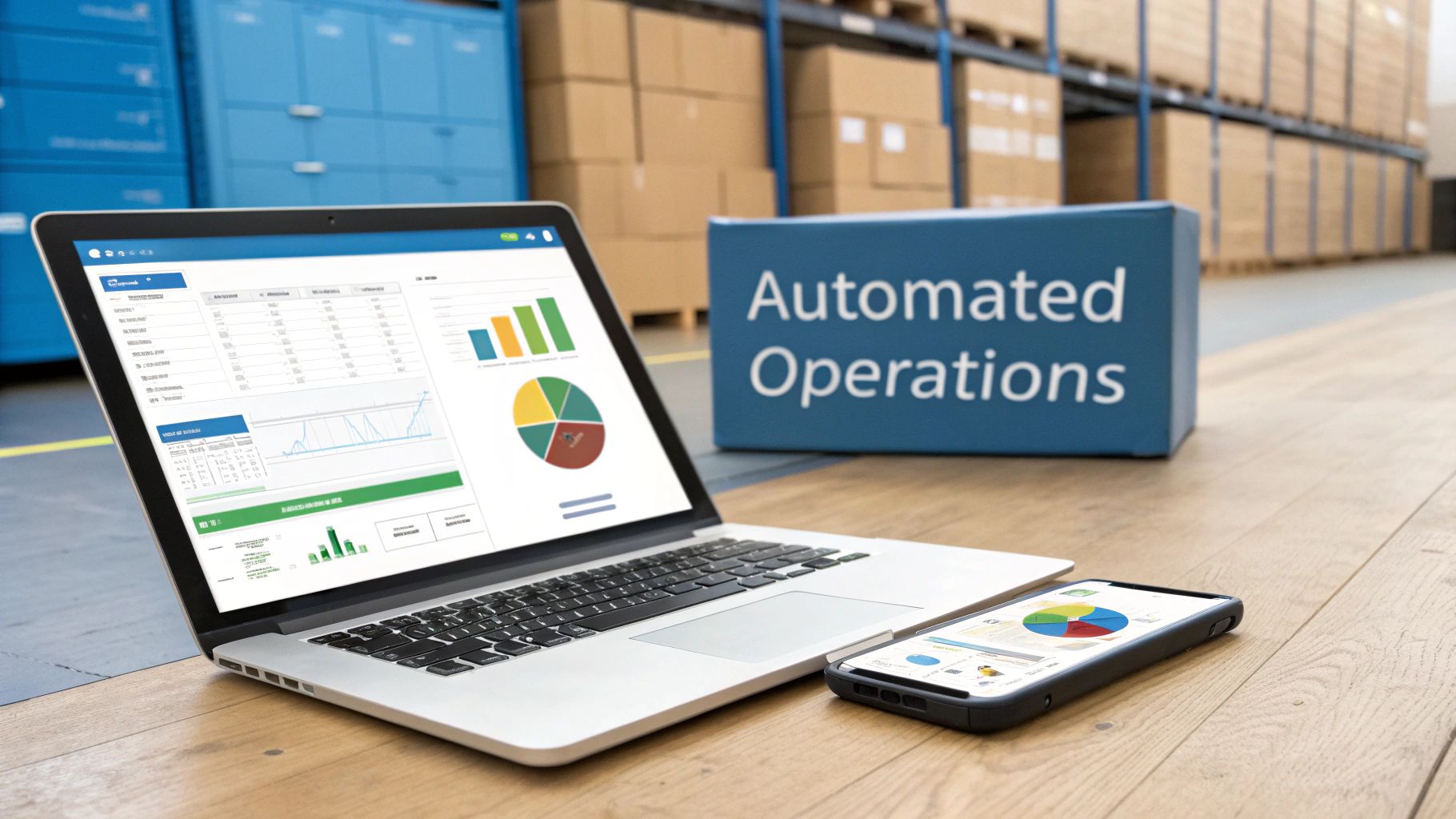
Thinking about diving into the self-storage game? You’re not alone. It’s an industry that sparks a lot of curiosity, especially around the numbers and the day-to-day realities. Let’s cut through the noise and tackle the questions we hear most often from aspiring investors and developers right here in the UK.
First up, the big one: is it actually profitable? The short answer is yes, very. A well-run facility in the right spot is a cash-generating machine. Once you’re past the initial build and lease-up phase, a modern site can pull in net profit margins between 30% and 50%. The secret sauce is stable occupancy combined with surprisingly low overheads, especially when you run a lean, tech-driven operation.
How Much Capital Do I Need To Start?
There’s no single answer here—the initial investment can be hefty and really depends on your location and the spec of your build. For a brand-new facility, construction costs alone can run anywhere from £25 to £70 per square foot, and that’s before you even buy the land.
But don’t let that number scare you off. There are clever ways to structure the financing. For instance, a Profit Share Lease can fund the entire internal fit-out, which slashes the upfront capital you need to get the doors open and the rent rolling in. It makes the self-storage business far more accessible than most people think.
The key is to shift focus from just the initial cost to the lifetime value and ROI. A higher initial investment in a prime location with modern features often generates superior long-term returns compared to a cheaper build in a secondary market.
Who Are The Main Customers?
If you think self-storage is just for people moving house, you're missing half the picture. The commercial sector is a massive, and often overlooked, driver of revenue in the UK.
In fact, business use is a cornerstone of the industry. A huge 27% of renters are commercial clients stashing everything from inventory and archives to tools and equipment. This allows over 680,000 businesses to dodge the high cost of traditional warehouses, saving them 40-60%. With e-commerce now making up over 30% of UK retail sales, this trend is only getting stronger. You can get more insights on this growing business trend at Cleveland Containers.
Getting to grips with this dual customer base—personal and business—is fundamental. It shapes everything from your unit mix to your marketing, allowing you to capture demand from both sides. This diverse appeal is exactly what makes the self-storage business so resilient.
Ready to turn your vision into a high-performing asset? The expert team at Partitioning Services Limited specialises in the design and installation of profitable self-storage facilities. From maximising your net lettable area to navigating fire regulations, we provide complete turnkey solutions tailored to your project. Explore our services and start building your investment today at https://psllimited.co.uk.