

Building a self storage facility is a serious investment, and the final price tag swings wildly depending on your location, design choices, and the quality of the finish. As a rough guide, you can expect self storage construction costs in the UK to fall somewhere between £550 and £850 per square metre. This covers the core build and fit-out but doesn't include the big-ticket items like buying the land or paying your professional team.
Decoding Self Storage Construction Costs in the UK
Kicking off a self storage development isn’t just another construction job; it’s a strategic investment where every pound spent at the start has a direct knock-on effect on your long-term profits. Getting to grips with the financial anatomy of a build is the first step toward creating a high-performing asset that delivers for years to come.
The final figure on your budget sheet is far more than the cost of steel and concrete. It’s a complex calculation shaped by market forces, the unique challenges of your site, and the strategic decisions you make along the way. To navigate this landscape successfully, you need to look beyond the obvious expenses and dig into the key financial drivers that will make or break your project.
Here's a quick look at the main cost categories you'll be dealing with. Think of these as the foundational pillars of your entire project budget, each influencing the others.
Primary Self Storage Construction Cost Components at a Glance
This table breaks down the main cost buckets for a typical UK self storage development, from securing the land to the final fit-out.
| Cost Category | Description & Key Drivers | Typical % of Total Budget |
|---|---|---|
| Land Acquisition | Often the single biggest outlay. Costs are driven by location, with prime urban sites commanding a huge premium over regional plots. Zoning and accessibility are also major factors. | 25% – 40% |
| Hard Construction Costs | This is the physical build itself. It includes groundwork, foundations, the building shell (steel frame, cladding), and the complete internal fit-out of partitions, doors, and mezzanine floors. | 40% – 50% |
| Material & Labour | The engine room of your hard costs. Fluctuations in steel prices, concrete, and insulation can have a massive impact. Regional variations in skilled labour rates will also affect the final bill. | (Part of Hard Costs) |
| Soft Costs & Compliance | All the 'unseen' but essential expenses. This covers professional fees for architects, surveyors, and engineers, plus planning application charges, legal fees, and the costs of meeting strict building and fire regulations. | 10% – 20% |
Understanding how these elements interact is crucial. A cheap plot of land might seem like a bargain, but if it requires extensive groundwork or has poor access, those savings can be wiped out in your hard construction costs.
You can think of building a self storage facility like assembling a high-performance car. The land is the chassis, the core build is the engine, and the internal fit-out is the gearbox and electronics. Each part has to work in perfect harmony. Cutting corners on one component will inevitably compromise the performance of the whole system.
The Role of a Specialist Partner
The sheer complexity of balancing these variables is exactly why bringing an experienced partner on board early is so valuable. A specialist like PSL helps developers and investors navigate this intricate process, making sure every pound spent is optimised for the best possible return.
By managing the entire project lifecycle—from the initial design concepts right through to the final installation—a dedicated partner can spot cost efficiencies, head off potential risks, and ensure the finished facility is perfectly tuned to market demand and your financial goals.
This proactive approach turns the construction process from a simple list of expenses into a carefully executed investment strategy. It sets the stage for a much deeper financial analysis, which starts with the detailed cost breakdown we'll explore next. For anyone serious about calculating the true cost and potential of their self storage venture, this foundational knowledge is non-negotiable.
The Core Build Cost Per Square Metre Explained
Trying to pin down a single, exact figure for self storage construction costs is a bit like asking "how much does a car cost?" The answer depends entirely on what's under the bonnet. You can have the basic chassis, but the real performance comes from the engine, the interior, and all the systems working together. It’s the same with self-storage; the external building is just the start. The internal fit-out is where your facility truly comes to life and starts earning its keep.
So, let's get into the tangible construction costs you can expect on a per-square-metre basis. This figure is a blend of the building's outer shell and the crucial internal components that actually generate your revenue.
Typical Cost Ranges For UK Self Storage Builds
For a brand-new, purpose-built facility, the numbers can swing quite a bit depending on how complex the build is and, of course, where you're building it. A sprawling single-storey site has a completely different cost profile to a multi-storey structure that needs much beefier foundations and a serious amount of structural steel.
Here’s a rough guide to help set your budget expectations. Remember, these figures don’t include the cost of the land or professional fees.
- Single-Storey Facilities: Construction costs here typically fall between £550 and £700 per square metre. These are generally simpler builds, perfect for sites with a larger footprint where you can spread out.
- Multi-Storey Facilities: For these more complex structures, you’re looking at something in the range of £700 to £850 per square metre. They’re the ideal solution for squeezing the maximum rentable space out of more compact, high-value urban plots.
Sometimes, converting an existing building like a warehouse or an old retail unit can look like a cheaper option, since the main structure is already there. But be warned, these projects often throw up their own curveballs. You might find yourself needing to upgrade fire protection or reinforce floors to handle the weight, which can quickly add unexpected costs to the bill.
This chart gives you a clear picture of how a total project budget usually breaks down between land, the physical build, and all the associated professional fees.
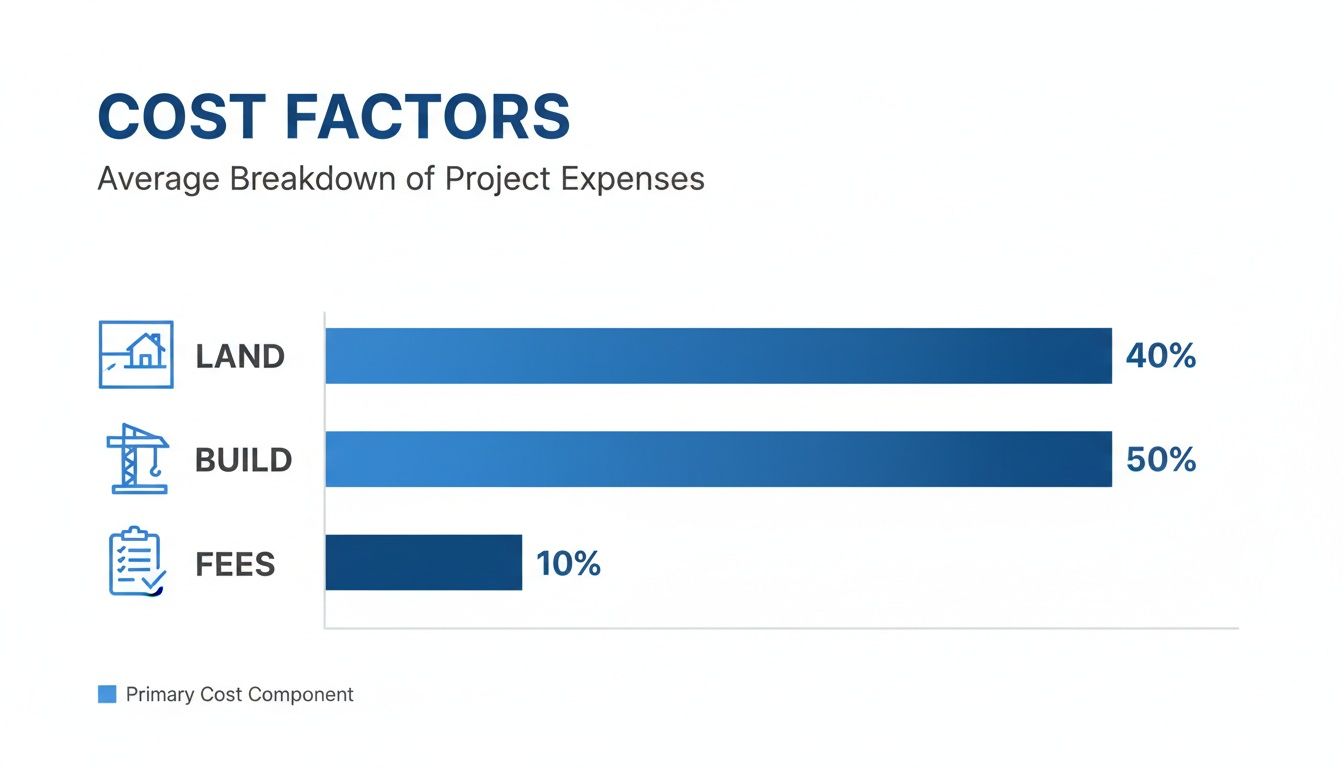
As you can see, after buying the land, the physical construction is the single biggest slice of the pie. That’s precisely why getting these costs right is absolutely critical to your project's financial success.
The Fit-Out: The Heart of Your Investment
While the outer shell keeps the weather out, it’s the internal fit-out that actually turns a simple box into a profitable self-storage business. This is where a huge chunk of your construction budget goes, and every decision here directly affects your facility's quality, security, and ultimately, its lettable area.
The key moving parts of any internal fit-out include:
- Partitions and Corridor Systems: This is what creates your individual units and the hallways that lead to them. The quality of the steel, the finish, and the cleverness of the layout are all vital.
- Doors and Locking Systems: The choices you make here, from standard roller doors to high-tech electronic access, will shape both your costs and your customers' experience.
- Mezzanine Floors: These are absolutely essential for multi-storey facilities or for making the most of the vertical space in a warehouse with high ceilings. Designing and installing commercial mezzanine floors is a specialist job that has a massive impact on your total lettable square meterage.
- Lifts, Lighting, and Security: Goods lifts for easy access, energy-efficient LED lighting to keep bills down, and solid CCTV and access control are non-negotiable for a modern, secure facility.
A well-designed internal fit-out isn't an expense; it's the engine of your revenue. Every design choice, from the unit mix to the width of the corridors, should be geared towards maximising rentable space and creating a seamless customer journey.
How Regional Variations Impact Your Bottom Line
It’s no great secret that building in central London comes with a very different price tag than a project in Newcastle or Glasgow. Everything from labour rates and the cost of transporting materials to local authority fees creates some pretty significant regional price differences.
For example, labour costs in the South East can be up to 20% higher than in other parts of the UK. That kind of variance hits your total self storage construction costs hard and has to be factored in right from your initial feasibility studies. This is where working with a national provider like PSL really pays off. We understand these regional quirks and can help you build a much more accurate and realistic budget from day one.
How Market Volatility Reshapes Your Project Budget
Building a self-storage facility is a strategic move, but it doesn’t happen in a bubble. External economic forces can feel like they come out of nowhere, but understanding them is the only way to keep your project on track and on budget.
Think of it like sailing: a good captain has to constantly read the currents of market trends and the winds of material prices to navigate successfully. These factors are what will ultimately shape your self-storage construction costs.
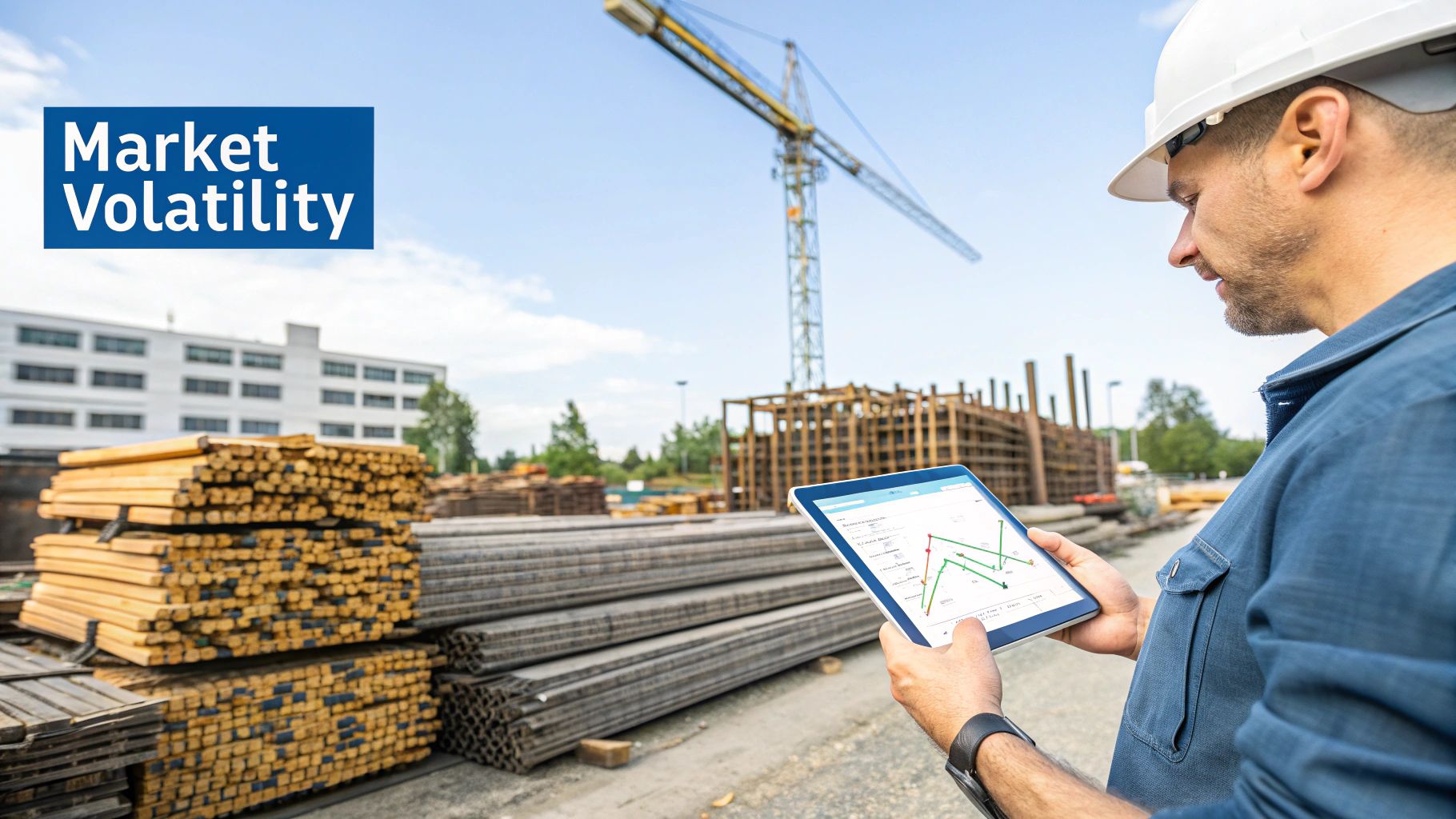
Forecasting a project budget isn’t just about adding up quotes for steel and labour. It demands a real-world view of inflation, supply chain stability, and whether you can even find skilled workers. These things can shift fast, turning a solid budget into a moving target. Staying ahead of these changes is what separates a smooth build from a stressful one.
The Ripple Effect of Supply Chain Issues
The journey materials take from a factory to your site is a long, complicated chain. When just one link breaks—whether it’s a global event, shipping delays, or a production bottleneck—the ripple effect can hit your project hard. It’s not just about delays; it directly hammers prices.
A sudden shortage of a specific grade of steel or a holdup in insulation production can cause sharp price hikes as suppliers scramble for limited stock. This volatility makes fixed-price contracts incredibly difficult and really highlights why a healthy contingency fund is non-negotiable. Without it, you could be facing tough choices, like pausing work or cutting corners on quality.
Navigating Material Price Fluctuations
Certain materials are the lifeblood of a self-storage facility, and when their prices swing, your budget feels it immediately. Steel, which is used for the frame, partitions, and mezzanine floors, is especially vulnerable to global market shifts. A 10% increase in steel prices can easily add tens of thousands of pounds to the cost of a medium-sized facility.
Other critical materials are feeling the pressure too:
- Insulation: Absolutely vital for climate-controlled units, and its cost is often tied to petrochemical prices.
- Concrete: While it's usually sourced locally, its price can still be pushed up by energy costs and the availability of aggregates.
- Fire-rated components: Compliance isn’t optional, but the specialised materials you need can see some of the sharpest price changes.
The data speaks for itself. The Self Storage Association UK's 2022 report showed a major surge in construction costs for new builds, driven by both labour shortages and material price hikes. This lines up with wider government data, which revealed prices for imported wood jumping 11.9% and other builders’ ironmongery climbing 6.9% in just one year. It’s a perfect example of the uneven pressures hitting a typical build.
The Labour Market Squeeze
The final piece of this puzzle is finding enough skilled labour. A shortage of qualified tradespeople—from steel erectors to electricians—inevitably pushes labour rates up. This squeeze means you’re not just paying more for good work; you’re also competing with every other project for the best teams, which can cause delays if crews are stretched thin.
Planning a construction budget in a volatile market is less about predicting the future and more about building resilience. Your budget needs shock absorbers—a healthy contingency, strong supplier relationships, and smart design choices—to handle the bumps in the road without derailing the project.
This is where working with a specialist like PSL gives you a serious advantage. Our established supply chains and in-house manufacturing capabilities act as a stabilising force in a choppy market. By controlling the production of key components like partitions and mezzanines, we can help cushion the blow from price shocks and give you much greater cost certainty, keeping your project moving forward no matter what the market throws at it.
Smart Strategies to Lower Construction Costs
Knowing what drives your self storage construction costs is one thing, but getting a firm grip on them is how you turn a good project into a great one. A smart construction budget isn’t about picking the cheapest materials or cutting corners. It's about making clever, strategic decisions that deliver real value over the long haul without bloating your initial investment.
Think of it like a master chef crafting a gourmet meal on a budget. They don’t just grab the cheapest ingredients off the shelf. Instead, they choose high-quality, cost-effective items and use smart techniques to create something exceptional. The same principle applies here—it’s about using the right components and design strategies to build a high-performing asset.
Optimise Your Unit Mix and Layout
One of the most powerful ways to control costs while pushing up revenue is a well-thought-out unit mix. Before a single blueprint is finalised, you need to dive deep into the local demand. Does your target market need a ton of small 25 sq ft lockers for student belongings, or are local businesses crying out for larger 150 sq ft units for inventory?
A specialist-designed, optimised layout ensures you're not wasting a single square metre. This means efficient corridor widths, ideal unit depths, and a mix that perfectly matches what customers are looking for, which in turn gets you to full occupancy—and profitability—much faster. Modern software can even model different layouts to strike the perfect balance between rentable space and construction efficiency.
Embrace Modular and Prefabricated Components
On-site construction is often at the mercy of the weather and unpredictable labour availability, both of which can throw unexpected costs onto your project. Moving key parts of the build process off-site is a game-changing strategy for keeping your budget in check.
Using modular or prefabricated components brings some serious advantages:
- Faster Installation: Things like pre-assembled partition walls or standardised door systems are made in a controlled factory environment. They arrive on-site ready for quick installation, drastically cutting down on-site labour time.
- Improved Quality Control: Factory production guarantees a higher, more consistent level of quality. This reduces the risk of expensive on-site mistakes or having to redo work.
- Reduced Waste: Precision manufacturing keeps material offcuts and waste to a minimum, which is not only better for the planet but also for your budget.
This approach streamlines the entire construction timeline, getting your facility open and earning money sooner.
The smartest investment isn't always the cheapest one upfront. It's the one that balances initial construction costs with long-term operational efficiency, durability, and revenue potential. Sacrificing quality for a small saving now can lead to much larger repair and maintenance bills down the line.
Specify Durable and Cost-Effective Materials
Choosing your materials is a delicate balancing act. While it’s tempting to go for the lowest-priced options, this is often a false economy. True cost-effectiveness comes from picking materials that give you the best mix of durability, low maintenance, and a sensible initial price.
For example, choosing a slightly more robust grade of steel for partitions and doors might add a small percentage to the initial fit-out cost. But it will pay for itself many times over by resisting the dents, damage, and general wear and tear from customer use, keeping your facility looking sharp and saving you from constant repair bills.
Likewise, investing in energy-efficient LED lighting or high-performance insulation might increase the upfront budget, but it will deliver significant savings on your utility bills for the entire life of the facility. For a comprehensive way to manage project finances and spot these efficiencies, using a robust Exayard construction estimating platform is a smart move. These tools help you track every expense accurately and identify opportunities for savings, ensuring every decision is backed by solid data.
Financing Your Build and Projecting Your ROI
A meticulously planned budget is one thing, but securing the capital to bring it to life is the critical next step. A successful build rests on a solid financial foundation. This means understanding your financing options and having a crystal-clear picture of your potential returns long before you ever break ground. It’s what turns abstract self storage construction costs into a tangible investment with a clear path to profitability.
Securing funding for a new development can feel like a complex puzzle, but it’s often more straightforward than you might think. For most projects, developers turn to traditional commercial loans from high street banks or specialist lenders who really understand the property sector.
To get your project funded, you need to know how lenders think. They’ll want to see a robust business plan, accurate costings, and a clear ROI projection, which is why understanding what banks look at when a small business applies for a loan can give you a massive advantage.
Exploring Your Funding Avenues
While traditional loans are the common route, other innovative options are popping up. Some specialist partners, including us here at PSL, offer structured financing packages. These can be particularly attractive because they’re designed to get your facility operational and generating income without needing a huge upfront capital outlay for the fit-out.
You can learn more about how specialist self storage financing can ease cash flow and get your project off the ground faster. These kinds of arrangements can be a real game-changer, allowing you to preserve capital for other crucial project phases, like marketing or future expansion.
Calculating Your Return on Investment
Once you have a handle on your financing, it’s time to model your profitability. Calculating your Return on Investment (ROI) and breakeven point isn’t just an exercise for your business plan—it’s the compass that guides your entire project.
The basic formula for annual ROI is simple enough:
(Annual Net Profit / Total Investment Cost) x 100 = ROI %
To get to that number, you need to project your income and subtract all your expenses. It sounds complicated, but let’s break it down with a simple, hypothetical example.
Let's walk through the numbers for a hypothetical mid-sized facility to see how this plays out in the real world. Below is a simplified financial model that shows how the key metrics come together to calculate your potential return on investment. This table breaks down the construction costs, operational expenses, and rental income to give you a clear picture.
Sample ROI Calculation for a Mid-Sized UK Self Storage Facility
| Financial Metric | Calculation Example | Notes & Assumptions |
|---|---|---|
| Total Investment | Land: £750,000 Build/Fit-Out: £1,500,000 Soft Costs: £250,000 Total: £2,500,000 |
This includes everything from the land purchase to professional fees. It's your all-in cost to get the doors open. |
| Annual Gross Income | 5,000 m² @ £240/m² x 85% occupancy £1,020,000 |
This is based on a stabilised occupancy rate. New facilities typically take 18-24 months to reach this level. |
| Annual Operating Costs | 35% of Gross Income £1,020,000 x 0.35 £357,000 |
Covers staff salaries, rates, utilities, marketing, insurance, and maintenance. A common industry benchmark. |
| Annual Net Profit | Gross Income – Operating Costs £1,020,000 – £357,000 £663,000 |
This figure is your profit before accounting for any loan repayments (debt service). |
| Annual ROI % | (Net Profit / Total Investment) x 100 (£663,000 / £2,500,000) x 100 26.5% |
This is the key percentage that shows the project's financial viability to lenders and investors. |
This powerful final percentage—26.5%—is what truly demonstrates the financial viability of your project. It shows lenders and investors that after covering the significant initial self storage construction costs, the business is set to deliver strong, sustainable returns. While it can often take 18-24 months for a new facility to reach this stabilised occupancy, this projection provides a clear and compelling target to aim for.
Partnering With a Specialist to Ensure Success
Navigating the world of self storage construction costs takes more than a sharp calculator; it demands real-world expertise. From unpredictable material prices to baffling planning regulations, the road from a blueprint to a grand opening is littered with financial traps. A great project depends on making all these moving parts work together perfectly—a job best left to a dedicated partner.
This is where a specialist’s value truly shines. Think of it like hiring a seasoned captain to guide your ship through choppy waters. An end-to-end partner doesn’t just sell you materials; they deliver a complete strategy forged from years of industry experience. They know exactly how a fine-tuned unit mix can drive long-term revenue and how clever design choices will slash your operational costs for decades to come.
A Single Point of Accountability
Trying to juggle separate contractors for design, groundwork, steel erection, and the final fit-out can quickly turn into a logistical nightmare of delays and spiralling costs. Bringing everything under one roof with a single, accountable partner smooths out all that friction. With over 24 years of experience, PSL’s integrated model does just that. Our in-house design, manufacturing, and installation teams work as one, making sure every project stage is perfectly in sync.
This joined-up approach brings some serious advantages:
- Cost Certainty: Because we manufacture key components ourselves, we can better shield your budget from market volatility.
- Streamlined Timelines: Coordinated project management cuts out the delays that plague fragmented projects, getting your facility open for business faster.
- Quality Assurance: From the first sketch to the final screw, quality is embedded and checked at every single step.
Choosing a specialist partner transforms your project from a series of transactions into a strategic collaboration. It's an investment in de-risking your development, ensuring it's delivered on time, on budget, and perfectly primed for profitability.
By connecting all the dots, a partner like PSL gives you the clarity and confidence needed to build a high-performing asset. You can see for yourself how our dedicated storage facility project management services guide developers through every challenge, turning ambitious visions into profitable realities.
Answering Your Top Questions on Self Storage Construction Costs
When you’re looking at a self-storage development, the numbers are everything. It’s completely natural for a lot of questions to bubble up, especially around the kind of financial commitment you’re facing. Here are some straightforward answers to the questions we hear most often from developers and investors gearing up for a new project in the UK.
What’s a Realistic All-In Construction Cost?
While no two projects are identical, a solid ballpark figure for a new, multi-storey facility is between £550 and £850 per square metre. That number gets you the core build plus the complete internal fit-out.
It’s crucial to remember this figure doesn't cover the initial land purchase or professional fees, which are significant costs you'll need to budget for separately. A project in London or the South East will naturally sit at the higher end of that range, thanks to steeper labour and logistical costs. In contrast, a development in a regional city might come in a bit lower. The only way to nail down an exact number is to get a detailed quote based on a professionally optimised design.
How Long Does It Take to Build a Facility?
From the first sketch to opening the doors for business, a typical project timeline runs anywhere from 9 to 18 months. This isn't one long slog, though; it breaks down into several key phases:
- Planning and Design: 2-4 months
- Securing Approvals: 3-6 months
- Site and Groundwork: 1-2 months
- Main Construction and Fit-Out: 3-6 months
Bringing an end-to-end provider on board is the single most effective way to keep things moving. When one team coordinates every stage, you can get ahead of potential delays and work to a much more efficient and predictable timeline.
Is It Cheaper to Convert a Building or Build New?
On the surface, converting an existing warehouse or an empty retail unit often looks like the smarter financial move. After all, the main structure is already there, which can save a small fortune on groundwork and steel framing.
But conversions can be full of expensive surprises. You might run into structural issues that completely hamstring your layout, or find yourself facing costly upgrades just to meet today's fire-rating and building regulations. A new build, on the other hand, gives you total design freedom and far more predictable costs from the get-go. A detailed feasibility study is absolutely essential to figure out which path will be more profitable for your specific site and goals.
At Partitioning Services Limited, we have deep expertise in both new builds and conversions. We help you analyse the numbers to make the smartest investment decision. Discover how our end-to-end project management can deliver your facility on time and on budget.