

If you're thinking about starting a self-storage business, you've landed on a sector that’s not just growing, but showing incredible resilience. The UK market is genuinely thriving, powered by deep-rooted social and economic shifts that aren't going away anytime soon. This isn't some flash-in-the-pan trend; it's a fundamental change in the way we all live and work.
Why the UK Self Storage Market Is Booming
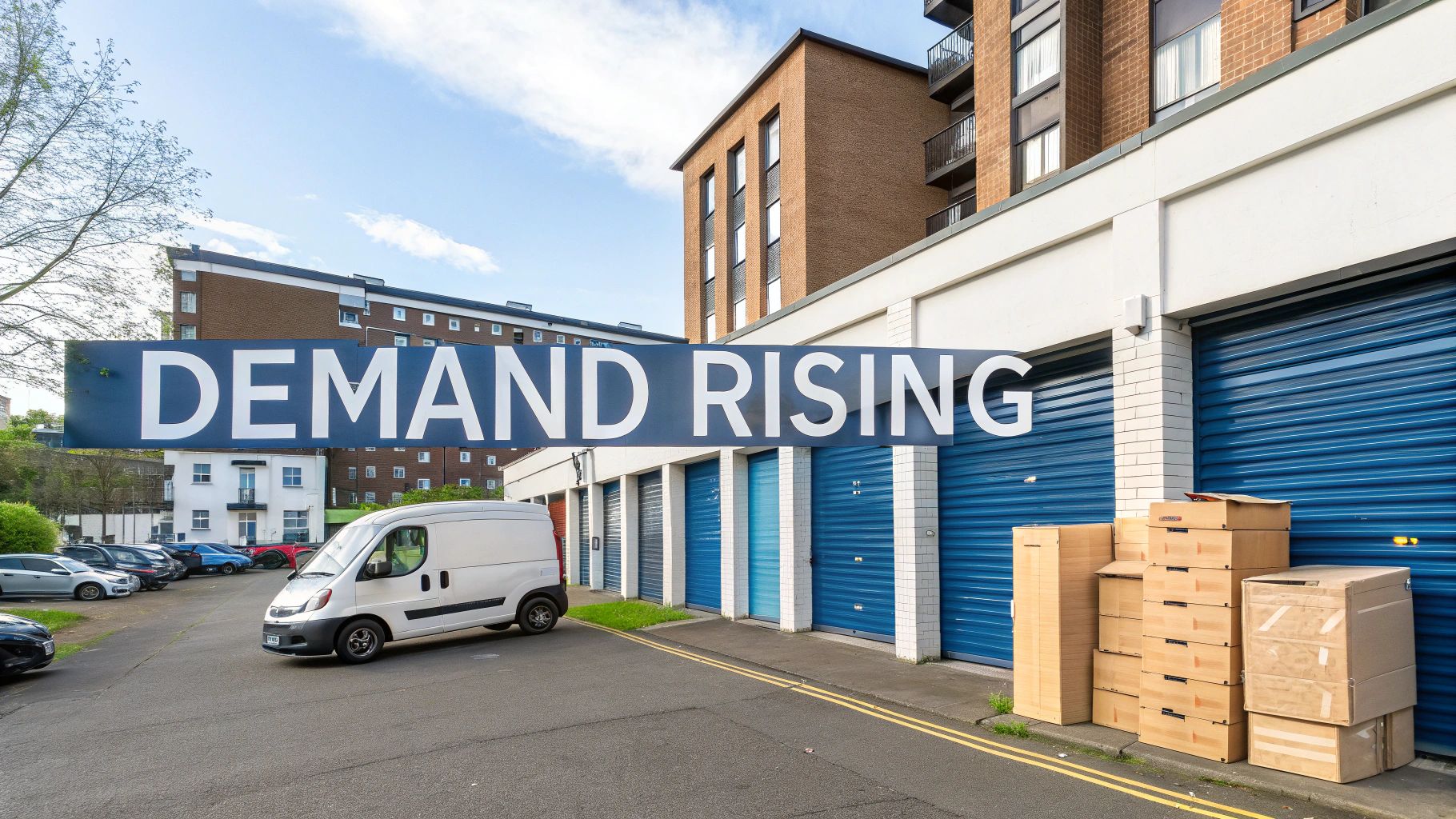
The demand for self-storage comes from a perfect storm of factors. For starters, our living spaces, especially in urban areas, are getting smaller, forcing people to find somewhere else to keep their belongings. Of course, the classic drivers are still there—moving house, downsizing, or dealing with a bereavement have always filled storage units. But today's demand is much more varied.
The boom in flexible working and the gig economy means more people need a secure spot for their tools and equipment. At the same time, the explosion of e-commerce has created an entirely new and hungry customer base.
A Shifting Customer Profile
Forget the old image of a self-storage customer just clearing out their attic. The modern user base is a dynamic mix of individuals and businesses, all with their own specific needs. Getting to grips with this diversity is the first step to spotting a real opportunity.
- Renters and Students: This group is all about flexible, short-term solutions. They need somewhere to stash their stuff between tenancies or over the university holidays, and they’re looking for convenience and a good price.
- Small E-commerce Businesses: Many online sellers quickly outgrow their garage or spare room. They need secure, easy-to-access units for their stock, without being tied into an expensive commercial lease.
- Tradespeople: Plumbers, electricians, and builders are increasingly using storage units as a cost-effective base for tools and materials. It’s a secure hub to run their operations from.
- Homeowners: While they're still a core market, their needs have changed. It's no longer just about decluttering. They're storing everything from seasonal sports gear to valuable collections and hobby materials.
This wide appeal is what de-risks the investment. Unlike businesses that rely on a single demographic, self-storage serves multiple segments. That provides a really stable foundation, even when the economy gets a bit shaky.
A quick look at the numbers shows just how healthy the market is.
UK Self Storage Market At a Glance
The table below gives a snapshot of the industry's performance, highlighting why now is such a compelling time to get involved.
| Metric | Current Statistic | Market Implication |
|---|---|---|
| Annual Turnover | £1.2 billion | The market has matured into a major economic force, demonstrating robust and sustainable demand. |
| Annual Revenue Growth | 6% | Strong pricing power and consistent demand, even with minor dips in overall occupancy. |
| Number of Facilities | Over 2,200 | A well-established but still growing industry with room for new, independent operators. |
| Total Rentable Space | 59.6 million sq ft | Significant capacity exists, but demand continues to absorb new supply in strategic locations. |
| Average Occupancy | 82.9% | High occupancy rates signal a healthy balance between supply and demand, ensuring stable rental income. |
These figures tell a clear story: the UK self-storage sector is a strong, stable, and profitable place to be. You can dive deeper into these industry statistics to get a fuller picture of the market’s potential.
The UK self-storage industry has demonstrated remarkable resilience and growth, achieving an annual turnover of £1.2 billion, marking the first time it surpassed the billion-pound milestone.
Modern Operations and Profitability
Profitability in this sector isn't just about demand; it's also being supercharged by modern, efficient ways of running the business.
Automation is a game-changer. With systems for online booking, automated billing, and keyless access control, the need for round-the-clock on-site staff has plummeted, which slashes overheads. This lean operational model, paired with a steady stream of rental income, makes for a very compelling financial case.
Ultimately, the UK self-storage market offers a rare mix of high demand, a diverse customer base, and proven economic resilience. For any entrepreneur with a solid plan, it represents one of the most stable and promising opportunities in commercial property today.
Laying the Groundwork: Your Strategic Blueprint
Every great self-storage facility is built on a foundation of solid planning, not just concrete. Before you even think about breaking ground, you need a strategic blueprint. This isn't just paperwork; it's the roadmap that guides every single decision you'll make, from choosing a location to welcoming your first customer. Skipping this step is one of the most common—and costly—mistakes new operators make.
A well-researched plan does more than just set goals. It puts your entire concept to the test, forcing you to answer the tough questions upfront. Does the demand actually exist? Is there a clear path to profitability? You need to know this before committing serious capital.
Getting Granular with Market Research
Your first job is to become the leading expert on your target area. A proper feasibility study is non-negotiable, swapping gut feelings for hard data. You have to get into the weeds of the local demographics. Is the area full of flat-renters who need smaller units for a few boxes, or is it a suburb of homeowners who need massive spaces to store furniture between moves?
A critical part of this is a deep dive into your local competitors, including understanding what makes top-rated self-storage facilities successful to see where you can find your own edge. Get a map and pinpoint every competitor within a three-to-five-mile radius.
- Who are they really? Look at their branding, check out their unit sizes, and try to get a sense of their occupancy rates.
- What are they charging? Build a simple spreadsheet to track their prices for comparable units. This data will be gold when you set your own rates.
- Where are they weak? Maybe their security looks like it's from the 90s, their online booking system is a nightmare, or they don't offer any climate-controlled units. Every gap in their service is a wide-open opportunity for you.
Building a Business Plan That Gets Funded
Once you have your market research nailed down, you can assemble a business plan that lenders and investors will actually read. Keep it clear, concise, and make sure every claim is backed up by realistic financial models. Vague, optimistic projections are a red flag; everything has to be rooted in the data you've just spent weeks gathering.
The financial projections are the heart and soul of your plan. This is where you'll model your expected revenue, map out your operational costs, and calculate your eventual return on investment (ROI). A key part of this is working out your break-even point—the occupancy rate you need to hit just to cover your costs. The good news? In self-storage, the break-even occupancy rate often hovers between a very achievable 40% and 45%, which is much lower than in many other commercial property sectors.
A detailed business plan isn't just a formality for the bank. Think of it as your personal playbook for making smart, profitable decisions every step of the way.
Now is the time to get serious about your funding options. Whether you're using your own capital, pitching to private investors, or applying for a commercial loan, your business plan is your primary tool. For those considering structured finance options, looking into different self-storage financing packages can open up clever ways to start generating income faster without a huge upfront cash outlay.
Designing a Smart and Profitable Unit Mix
Your research feeds directly into one of the most pivotal decisions you'll make: your unit mix. This is the specific blend of unit sizes you'll offer, and getting it wrong means having the wrong-sized units sitting empty while you turn away customers you could have served.
Think about your potential customers:
- Students & Renters: They're probably looking for small lockers or 5×5 ft units.
- Homeowners: Often need 10×10 ft or 10×20 ft units for bulky furniture and household goods.
- Local Businesses: Might require large, drive-up units for stock or specialised climate-controlled spaces for archives.
A smart opening strategy is to go with a balanced mix based on your demographic data. For example, if your facility is near a dense city centre, you might start by allocating 40% to small units (under 75 sq ft), 40% to medium units (75-150 sq ft), and just 20% to the big ones. You can always tweak this mix in future expansion phases.
New Build vs. Retrofit: The Big Decision
Finally, your blueprint needs to tackle the fundamental choice: do you buy land and build from scratch, or do you find an existing building and retrofit it? Each path comes with a completely different set of pros and cons that will heavily influence your budget and timeline.
| Consideration | Buying Land (New Build) | Retrofitting an Existing Building |
|---|---|---|
| Customisation | Complete freedom to design the perfect layout, unit mix, and traffic flow from day one. | You're limited by the existing structure—its layout, ceiling heights, and where the support columns are. |
| Timeline | A much longer process. You're dealing with planning permissions, zoning approvals, and ground-up construction. | Potentially much quicker to get up and running, since the main shell of the building is already there. |
| Initial Cost | Higher upfront investment for land acquisition and the full cost of construction. | Often a lower purchase price, but renovation costs can be unpredictable and spiral if you find nasty surprises. |
| Location | You may be restricted to zoned industrial areas further away from your core residential customers. | Can unlock amazing locations by converting old retail parks or warehouses right in the heart of a community. |
The right choice often boils down to how much capital you have, what properties are available, and how quickly you need to start generating revenue. A new build gives you the "perfect" facility but takes longer, while a retrofit can get cash flowing sooner—as long as the building is suitable and isn't hiding any expensive structural nightmares.
Getting to Grips with Design, Construction, and Compliance
With a solid strategy in place, it’s time to turn your vision into a physical, income-generating asset. This is where you get into the nuts and bolts of facility design, construction, and the often-daunting world of regulatory compliance. A well-thought-out design isn’t just about aesthetics; it directly drives profitability by making sure every single square foot of space is rentable.
The journey from architectural drawings to a fully kitted-out site is paved with critical decisions. Every choice, from the width of your corridors to the way you manage the build, will shape your construction timeline, your budget, and how efficiently you can operate in the long run. Getting this stage right is absolutely essential for starting a self-storage business on a strong footing.
This flowchart maps out the main decision you'll face: are you building from the ground up on a new plot of land, or are you converting an existing building?
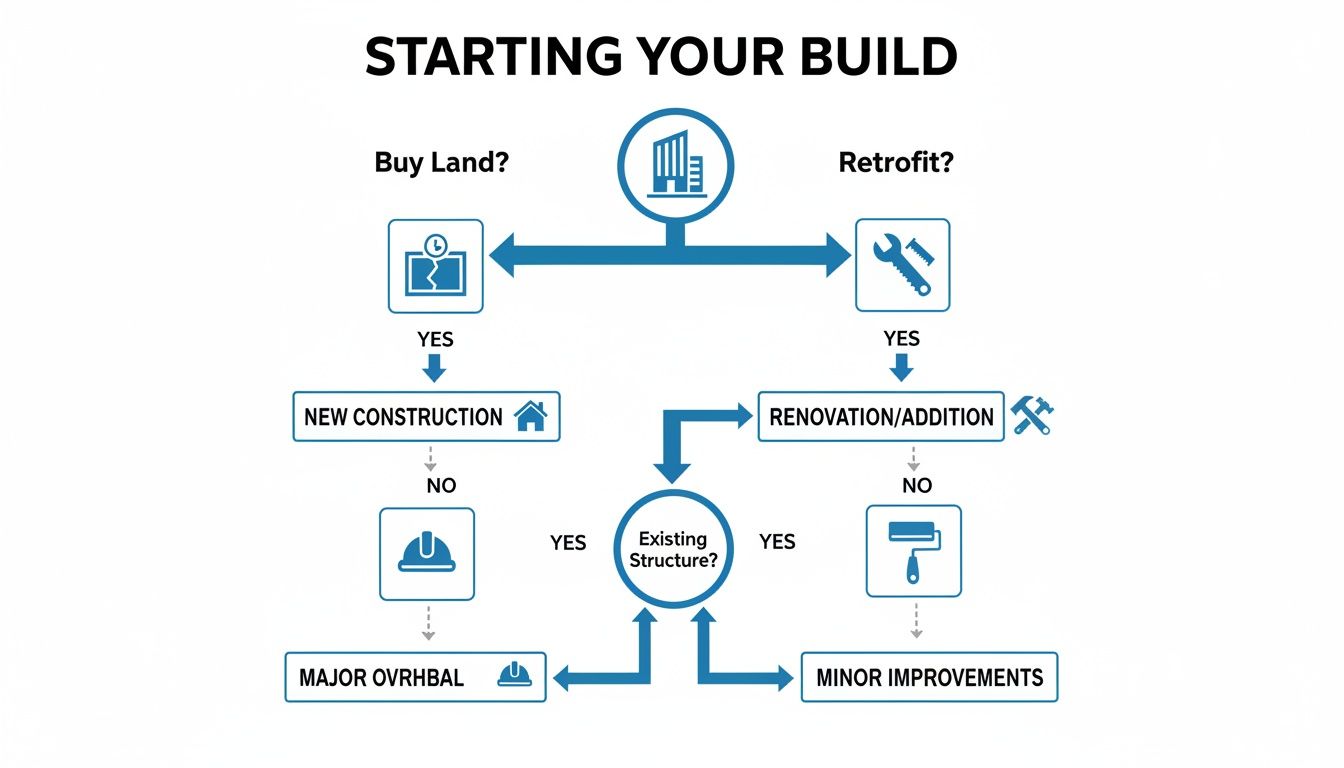
Each route has its own set of challenges and benefits when it comes to design freedom, how quickly you can get to market, and what your initial capital outlay looks like.
Maximising Rentable Space with Intelligent Design
The heart of any profitable self-storage facility is its net rentable area. Your entire goal here is to convert as much of the building’s footprint as you can into space that customers will pay for. This demands some clever design that goes way beyond just slicing up a warehouse into identical boxes.
Think vertically. Industrial buildings, which are a very popular choice for conversions, often come with high ceilings. That overhead space is essentially wasted, non-rentable volume. Installing commercial mezzanine floors is an absolute game-changer, effectively doubling your rentable space on the exact same footprint. You’re transforming a single-storey void into a multi-level facility without the massive expense of extending the building itself.
You can take a closer look at how mezzanine floors can be applied in self-storage design to see just how effective this approach is in the real world.
And don't forget the outside. Diversifying your unit mix with external, container-style units is a smart move. They’re a popular, cost-effective option for customers who need drive-up access for bulky items, vehicles, or business stock.
The Turnkey vs Self-Managed Build Decision
One of the biggest calls you'll have to make is how you manage the construction process itself. There are really two main models, and each comes with pros and cons that will suit different management styles and attitudes to risk.
Choosing your procurement model is a classic trade-off between control and convenience. A turnkey solution gives you a single point of contact and predictable outcomes, whereas self-managing provides granular control over costs but demands a huge amount of your time and expertise.
Let's unpack what each option really means for you on the ground.
Procurement Models: Turnkey vs Self-Managed Build
This table breaks down the key differences to help you decide which path is right for your project.
| Factor | Turnkey Solution (e.g., PSL Supply-and-Fit) | Self-Managed (Labour-Only & Sourcing) |
|---|---|---|
| Project Management | Handled entirely by a specialist contractor. They manage design, sourcing, logistics, and all trades. | You are the project manager. You’re responsible for sourcing materials and hiring/coordinating individual trades. |
| Cost Structure | A single, all-inclusive price. Provides budget certainty but may include a premium for the management service. | Potentially lower overall cost if you source materials and labour competitively. High risk of budget overruns. |
| Timeline | Generally faster and more predictable as the contractor controls the entire supply chain and schedule. | Prone to delays caused by material shortages, supplier issues, or coordinating different tradespeople. |
| Expertise Required | Minimal. Ideal for new entrants to the market who can lean on the contractor's experience. | Requires significant construction knowledge, project management skills, and a network of reliable suppliers. |
| Risk & Liability | The contractor assumes most of the risk for delays, quality control, and on-site issues. | You carry all the risk. Any mistakes, delays, or supplier problems are your responsibility to solve and pay for. |
For many first-time operators, a turnkey solution offers priceless peace of mind and a much clearer path to opening your doors. That said, seasoned developers with strong project management skills might find genuine cost savings in taking the self-managed route.
Mastering UK Building and Fire Safety Compliance
Navigating the web of UK regulations is a completely non-negotiable part of the build. Getting it wrong on planning permissions, building regulations, or fire safety standards can lead to eye-watering delays, fines, or even being forced to stop construction altogether.
Your design has to be compliant from day one. This covers everything from ensuring your corridors are wide enough for access to proper ventilation and structural integrity. Fire safety, in particular, is absolutely critical. A huge part of this is understanding and sticking to the latest commercial property fire safety regulations. This dictates everything from the fire rating of your partition walls and doors to the strategic placement of smoke detectors, alarms, and emergency lighting.
Honestly, the most effective way to guarantee full compliance is to work with experts who specialise in self-storage construction. They live and breathe the specific requirements and can design a facility that is not only profitable and efficient but also safe and fully compliant with every legal standard.
Launching and Operating a Profitable Facility
With the construction dust settled, your focus shifts from building a facility to building a business. This is where your strategic planning meets the real world. A strong launch and smooth day-to-day management really come down to three things: smart pricing, efficient tech, and a powerful marketing engine.
Nailing these from the get-go won't just bring in your first wave of customers—it’ll set the stage for long-term profitability and growth.
Setting a Competitive and Profitable Pricing Strategy
Your pricing strategy is a delicate dance between what the local market will bear and your own financial goals. Just copying the rates of the competitor down the road is a surefire way to leave money on the table. A much better approach is to look at a few different factors to really maximise your revenue per square foot.
Start by digging back into the local demand you identified during your research. A facility near a university, for instance, can often command premium prices for smaller lockers around term times. In contrast, one in a suburban area might find higher demand for larger, family-sized units.
Think about pulling these key pricing levers:
- Unit Size and Type: It's obvious that larger units cost more, but don't forget to put a premium on the most desirable spots. Ground-floor or drive-up units are gold dust for convenience, so price them accordingly.
- Promotional Offers: Introductory deals like "first month for £1" are brilliant for getting new customers through the door. Just make sure your standard rates are profitable enough to absorb that initial hit.
- Dynamic Pricing: Your prices shouldn't be set in stone. Use your management software to keep an eye on occupancy rates and adjust prices on the fly. As high-demand unit sizes start to fill up, you can nudge the rates up for the last few available.
A well-executed pricing model is your most powerful tool for revenue management. It’s not about being the cheapest; it's about offering the right value for the right price, reflecting real-time demand and occupancy levels.
The market outlook definitely supports strong pricing. With a projected 8.77% annual revenue growth rate through 2025 and average returns hitting £29.13 per square foot, there's a clear opportunity to establish a profitable rate card. You can dive into the complete analysis of the UK self-storage market performance to get the full financial picture.
Essential Technology for Streamlined Operations
Modern self-storage facilities are run by lean, efficient teams, and technology is the secret sauce that makes it all possible. Investing in the right software and systems from day one automates the tedious admin, beefs up security, and gives your customers a much better experience.
Your operational tech stack should include:
- Management Software: This is the brain of your operation. It needs to handle everything from online bookings and automated billing to tracking occupancy and managing customer accounts.
- Access Control Systems: Keypads, key fobs, or even slick smartphone apps give customers secure, trackable access. It also means you don't need staff on-site just to manage lock-ups.
- Security Systems: High-definition CCTV, motion-sensor lighting, and individually alarmed units are no longer nice-to-haves. They are absolute essentials for giving customers complete peace of mind.
These systems all work together to create a seamless experience. A customer can find you online, book and pay for a unit, and get their unique access code without ever needing to speak to someone. That frees up your team to focus on sales and keeping the facility in top shape. This efficiency is a core part of being profitable, and you can learn more about how smart design and tech impact storage facility profits in our detailed guide.
Your Go-to-Market Launch Plan
You can have the best facility in the world, but if nobody knows it exists, your units will sit empty. A multi-channel marketing plan is vital to generate buzz and drive enquiries from day one.
Focus your efforts on the local channels where you can reach your target audience directly.
- Optimise Your Online Presence: Get a professional website built and, crucially, claim your Google Business Profile. This is how you'll show up when people type "self storage near me" into Google.
- Forge Local Partnerships: Get out there and connect with estate agents, removal companies, and local business networks. Offer them a referral fee for every new customer they send your way. It's a classic win-win.
- Run Targeted Digital Ads: Use platforms like Google Ads and Facebook to run campaigns targeted to specific postcodes and demographics in your catchment area.
Your launch marketing should be all about building momentum quickly, filling up that first phase of units and establishing your brand as the go-to storage solution in the community.
Unlocking the Business Storage Market
While residential customers are the bread and butter for many self-storage sites, ignoring the commercial market is a huge missed opportunity. Businesses are a powerful and lucrative customer base, often looking for larger units, longer rental terms, and extra services that you can charge a premium for. Landing these clients can seriously boost your occupancy rates and create a stable, predictable revenue stream that you can rely on.
The needs of a commercial client are totally different from those of a homeowner. They aren't just decluttering; they're running an operation. This could be an e-commerce seller who's outgrown their spare room, a plumber needing a secure hub for expensive tools, or a sales rep storing promotional materials between events. To win them over, your facility has to be designed and run to solve their specific logistical headaches.
Catering to Business Needs
Becoming the go-to choice for local businesses is about more than just offering empty space. It’s about providing features that make their working lives easier. A few simple additions to your design and service offering can make a world of difference and set you apart from competitors who only think about the domestic market.
Consider building in these high-value features:
- Larger, Drive-Up Units: For businesses handling inventory or heavy equipment, direct vehicle access is non-negotiable. They need to be able to pull a van right up to the door.
- 24/7 Access: A tradesperson might need to grab tools at 6 AM, long before standard office hours kick in. Unrestricted access is a massive selling point.
- Delivery Acceptance Services: Offering to accept parcels on their behalf can be a game-changer for online retailers and field-based professionals who aren't always on-site.
- Enhanced Security: Businesses store high-value assets. Gated access, individual unit alarms, and extensive CCTV coverage are essential for their peace of mind.
This focus on business users is backed by some powerful market trends. In fact, commercial usage is a cornerstone of the UK self-storage market. A remarkable 27% of renters use their units for business purposes, which allows over 680,000 businesses to slash their costs by 40-60% compared to traditional warehousing. This demand is getting an extra push from the e-commerce sector, which now accounts for over 30% of all UK retail sales. You can dive deeper into these UK storage statistics and see the sheer scale of the opportunity.
Designing a Business-Friendly Facility
Your facility's layout should reflect this commercial focus from day one. You’ll need wider driveways to accommodate larger vans and delivery lorries, making sure they can navigate the site without any hassle. It's also a smart move to allocate a specific section of your facility for larger, ground-floor units, creating a dedicated business zone.
Think of your facility not just as a place to store things, but as a flexible, cost-effective operational hub for the local business community. This mindset shift is the key to unlocking long-term, high-value tenancies.
By strategically tailoring your design, security, and services, you position your facility as an indispensable partner for local companies. This approach transforms your site from a simple storage provider into a vital piece of local commercial infrastructure. It ensures a steady flow of high-quality, long-term clients who genuinely value the professional amenities you provide.
So, you’ve navigated the maze of planning, validation, and construction. Your self-storage facility is no longer just a blueprint—it's a reality. This is a huge milestone, but the real work starts now. The ultimate test isn't just opening your doors; it's building a business that stands the strong for years to come.
Long-term success hinges on the principles we've discussed: staying customer-focused, running a tight ship operationally, and having a clear vision for growth. Think of your initial unit mix, pricing strategy, and marketing plan as living documents. They need to breathe and adapt based on what the market tells you and how local demand shifts.
The Value of an Expert Partner
Trying to figure all this out on your own, especially if you're new to the industry, can be a tough road. This is where bringing in a specialist partner can be an absolute game-changer. An experienced team like PSL offers more than just steel and screws; they bring a wealth of industry know-how earned from successfully completing countless projects.
From fine-tuning your layout to squeeze every last bit of net rentable area out of your space to making sure every component is up to scratch with fire safety regulations, an expert guide takes the guesswork out of the equation. A full turnkey solution means you can hand over the technical details and focus on the bigger picture: launching your brand and growing your business.
Choosing the right partner is one of the most critical investments you’ll make. Their expertise becomes your competitive advantage, helping you sidestep expensive errors and fast-tracking your path to profitability from day one.
Scaling Your Storage Empire
A successful first site is a fantastic achievement, but for many, it’s just the beginning. It's the foundation for your future portfolio. Once your facility hits a stable occupancy rate and starts generating reliable cash flow, your thoughts will naturally turn to what's next. That might mean adding another phase of units to your current site or scouting locations for your second facility.
This is where having a trusted partner in your corner really pays off. They already get your business model and can help you replicate your success without reinventing the wheel. Even better, flexible financing options can be put in place to help fund this growth, allowing you to reinvest your profits and expand your footprint without getting bogged down by huge upfront capital costs.
With a solid operational plan and the right support network, you can turn a single successful site into a thriving storage empire, building long-term wealth and a powerful presence in the market.
Got Questions About Starting a Self-Storage Business?
Jumping into the world of self-storage always brings up a lot of questions. If you're an entrepreneur weighing up your options, you're not alone. Here are some quick, practical answers to the queries we hear most often.
How Much Does It Really Cost to Start a Self-Storage Business in the UK?
The initial investment can swing wildly. If you're dreaming of a brand-new, multi-storey facility in a prime urban spot, you could be looking at several million pounds. On the other hand, you might get started for a few hundred thousand by acquiring and retrofitting a smaller industrial unit or even beginning with external container storage on a plot of land.
The main costs you'll need to budget for are:
- Property: The cost of acquiring the land or building itself.
- Fit-out: Construction or conversion costs, including partitioning, mezzanines, and doors.
- Tech: Essential systems like security, access control, and management software.
- Professional Fees: Don't forget costs for planning consultants, legal advice, and architects.
Just How Profitable Is a Self-Storage Business?
Self-storage is well-known for its strong profit margins and surprising resilience, even in tougher economic times. While every facility is different, the break-even occupancy point often hovers between 40-45%. That's significantly lower than most other commercial property types, meaning you can start generating positive cash flow much faster.
Once your facility is stabilised and running smoothly, it can produce healthy, consistent returns. This is supported by steady demand and the flexibility to adjust your pricing as occupancy levels climb.
The self-storage model is built for profitability. High rental yields per square foot combined with relatively low ongoing operational costs—especially in automated facilities—create a compelling financial case for investors.
Should I Buy an Existing Facility or Build a New One?
This is a fundamental strategic decision, and there are good arguments for both. Buying an existing facility gives you an immediate cash flow and an established customer base right out of the gate. The downside? You might pay a premium and inherit an outdated design or layout that’s hard to change.
Building from scratch is your chance to create a modern, hyper-efficient facility perfectly tailored to your local market. But it's a longer game. You'll need to navigate the complexities of planning permissions and manage a full-blown development project. For many, retrofitting an existing warehouse offers the perfect middle ground—it's often faster than a new build but still gives you the freedom to customise it with a modern fit-out.
What’s the Biggest Mistake New Operators Make?
One of the most common—and costly—pitfalls is underestimating just how critical location and detailed market research are. Choosing a site with poor visibility, difficult access, or in an area already saturated with competitors can cripple a new business before its doors even open.
Another frequent error is getting the unit mix wrong. Without properly understanding the local demographics, you might build too many large units in an area dominated by flat-dwellers needing small-scale storage, or not enough small lockers near a university. Doing your homework upfront is the single best way to avoid these foundational mistakes when starting a self storage business.
At Partitioning Services Limited, we're here to guide you through every stage of this journey, from the initial design concepts to the final installation. Explore our turnkey services to see how we can help you build a successful and profitable self-storage facility. Find out more at https://psllimited.co.uk.