


Mezzanine Floors Design: A Practical UK Guide
You can stand in an empty unit with a tape measure, a budget, and a rent target, and still be far from a workable mezzanine. The hard part isn't the steel, it's turning spare height into income-producing floor area without painting yourself into a corner on load, access, or compliance.
That's why mezzanine floors design should be treated as an engineered commercial decision, not a platform purchase. In UK warehouse and storage schemes, the design sequence has been shaped for decades by material limits, handling bottlenecks, and later floor-system upgrades, including the move from simple platforms to more engineered solutions with Vertical Reciprocating Conveyors in the early 1980s and ResinDek® flooring in the 1990s, which changed how teams moved goods, carried loads, and protected the floor build-up United Storage history of mezzanine design.
The practical question is always the same. How do you convert vertical space into rentable area, keep the building compliant, and avoid redesign after the steel has been ordered?
What a Mezzanine Has to Deliver Before Anyone Cuts Steel
A developer usually arrives at this point with an empty shell, a target yield, and a rough idea of where the mezzanine should sit. The temptation is to sketch the deck first and let the details fall into place later. That's the fastest route to rework, because the mezzanine isn't just a raised platform, it's a system that has to earn its keep from day one.
The older UK mezzanine model was about creating a level. Modern mezzanine floors design has to do more. It has to turn unused vertical volume into usable, rentable floor area, and it has to do that while respecting load capacity, access, fire strategy, and the way people and goods move through the building.
The six inputs that drive the scheme
Good design circles back to six inputs repeatedly, and they should be fixed early:
- Building geometry, because the internal footprint determines where the deck can land.
- Intended use, because storage, office, and equipment zones need different structural treatment.
- Load requirement, because the floor is only as useful as the load it can safely carry.
- Available headroom, because a mezzanine that feels tight or violates clearance expectations can undermine the whole scheme.
- Access and goods transfer needs, because stairs, pallet gates, and lift routes shape the usable layout.
- Applicable Building Regulations, because compliance isn't a bolt-on afterthought.
Practical rule: if a requirement affects the column grid, stair location, or fire strategy, it needs to be decided before steel is ordered.
That's why the best schemes are scoped as an engineered asset. The floor has to create revenue, but it also has to survive inspection, commissioning, and future use changes without becoming a maintenance problem. In warehouse and self-storage environments, that means the mezzanine is never “just space above”. It's a capital decision with structural, operational, and compliance consequences.
Running the Site Survey and Feasibility Check
The survey starts with a tape measure, but it shouldn't end there. A proper feasibility check records the actual building, not the sketch in someone's head, because hidden constraints usually live in the slab, the roof void, the columns, or the service runs.
First, capture the internal dimensions and ceiling height. Then record the slab condition, because cracks, level changes, and questionable load paths can affect the entire structural approach. After that, map the column positions, the vehicle routes, the fire exits, and every visible existing service. Those are the details the structural engineer needs before load calculations and drawings start.
The geometry question matters just as much as the structural one. External design guidance aimed at high-ceiling spaces says a functional mezzanine ideally needs about 4.2 m total room height so both levels retain around 2.1 m clearance, and the mezzanine should typically occupy only 30% to 50% of the lower floor area to preserve usability and spatial quality functional mezzanine height and area guidance. In UK retrofit work, that's a useful feasibility filter even when the final use is storage rather than residential.
What to photograph and flag
A survey pack should include the following, even on a straightforward unit:
- All structural columns, including dimensions and their exact locations.
- Doorways and vehicle routes, especially where forklifts or pallet movement will pass.
- Fire exits and escape paths, because these influence stair placement and compartmentation.
- Slab defects, trip points, and visible changes in level.
- Services, such as pipes, cable trays, lighting, and ventilation routes.
- Headroom pinch points, especially near existing beams or roof obstructions.

Don't lock in a layout until the slab, exits, and service routes have been measured on site. That's where most “simple” mezzanine jobs get complicated.
The point of the feasibility check is not to prove the mezzanine will work no matter what. It's to find out early whether the building can support the use case without making the space feel cramped, non-compliant, or structurally awkward.
Setting Load Zones and Sizing the Structure
Load should never be guessed at the steel stage. It needs to follow the use of each zone, because a mezzanine that stores palletised stock, houses a small office, and carries equipment all at once is not one uniform loading problem. It's several different ones sitting on the same frame.
Design the load around the use
UK mezzanine guidance says the load rating should be driven by actual zone use, with separate checks for storage, office, and equipment areas, then matched to column point loads, staircase positions, pallet-gate locations, and fire-protection measures. That matters because the structure is not sized in isolation. It is sized around what the building team wants the floor to do.
A useful way to think about it is simple. Heavy storage areas, office areas, and machinery areas all create different structural demands, so the beam spans, section sizes, and connections have to follow the chosen column grid and the required load rating. Under-size the load case, and the problem doesn't just show up in calculations, it shows up in redesign, delayed procurement, and access changes that ripple through the whole scheme.
Restraint and span need to match
Longer bays need more restraint. The cited structural guidance uses a span-based rule where lateral restraint details vary with span, with up to 3 m using restraints at the top flange, 3 m to 6 m using one mid-span restraint, and over 6 m using two restraints at third points mezzanine planning guidance. That's not a decorative detail. It's a control against lateral instability in longer spans.

Practical rule: if one zone is heavier than the rest, size that zone first and let the rest of the frame follow it, not the other way round.
The commercial logic becomes obvious. A mezzanine isn't just a floor, it's a load-managed asset. The better the load zoning, the less likely you are to waste steel where you don't need it, or discover too late that the chosen layout can't carry the intended use.
Coordinating Building Regulations, Fire Strategy and Access
Compliance works best when it is designed into the first concept sketch. If it arrives after the steel order, the project team starts solving expensive problems with smaller and smaller options. That's when stair positions get awkward, fire separation becomes clumsy, and an otherwise sound mezzanine turns into a compromise.
UK guidance says occupied mezzanines need fire-rated ceilings, column casings, fire doors, and a defined escape route. It also says building-control submission, and planning permission where required, should be built into the programme from the start UK mezzanine regulations guidance. That sequence matters because fire and access drive layout. They're not just paperwork at the end.
Ask these questions in week one
Before anyone commits to a steel layout, the design team should answer:
- How will people escape? Stair and exit positions need to work with the actual occupancy and use.
- Where do fire-rated elements go? Ceilings, casings, and doors are part of the spatial plan.
- What happens to access for disabled users? If lifts or ramps are required, they affect floor area and circulation.
- Which areas need compartmentation? The answer can change the column grid and stair arrangement.
- What evidence will building control expect at handover? The as-built pack should be planned early, not assembled under pressure.
For a practical overview of the landlord-side obligations, the landlord fire safety rules UK resource is useful because it frames fire duties in a way that supports early coordination rather than last-minute patching.
Compliance is cheapest when it shapes the layout at concept stage. It's most expensive when it asks for changes after fabrication.

A good compliance pack doesn't just satisfy an inspector. It lets the building team hand over a mezzanine that can be operated without constant second-guessing, because the escape route, access solution, and fire measures were designed as one system.
Optimising Layout for Maximum Rentable Area
Once the structure and compliance rules are fixed, the layout question becomes commercial rather than abstract. Every column, stair, and service route either protects rentable area or consumes it. That's why the actual design task is to make the dead space do as little damage as possible.
The column grid is usually the biggest lever. A tighter or better-positioned grid can sometimes free enough continuous floor area to improve unit planning, reduce awkward corners, or give a cleaner circulation line. The opposite is also true. Put the columns badly, and you can lose a useful row of units to circulation waste, poor gate positioning, or unusable edge zones.
Treat services as part of the layout
Sprinklers, lighting, and electrical runs should be threaded through the structure, not casually across it. If the service strategy is left until late, it can force lowered clearances, clash with pallet gates, or consume space that had already been sold in the leasing model. A mezzanine that looks efficient on a drawing can become a poor revenue asset if the actual circulation paths are broken by service compromises.
A simple commercial check helps here. Compare the area the mezzanine creates with the space it makes harder to rent. Stairs, lifts, gates, and fire separation all take floor area, so the layout needs to justify those losses with clean, usable square metres elsewhere. That's especially true in self-storage schemes, where consistent unit planning tends to matter more than dramatic geometry.
Cost per square metre at a glance
| Installation size | Installed cost band | What's included |
|---|---|---|
| 500 m² | £150,000 to £300,000 | Steelwork, decking, staircases, handrails, and Building Regulations compliance |
| Any typical freestanding warehouse mezzanine | £300 to £600 per square metre installed | Steelwork, decking, staircases, handrails, and compliance package |
Those numbers matter because they force the layout to earn its keep. A modest change in column position or stair route can either protect or erode the return on the installation, so the design team should test the layout against rental yield, not just against fit.
Choosing Decking, Staircases and Finishes That Fit the Use
A mezzanine scheme can look efficient on paper and still perform badly in use if the deck, stairs, and finishes are picked in isolation. Each of those decisions affects load behaviour, installation sequence, noise, durability, and how the space feels once tenants or operators start using it. For warehouse and storage projects, the comparison is usually between concrete-on-metal-deck solutions, timber, particle board, and engineered flooring systems such as ResinDek®.
Match the deck to the commercial use
Steel-based systems suit heavier, more industrial applications because they offer strong structural performance and can handle demanding use. Wood-based options can work in lighter office or customer-facing areas, but they need more care around fire, wear, and moisture. Engineered flooring systems sit between the two, giving a lighter-duty but still strong solution for heavier goods, equipment, and personnel without the cost and disruption of concrete flooring.
The choice is commercial as much as technical. If the upper floor is mainly storage, the priority is durability and predictable load behaviour. If it carries mixed use, the finish has to balance appearance, maintenance, and access requirements without creating avoidable downtime. The wrong deck can also force later changes to the stair position, edge protection, or service route, which is where avoidable rework starts to eat into the project budget.
Access components need to be specified with the deck
Staircases, handrails, and edge protection should be treated as one package with the deck, not as items to sort out later. Stair position affects circulation, pallet gates affect goods transfer, and handrails affect the usable perimeter. If those elements are left to the end of the design process, the result usually feels bolted on and can cost rentable area in the wrong places.
That is why the access strategy should be checked against the intended use of the floor before the layout is frozen. A storage scheme, for example, needs safe movement without sacrificing too much usable edge space or creating awkward dead corners around the stairs. For projects where the flooring specification needs to be matched to the intended load and use, the warehouse mezzanine flooring overview is a practical reference point because it ties surface choice to access and day-to-day operation.
Practical rule: choose the deck after you know the load, the use, and the maintenance plan. Choosing it before that usually means paying twice.
The right finish package supports the revenue model without adding unnecessary complexity or turning a straightforward install into a long list of site fixes.
Installation Planning, Commissioning and Common Pitfalls
A mezzanine only turns into a working asset once it is installed, checked, and handed over with the right evidence. On site, that starts with a sequence that avoids clashes with other trades, delivery planning that keeps the existing slab within its limits, and protection for finished areas while the rest of the build is still active.
The handover chain needs to be clear from the start. The installer should provide as-built drawings, structural calculations, and the relevant compliance certificates, and the client should check that the access arrangement, fire measures, and fixings match what was approved. A mezzanine can pass inspection and still cause problems if the paperwork is incomplete, because operations and maintenance do not begin cleanly without it.
Five pitfalls that cause mezzanine rework
| Pitfall | Where it surfaces | Fix in design |
|---|---|---|
| Layout drawn before loads | Early concept stage | Set the load zones before freezing the column grid |
| Fire strategy added late | Building control review | Design escape routes, fire-rated elements, and compartmentation from day one |
| Services re-routed on site | Installation phase | Coordinate lighting, sprinkler, and cable routes in the drawings first |
| Access stairs under-sized | Procurement and fit-out | Confirm staircase position and width against the actual flow of people and goods |
| Slab loading ignored during delivery | Site logistics | Plan delivery sequencing around the existing floor capacity |
Strongest projects avoid these traps because the team treats the mezzanine as a coordinated system, not a frame with extras bolted on later. That means the install plan, commissioning checks, and sign-off process are all tied back to rentable area, compliance risk, and the actual sequence of work on site.
For a delivery sequence and installation package, the mezzanine floor installation page shows the kind of service structure that helps keep design, fabrication, and site handover aligned.
Partitioning Services Limited handles self-storage design and build work, including mezzanine flooring, technical design support, rolling staircases, and commissioning. If you are planning a scheme and want the mezzanine designed as rentable area rather than just steel in a shell, visit Partitioning Services Limited to discuss how the layout, compliance, and installation package can be coordinated from the start.

Fire Rated Partition Walls for Self-Storage Facilities
You're standing in a familiar spot. The unit mix is drawn, the mezzanine looks workable on paper, and every metre of wall has a direct impact on rentable area. Then the fire strategy lands on your desk and the questions start, what rating is needed, where does the partition stop, and how do you avoid losing space or slowing the programme?

For self-storage developers, fire rated partition walls are rarely just a compliance item. They sit at the intersection of compartmentation, tenant safety, build speed, and layout efficiency, which is why they deserve proper design time rather than a late-stage fix. If you want a useful overview of the wider life-safety context, the fire and life safety guide is a solid starting point, but the actual job is translating that principle into a tested wall that suits your building and your programme.
Why Fire Rated Partition Walls Matter in Self-Storage
A self-storage scheme looks simple from the outside, but the fire strategy usually isn't. One block might have a ground-floor reception, a mezzanine, cellular storage rooms, and a service route all sharing the same envelope. In that setting, fire rated partition walls do more than divide space. They help preserve escape routes, keep fire spread under control, and buy time for occupants and firefighters when it matters most.
The UK framework has long treated this as a compartmentation problem rather than a decorative fit-out issue. Guidance for England and Wales requires internal compartment walls and fire-resisting construction to limit spread and protect escape routes, and UK practice commonly uses 1-hour fire resistance for many internal partitions, with 30 minutes still appearing in some corridor or dwelling-unit separations. A developer looking at a self-storage retrofit should read that as a design signal, not a menu of interchangeable options. The rating is tied to the building's risk profile, use-case, and the tested assembly, not just a line on a drawing. UK compartmentation guidance for fire-resisting construction
Practical rule: if the wall has to protect an escape route, it's part of the life-safety system, not just the layout.
The reason this matters commercially is straightforward. Every extra square metre of rentable area helps, but a poor partition strategy can destroy that gain if the project later needs remedial fire-stopping, extra lining, or an awkward redraw of the ceiling void. The best outcomes come from treating the partition as an integrated part of the fire strategy from day one. That usually means deciding early where the compartments start and stop, what has to continue to the structural deck, and which zones justify a higher-rated assembly.
Understanding Fire Rating Classifications and Compartmentation
A fire rating is a tested measure of how long a wall assembly can resist fire exposure. In UK practice, 30 minutes has long been a common benchmark for lighter internal partitions, while many commercial fit-outs are specified around 60 minutes. More demanding projects may call for 90, 120, or 240 minutes, depending on the building's risk profile, occupancy, and the time needed to keep fire contained before the assembly fails. UK partition ratings and historical benchmark ranges
What the numbers mean on site
A 30-minute wall is usually the lightest performance level in this group. It suits straightforward compartmentation where the partition is helping to separate uses, but the broader fire strategy does not rely on long resistance from that wall.
A 60-minute partition is the common commercial baseline in many UK interior fit-outs. On self-storage projects, it often becomes the point where the wall is treated as a timed barrier rather than a simple divider, especially near circulation routes, escape arrangements, or areas where the compartment line has to stay reliable through the full fit-out. In that context, the rating has to be read alongside the ceiling void, because a wall that stops below a leaky void does not give the same separation as a wall that continues to the structural deck. self-storage construction materials and fit-out considerations
At 90 minutes and 120 minutes, the conversation changes. Those ratings are more likely where the compartment is carrying a heavier share of the building's life-safety strategy, or where a mezzanine retrofit creates more complex escape routes and more pressure on compartment continuity. At the upper end, 240 minutes appears in specialist applications where the tested assembly is expected to hold its performance for a much longer period. UK partition ratings and historical benchmark ranges
A rating only means something if the full wall assembly, joints, voids, and openings follow the tested detail.
That is where compartmentation matters. The wall is there to slow fire and smoke, protect escape routes, and stop one zone from undermining another. In self-storage schemes, the practical question is not which rating sounds strongest, it is where the compartment lines sit, how they connect to the structure above, and whether the selected system can be installed without creating gaps around services, slab edges, or steelwork that later need fire stopping. Where steel members are exposed in the same zone, fire protection paint for structural steel may form part of the same strategy, but it still has to be coordinated with the partition and ceiling line, not treated as a separate fix. fire protection paint for structural steel

Materials and Construction Methods That Deliver Fire Resistance
A fire-rated partition only performs as intended when the complete tested assembly is built exactly as specified. In UK passive-fire practice, that usually means a partition validated to BS 476: Part 22 for integrity and insulation, with the board type, stud arrangement, joint treatment, cavity detail, and fixings all working together. Two walls can look almost identical on a drawing and still behave very differently once they are tested and installed on site. BS 476-based UK partition construction handbook detail
What changes the rating
The published assemblies make the pattern clear. More material, more layers, and tighter detailing extend resistance, but only inside a tested system. One listed build-up uses 9 mm mineral boards each side on steel studs for 60 and 120 minutes. Another uses two layers of 9 mm boards for 240 minutes, while two layers of 12 mm boards reach 360 minutes. For a developer, the message is straightforward, added mass and layer count can raise resistance, but the wall has to remain inside the tested configuration. Published Promat dry wall assembly examples
A separate Promat UK handbook example shows a 90-minute insulation build-up using Promat SUPALUX boards 20 mm + 25 mm with joints staggered by at least 600 mm. That is not a detail for the drawing office to tidy up later, it affects how the assembly holds together under fire exposure. Board thickness, layer sequence, and cavity treatment all contribute to the result, and each one needs to match the tested evidence rather than a contractor's preferred shortcut. Promat UK partition detailing example
Fire resistance is built into the assembly. The site team's job is to reproduce it without drifting from the test.
| Board Thickness | Layers Each Side | Stud Type | Achieved Fire Rating |
|---|---|---|---|
| 9 mm mineral board | 1 | Steel studs | 60 and 120 minutes |
| 9 mm mineral board | 2 | Steel studs | 240 minutes |
| 12 mm board | 2 | Steel studs | 360 minutes |
In self-storage fit-outs, speed still matters, but it cannot come at the expense of the tested detail. A useful reference point for the broader specification discussion is self-storage construction materials, because partition choice sits alongside doors, linings, and the rest of the fit-out package.
Where the project also includes exposed steel, the fire strategy may need a separate treatment for the frame. In that case, fire protection paint for structural steel becomes part of the passive-fire package, but it does not replace the need to specify the partition as a validated assembly in its own right.
UK and EU Regulations and Testing Standards Explained
A self-storage project in the UK usually lives or dies on the fire strategy, not on the marketing sheet from the partition supplier. The designer has to line up the wall build-up, the way the compartments are formed, and the route the building takes through Building Regulations. In England and Wales, the relevant guidance focuses on fire-resisting construction, internal compartment walls, and preserving escape routes, with UK practice commonly relying on BS 476: Part 22 for tested fire resistance evidence.
UK and EU side by side
For a retrofit or mezzanine fit-out, the UK route is normally the one that governs the decision on site. A wall used to divide storage bays is not automatically enough for compartmentation, especially where escape routes, stair cores, or shared circulation areas sit nearby. The detail has to suit the building, because a neat-looking wall that stops short at a ceiling line or misses a service zone can still fail the fire strategy.
The European side still matters when products or systems are sourced across borders. EU standards use different classification routes, and those are not interchangeable with the UK requirements for compartment walls and means of escape. The safe approach is to check the exact assembly against the code path that applies to the project, then confirm that the test evidence matches the wall as installed, not a similar-looking variant.
Practical rule: the compliance route should match the building, the jurisdiction, and the exact wall build-up, not whichever brochure looks easiest to file.
For teams working through storage-specific requirements, a useful starting point is self-storage building regulations. A stated fire rating is only part of the picture. The wall, openings, ceiling interface, and any service penetration still need to match the tested detail and the intent of the fire strategy.
Integrating Fire Rated Partitions With Storage Layouts and Mezzanines
The hardest part of a self-storage layout isn't drawing the cells, it's making the fire compartments work without wasting usable area. A mezzanine retro-fit makes that harder because the partition often has to negotiate steelwork, deck edges, and suspended ceilings at the same time. If the wall stops in the wrong place or the void detail is weak, smoke and fire can bypass the compartment even when the visible wall looks complete.
Where the layout usually goes wrong
The most common failure point is the ceiling void. A wall that only rises to the suspended ceiling may still need continuity, fire-stopping, or a tested interface to stop fire passing above it. That detail is why the wall has to be treated as part of a complete tested assembly, not a piece of board that ends wherever the installer finds it convenient. The NIST publication on fire-rated partitions points to this exact issue, the partition, the ceiling void, and the fire-stopping details interact, and the practical ambiguity shows up most often in retrofit and self-storage projects. NIST guidance on partition continuity and ceiling void interaction
That's also why mezzanine design has to be coordinated early. A storage scheme with a mezzanine, rolling stairs, and partitioned bays needs a coherent compartmentation plan, not separate decisions made by different contractors in isolation. If the service routes are threaded through the wall line after the layout is fixed, the project team often ends up paying twice, once in installation disruption and again in remedial fire-stopping.
The commercial trade-off is real. A continuous wall to deck may reduce flexibility in some areas, but it can also be the cleaner compliance answer where the fire strategy demands it. If the layout is being squeezed for rentable area, the temptation is to shave off complexity at the interface. That's usually where problems start.
A useful design discipline is to define three things before installation begins.
- Compartment boundaries: Mark exactly where the fire line starts, turns, and ends.
- Void continuity: Decide whether the partition must continue through or up to the deck, and what happens at the suspended ceiling.
- Penetration control: Catalogue every planned service crossing so the installer can fire-stop it correctly the first time.
For teams planning a raised storage deck or a retrofit, the practical reference point is self-storage mezzanine install. The best projects coordinate the mezzanine, the partition line, and the ceiling strategy together, because that's how you protect compliance without giving away more rentable area than necessary.
Maintenance and Inspection Guidance for Long-Term Compliance
A compliant wall can drift out of compliance long after handover. Tenants drill through it, maintenance teams add cables, and a careless repair leaves a gap around a penetration that didn't exist at practical completion. In a storage building, that risk is amplified because usage changes constantly and small alterations can spread across many units before anyone notices.

What operators should inspect
The first line of defence is visual inspection. Check for damage, cracks, gaps, missing sealant, disturbed board edges, and any new service penetrations that weren't part of the approved layout. If a wall has been struck by moving equipment or cut for a cable route, assume the tested detail has been compromised until a specialist confirms otherwise.
The second line is documentation. Keep a record of approved alterations, repairs, and penetrations so the compliance trail doesn't disappear with staff turnover. That matters for insurers and for future refurbishments, because nobody wants to reverse-engineer a hidden wall build-up from scattered site notes.
A sensible maintenance rhythm is straightforward.
- Quarterly Visual Inspections: Look for cracks, impact damage, gaps, and unsealed penetrations.
- Sealant and Gasket Review: Check fire-stopping materials and door seals for deterioration.
- Tenant Change Control: Log every approved fit-out alteration before work starts.
- Unauthorised Penetration Checks: Trace any new cables or pipes and verify they've been fire-stopped.
- Independent Audit: Bring in a third party when the layout changes materially or the fire strategy is being reviewed.
Keep a wall in service the same way you'd keep a fire extinguisher ready, regular checks matter more than the original certificate.
For broader operational scheduling, the logic is similar to extinguisher inspection schedules, because passive protection only stays reliable when someone checks it. The practical rule is simple, if the partition line changes, the inspection record should change with it.
Planning Your Fire Rated Partition Strategy With Confidence
The best self-storage projects get the partition strategy right before anyone starts cutting steel. That means picking the right rating, proving the wall with a tested assembly, coordinating the ceiling and mezzanine interfaces, and planning how the building will be inspected after handover. Get those decisions right early and you protect compliance, rentability, and programme speed in one move.
If you're developing or retrofitting a site and want the partition line to work as part of the wider fire strategy, speak to a specialist who understands self-storage layouts, tested assemblies, and installation sequencing. Partitioning Services Limited can help turn that brief into a coordinated scheme from concept through to commissioning, so you're not left solving fire-detail problems at the end of the job.
If you want a self-storage partition strategy that balances compliance, rentable area, and build speed, visit Partitioning Services Limited to discuss your project. Their team can take a scheme from early layout through manufacturing and installation, with fire-rated partition walls integrated into the wider fit-out from the start.
How to Build a Self Storage Facility: A UK Developer's Guide
You're standing in front of a site that looks promising, maybe an old warehouse, maybe a vacant plot with decent road access, and the numbers on paper seem to make sense. That's the easy part. The hard part is turning that instinct into a self-storage facility that gets planning approval, meets UK compliance requirements, and opens with units people want to rent.
In the UK, how to build a self storage facility has never been a generic real-estate exercise. The modern sector began in the 1980s, with the first UK centres opening in 1981, and that matters because planning, layout, fire safety, and operating standards have developed around a relatively new commercial property type, not an old one. That's one reason the market now leans on multi-storey schemes and mezzanine floors to improve returns on constrained sites.
The best projects start with a simple question. Not “Can I fit units in here?”, but “Can this site support a storage business that survives planning, construction, and lease-up?” Answering that properly means treating the build as a sequence of linked decisions, each one affecting the next.
Your Self-Storage Project Starts Here
A developer usually arrives here with one of two assets, a plot with decent visibility or a tired building that looks underused. Both can work, but neither should be treated as a blank slate. Self-storage is a property business, a planning exercise, and an operations model rolled into one.
The UK market has grown into a mainstream niche measured in tens of millions of square feet of lettable area, and the sector serves millions of customers according to the Self Storage Association UK. That scale changes the way you think about site strategy. You're not creating a one-off shed with a few units inside, you're building a revenue system that depends on catchment strength, access, layout efficiency, and compliance discipline.
Why the UK market behaves differently
The UK's self-storage industry developed later than many other commercial property types, so the design rules are more specialised than people expect. Multi-level schemes, mezzanine additions, engineered partitions, and carefully planned circulation space are now normal responses to urban land pressure. They're not aesthetic choices, they're financial ones.
That history also explains why a project can go off track quickly if the team treats the building like a standard warehouse conversion. Storage use has its own practical demands, especially around fire strategy, access, and unit density. A site that looks cheap at acquisition can become expensive if the layout can't support profitable storage use.
Practical rule: If the building can't support a workable circulation plan and a compliant fire strategy, the acquisition price doesn't matter.
For architects and developers who want a technical lens on early-stage constraints, BIM Heroes' guidance on architectural feasibility is a useful reference point because it approaches feasibility as a buildability and compliance problem, not just a sketching exercise.
The strongest projects begin with that mindset. The weak ones start with unit counts and hope the rest resolves itself later. In self-storage, that usually means redesign, delay, or both.
Validating Your Vision with Feasibility Studies
A proper feasibility study is where the project earns or loses the right to exist. If the numbers and the site don't stack up here, nothing downstream fixes that. Good feasibility work starts broad, then gets brutally local.
Start with the catchment, not the property
A national view tells you very little about whether a site will lease up. UK-facing guidance repeatedly points investors back to regional data and local demand analysis, because storage success depends on catchment density, road access, and competition rather than the national market alone. The right question is not whether self-storage is growing in general, but whether a specific neighbourhood can support your unit mix, your rents, and your ramp-up.
That is where many beginner plans become vague. They assume that because storage is needed somewhere, it will be needed here. In practice, you need to test local access patterns, visibility from the road, nearby housing mix, competitor occupancy signs, and whether the location feels convenient enough to become a habitual stop.
A few practical checks belong in every feasibility pack:
- Drive-time reality: Map how customers typically reach the site, not just the straight-line distance.
- Competition audit: Visit nearby facilities and assess unit mix, presentation, and booking friction.
- Unit demand fit: Match the likely customer base to small, medium, and larger units instead of assuming one standard mix fits all.
- Visibility and access: If the site is awkward to enter, the marketing budget will work harder than it should.
Read the building before you draw the plan
Many UK developers are now working with repurposed industrial or retail stock, which means the key question becomes whether the structure can legally and physically support storage use. Industry guidance notes that planning permission, building control, utilities, fire suppression, and final inspections all sit early in the process, and that's especially true for conversions. The old mistake is to assume fit-out can solve everything later. It can't.
The building has to be tested for access, ventilation, fire separation, servicing routes, and whether the internal geometry can produce rentable space without causing dead corridors. That's why site selection and feasibility should be treated as one exercise, not two.
The most useful output is a go or no-go recommendation. If the site only works after heroic assumptions, walk away or redesign the concept before spending heavily on consultants and drawings. That discipline saves real money.

What the feasibility paper should answer
The paper doesn't need to be decorative. It needs to answer hard questions in plain English. Can the site support storage use? Can the catchment fill the units? Can the design deliver enough rentable area after circulation, services, and compliance space are accounted for?
If those questions stay fuzzy, the project will drift. Strong developers use feasibility to kill bad ideas early, sharpen promising ones, and give lenders something they can underwrite with confidence. That's the core task.
For operators comparing site potential, the UK market still rewards disciplined local analysis more than national optimism. A site with weak access and soft competition can underperform even in a healthy market, while a well-positioned conversion can work in a quieter town if the catchment is dense enough and the layout is efficient. That's the difference between a concept and a business.
Designing for Profit and Compliance
Design is where the economics and the regulations collide. Every extra square metre of rentable area improves the revenue story, but every added wall, stair, corridor, or fire requirement reduces usable space. Good design manages that trade-off instead of pretending it doesn't exist.
Build the layout around rentable area, not just unit count
The right unit mix depends on who is likely to rent in that catchment. A site with more apartment movers and small businesses usually needs more compact units. A location with more homeowners and trade users may justify larger formats. There isn't a universal template, because unit mix is a response to local demand, not a branding exercise.
That's why circulation space matters so much. A dense layout that blocks access, frustrates staff, or creates awkward corners is a false economy. You may end up with more gross space and less rent.
A practical storage layout usually has to balance:
- Net lettable area, because that drives income.
- Traffic flow, because customers and staff need direct, simple movement.
- Unit visibility, because easier-to-find units reduce friction.
- Future flexibility, because lease-up seldom behaves exactly as forecast.
The internal floor plan matters early, which is why many teams lean on established design guidance such as PSL's optimal storage facility floor plan when they want the layout to reflect revenue logic rather than guesswork.
Treat compliance as a design input, not a hurdle
For UK developers, the biggest risk in a conversion is not whether the building looks suitable, it's whether it can legally support storage use. Fire safety, ventilation, and access have to be solved before fit-out begins, and planning permission and building control are early blockers, not afterthoughts. That point is easy to ignore when a building looks cheap and available. It becomes expensive when approvals stall.
A conversion that works on paper can fail because the fire strategy is too difficult, the circulation routes are compromised, or the building geometry creates dead zones that can't be used productively. That's why experienced teams start compliance reviews at concept stage. The earlier the issue appears, the cheaper it is to fix.
A strong layout usually saves more money than a cheaper build ever does.
Fire separation, escape routes, ventilation, security layering, and access control all need to be considered together. If one is handled in isolation, the others usually suffer. This is where storage development differs from generic warehouse fit-out work.
Some developers also use specialist systems that combine partitioning, mezzanine floors, and compliant storage components. PSL, for example, works across design, manufacture, and installation in this space, and that integrated approach is useful because the layout, the structure, and the installation sequence have to work together. If the design and the build are separated too loosely, the final result often loses rentable area or creates approval headaches.
Don't overdesign the wrong parts
It's tempting to spend too much on visible finishes and too little on operational functionality. That usually creates a nice-looking facility that performs badly. The better decision is to prioritise structural efficiency, fire and access compliance, and a clear customer journey, then spend selectively on the elements users notice.
The best storage facilities feel simple because a lot of hard thinking went into making them simple. That is the point. Simplicity for the customer usually hides complexity in the design team.
Funding the Project and Estimating Costs
Money determines whether the project is merely well planned or deliverable. A solid concept with weak funding assumptions can still collapse when the numbers get real. That's why the cost model has to be built from the ground up, not guessed from headline comparisons.
Start with the cost drivers that actually move the needle
UK guidance notes that land is often the largest expense, and a starting construction benchmark is about £8,000 to £12,000 per unit. That range is useful, but only as a starting point, because the actual budget depends on site condition, access, servicing, planning constraints, and the mix of structural and fit-out work. Use the benchmark as a sanity check, not a substitute for a priced scope.
A proper development budget should separate the main buckets clearly:
- Land or acquisition cost, often the biggest line item.
- Construction and fit-out, including partitions, access systems, and any structural works.
- Professional fees, such as design, planning, engineering, and compliance support.
- Project contingency, because conversions and approvals rarely go exactly to plan.
- Early operating costs, since a facility rarely opens at full occupancy.
The biggest budgeting error is treating fit-out as the whole project. It isn't. The site has to be bought or controlled, the design has to be approved, and the facility has to reach opening in a state that can attract customers immediately.
Finance has to match the delivery model
The funding route should reflect the project type. Traditional commercial debt works for some schemes. Joint ventures can reduce upfront exposure. Structured finance can be helpful where the developer needs to preserve cash while moving the project forward. The point is not to chase the most complicated option, it's to use the one that matches the risk profile of the site and the delivery timetable.
If you need a practical overview of how to get capital for construction projects, Business Loan Warrior's construction finance guide is a useful starting point for understanding the range of capital structures developers sometimes consider.
For a storage-specific cost lens, PSL's self-storage construction costs resource can help anchor the discussion around delivery assumptions rather than wishful thinking.
The primary funding issue is timing. A strong project still has to survive the period before income starts. That means your financing structure must accommodate planning delay, procurement lead times, build variance, and lease-up lag. If the cash model assumes instant stabilisation, it's not a model, it's a hope.
Underwrite the project like an operator, not just a developer
That means asking how the site performs after opening. How does occupancy ramp? What rent levels are supportable? What happens if lease-up is slower than expected? These aren't pessimistic questions, they're the questions that keep a good project alive.
Financial reality: A development that looks cheap upfront can become expensive if the unit mix is wrong and the opening schedule slips.
The goal is to create a budget and funding plan that can absorb normal friction. Storage development rarely fails because of one dramatic event. It fails when several manageable issues stack up because nobody built enough margin into the model.
Choosing Your Construction Model and Managing the Build
Once the design is approved and the money is in place, execution becomes the test. Here, good intentions meet suppliers, programme dates, site conditions, and contractor discipline. The method you choose now affects control, speed, cost, and how much risk stays on your side.
Compare the delivery models before you commit
Two questions dominate the build phase. First, whether the scheme should use traditional construction or a more modular route. Second, whether you want a turnkey supply-and-fit package or a labour-only arrangement. Those are not just procurement choices, they define who owns risk at each stage.
| Factor | Supply-and-Fit (Turnkey) | Labour-Only |
|---|---|---|
| Scope control | Single point of responsibility across supply and installation | More control over purchasing and site coordination |
| Programme | Usually easier to coordinate | Depends more on your own project management strength |
| Risk | More risk transferred to the contractor | More risk remains with the client team |
| Budget visibility | Often clearer at the outset | Can be more flexible, but cost control is harder |
| Best fit | Developers wanting simpler delivery | Clients with strong internal oversight and procurement experience |
Turnkey delivery suits developers who want fewer interfaces and a cleaner chain of responsibility. Labour-only can work well where the client already has strong management capacity and wants tighter control over specific inputs. Neither is automatically cheaper once delays, rework, and coordination time are counted.
Manage the site like a live risk environment
A storage build site attracts theft, damage, weather disruption, and avoidable mistakes if it isn't controlled properly. That's why the build plan needs site security, delivery scheduling, and trade sequencing from day one. For practical context on risk management for construction projects, the principles around secure access, monitored materials, and controlled site movement are worth applying early.
The old habit of letting contractors work loosely around each other is expensive. Materials go missing, trades clash, and quality slips. A strong project manager keeps the programme tight, checks progress against the drawings, and insists on sign-off at each key stage instead of waiting until the end.
Keep the structure and the storage system aligned
Self-storage projects often rely on mezzanine systems and partitioned internal layouts. That means the structural works, the fit-out, and the operational design can't be treated separately. If the mezzanine arrives late, if the partitions don't match the approved layout, or if the stair position is wrong, the downstream impact can be serious.
For teams planning a mezzanine-heavy scheme, PSL's mezzanine installation resource is a useful reference because mezzanine placement affects both rentable area and access logic. Get the sequence wrong and you end up compromising the floor plan to suit the structure instead of the other way round.
The best builds are coordinated builds. That sounds obvious, but it's where many projects slip. Someone approves a change in one meeting, another team member updates procurement later, and the site ends up solving yesterday's decisions. Tight document control prevents that.
Decide what you want handled for you
If you choose supply-and-fit, you're buying simplicity and accountability. If you choose labour-only, you're buying more control but also more management burden. The right choice depends on your confidence, your team size, and how much risk you want to carry during construction.
Either way, the contractor should be judged on sequence discipline, quality checks, and responsiveness to issues, not on how optimistic the early programme sounds. Storage projects reward boring consistency more than dramatic problem-solving.
Preparing for Launch and Ramping Up Operations
A completed facility isn't a business until tenants start moving in. The opening phase is where design quality turns into commercial performance, and where weak operational preparation can slow lease-up even if the build itself went well. The aim is simple, get the site market-ready before the first customer arrives.

Get the technology and security stack working first
The operational backbone usually starts with management software, access control, and surveillance. Billing, move-ins, tenant communication, unit management, and reporting all need to work cleanly before opening. If those systems are clumsy, staff spend their time firefighting instead of leasing.
Security and access matter just as much. Customers need to feel that the facility is organised, controlled, and easy to use. A gate that doesn't open properly or a booking process that stalls on day one can undermine confidence quickly.
Build the pre-leasing plan before the grand opening
Many facilities should be marketing while construction is still finishing. The point is to build a waiting list, not to hope people discover the site after launch. That's especially important outside major hubs, where local demand has to be actively captured.
For a concise checklist on how to start a self-storage business, the emphasis on local catchment analysis, road access, and competition is the part developers should operationalise. The national market might look healthy, but the site still has to earn its own occupancy.
A practical launch plan usually includes:
- Pre-leasing campaigns, so enquiries are already flowing before opening.
- Local awareness activity, especially around nearby businesses and housing.
- Pricing discipline, so the opening rates are coherent with the market.
- Staff training, so the first customer experience feels smooth.
Don't open without an operating rhythm
A self-storage site needs routines. Staff need to know how to handle onboarding, lock issues, maintenance checks, customer questions, and site inspections. If those processes aren't documented, the facility will feel disorganised even if the physical build is excellent.
Open with systems, not guesses.
This is also the stage where pricing should be watched carefully. If the rate card is too aggressive, leads may stall. If it's too soft, revenue is left on the table. The right balance comes from the local market, not from copying another operator's brochure.
The launch event matters less than the weeks that follow. A good opening can attract attention, but consistent lead handling, fast responses, and clean operations convert that attention into occupancy. That's the ultimate objective.
Your Path to a Successful Self-Storage Venture
Building a storage facility in the UK is never just a construction job. It's a sequence of decisions that have to line up, market feasibility, site suitability, design efficiency, funding discipline, build control, and launch readiness. Miss one, and the whole project becomes harder to rescue.
The strongest developments treat each stage as part of one system. The feasibility work informs the layout. The layout shapes compliance. Compliance affects cost. Cost shapes finance. Finance influences the build model. The build model affects opening speed. Opening speed shapes early revenue. That chain is why experienced teams matter.
You don't need to solve every problem alone, but you do need the right specialists in the room. UK self-storage development rewards teams that can move from concept to compliance to installation without losing rentable area or wasting time on avoidable redesigns. That's where a partner with design, manufacturing, and installation experience can remove friction from the process.
If you're planning a new facility or converting an existing building, start with a site and layout review that tests critical constraints early. Then build from there with people who know the UK market, the compliance risks, and the delivery trade-offs that decide whether a project opens cleanly or stalls halfway through.
A CTA for Partitioning Services Limited.
Self Storage Facility Design Guide: Maximize ROI 2026
You're likely looking at one of two situations right now. You've either got a cleared site and want to know whether self storage is the best use of it, or you're standing in an older industrial building trying to work out how much lettable space you can realistically recover from the shell.
That's where most generic advice falls short. A lot of self storage content is written around US assumptions on fire strategy, circulation, retrofit geometry, and procurement. In the UK and wider European market, those assumptions can damage your appraisal before the first partition is ordered.
A good self storage facility design guide isn't about drawing neat rows of units. It's about protecting gross-to-net efficiency, designing around UK compliance from the start, and making procurement decisions that don't create expensive redesigns later. The developers who get the best returns usually aren't the ones chasing the cheapest fit-out package. They're the ones who resolve planning constraints, fire strategy, unit mix, access, utilities, and operational flow as one commercial problem.
The UK Self Storage Opportunity
The UK market still gives developers room to move, but only if the design is commercially disciplined. The self-storage industry in the UK has grown from approximately 1,022 sites in 2015 to roughly 5,100 facilities as of 2025, with annual industry revenue exceeding £990 million and per-capita availability sitting at 0.20 sq ft/capita, according to the SSA UK industry figures referenced here.
That combination matters. Strong growth in facility count tells you the asset class has moved well beyond niche status. Low space per person tells you the market still isn't built out to mature-market levels. For a developer, that means the question usually isn't whether storage can work in principle. It's whether a specific site can be designed to capture demand efficiently enough to justify the capital deployed.
Why the opportunity is design-led
On paper, many sites look suitable. In practice, value is won or lost in the conversion from gross area into rentable space, and in how easily customers can use the building once it opens.
A vacant roadside parcel may offer clean circulation and easier phasing. An existing warehouse may offer speed to market, but only if the layout can absorb columns, fire constraints, and access limitations without gutting rentable area. The wrong scheme can leave you with too much dead corridor, awkward unit proportions, and a product that costs money to build but underperforms operationally.
Practical rule: In self storage, demand gets you interested. Layout efficiency gets you paid.
What a developer should focus on first
Before you think about façade treatments or fit-out finishes, focus on three commercial questions:
- Can the site support compliant access and circulation? If vehicles, loading, and internal movement are awkward, customer experience suffers from day one.
- Can the building produce a sensible unit mix? A facility full of technically rentable space can still underperform if the unit sizes don't match local demand.
- Can the design preserve enough lettable area? Gross floor area is not income. Net rentable area is.
The market opportunity is real. The profitable response to that opportunity is selective, not speculative. The best-performing projects are usually the ones where the design brief starts with compliance and unit economics, not with a rough sketch of partitions.
Navigating Site Selection and Regulatory Hurdles
A self storage scheme can fail long before construction starts. Most problems appear in due diligence, usually because the site was assessed as a generic commercial plot rather than as a storage operation with very specific access, height, and compliance demands.
UK design guidance consistently points to the same starting point. Site suitability, local zoning, building code constraints, and unit mix need to be resolved before the layout is fixed, as noted in Stora's guidance on self storage site layout and customer experience.
Start with planning reality, not concept drawings
The first filter is simple. Is self storage an acceptable use on this site, and under what conditions?
That sounds obvious, but planning risk often sits in the details rather than in the headline use class. A site may appear viable until you hit restrictions around building height, external circulation, vehicle access, visibility splays, service yard design, or limits on the facility type itself. Indoor multi-storey storage, drive-up layouts, and mixed-format schemes all trigger different design consequences.
A sensible pre-design review should test:
- Planning designation and whether storage use is likely to be supported.
- Height and massing constraints, especially where mezzanines or multi-level fit-outs are being considered.
- Access and highway conditions, including customer arrival, van movement, and emergency vehicle access.
- Neighbour sensitivity, particularly if the scheme sits near residential or mixed-use boundaries.
- External operational needs, such as loading areas, gate positioning, and refuse handling.
Survey the site like an operator
A proper site survey shouldn't just tell you dimensions. It should tell you what kind of storage business the site is capable of running.
For undeveloped land, shape matters almost as much as area. Narrow or irregular plots can consume value in turning circles, setbacks, and compromised building footprints. For existing buildings, column spacing, slab condition, roof integrity, loading capacity, and service routes all affect what can be delivered without major corrective works.
Key survey priorities include:
- Land shape and topography: These influence circulation, drainage, and how efficiently the building footprint can be organised.
- Utility availability: Power, drainage, telecoms, and service entry points shape both capex and programme.
- Access geometry: Storage customers arrive with cars, vans, and trailers. If they can't enter, manoeuvre, unload, and leave comfortably, the site will feel wrong even if the unit mix is technically sound.
- Existing structural constraints: In retrofit projects, these often decide whether a layout remains commercially viable.
A site that looks generous on a title plan can become tight very quickly once access, fire routes, and service zones are drawn properly.
Build the design brief around demand
The strongest schemes don't treat unit mix as a late-stage marketing exercise. They build the layout around the customer base the site is most likely to attract.
That means testing local demographics, nearby competing offers, likely move-in behaviours, and whether the catchment supports more small internal units, larger family storage, business storage, or a blend. The unit schedule then informs corridor planning, loading provision, reception positioning, and vertical circulation.
A practical developer brief should answer these points before detailed design starts:
| Due diligence item | Why it matters |
|---|---|
| Planning and zoning review | Avoids designing a scheme that can't be approved |
| Site and building survey | Identifies geometric and structural constraints early |
| Access strategy | Protects customer usability and serviceability |
| Utility review | Prevents expensive late-stage redesign |
| Demand-led unit mix | Aligns rentable stock with the local market |
Early discipline saves more money than late optimisation. Once a scheme has gone too far on the wrong assumptions, every change costs more than it should.
Maximising ROI Through Layout and Unit Mix
Return on investment in self storage is driven by a blunt fact. You don't earn from gross building area. You earn from the part a customer can rent, access, and use without frustration.
That sounds elementary, yet many appraisals still start with a broad rule of thumb and assume the space will somehow convert itself into income. In UK retrofit projects, that's where mistakes creep in fastest.
Net rentable area is the number that matters
A lot of developers begin with a standard 70% net-to-gross ratio, but that benchmark can be misleading in UK conversions. Industry data cited in this discussion of self storage retrofit design ratios notes that older fire-rated structures and irregular column grids can reduce usable space to 55–60% without specialist partitioning strategies.
That gap is not academic. It changes the investment case.
If your appraisal is built on a clean benchmark but the actual shell is full of offsets, structural interruptions, and awkward fire constraints, your lettable area can collapse before you've priced the fit-out. The fix is not to force a standard layout into a non-standard building. The fix is to design around the building's geometry and recover efficiency where you still can.

Where layouts usually lose money
Bad layouts rarely fail because of one major flaw. They fail through cumulative waste.
Common value leaks include:
- Over-wide circulation in the wrong places: Aisles need to work, but every unnecessary width increase takes sellable area off the plan.
- Poor door positioning: Units that are awkward to access create friction for customers and can produce unusable corner conditions.
- Untreated dead zones: Columns, recesses, and perimeter irregularities often get surrendered too easily instead of being redesigned into smaller units, lockers, or serviceable ancillary space.
- Rigid partition logic: Repeating one partition module across the whole building can simplify drawing packages but reduce commercial flexibility.
For a practical example of how customer expectations around access and unit choice are framed in another market, TLC Moving & Storage's Medford storage guide is useful reading. The local context is different, but the customer logic is familiar: people respond well to clear access, understandable options, and unit sizes that fit real-life use cases.
Unit mix is not a spreadsheet exercise alone
The best unit mix starts with research, but it shouldn't end there. It has to survive the physical realities of the building.
A good mix usually balances flexibility with operational clarity. Smaller units can increase density and widen the appeal to domestic customers. Larger units can anchor business users and longer-term occupiers. The mistake is to force a target ratio without testing how those units sit against columns, corridor turns, loading points, and upper-floor access.
Three principles tend to hold up well:
Design for adjustment, not certainty
No initial unit mix is perfect. Markets shift, and customer behaviour often reveals itself only after trading starts. Layouts that allow straightforward reconfiguration are more valuable than layouts that look mathematically perfect on day one.
Put convenience where it earns most
Ground floor, near-loading, and easy-turn units are premium positions. Use them carefully. They're often best reserved for unit sizes or customer types that benefit most from fast, frequent access.
Match geometry to product
Awkward building edges are rarely good homes for standard units. They often perform better as compact lockers, specialist shapes, or operational support space.
The strongest layouts don't chase symmetry. They chase monetisation of difficult space.
Customer flow belongs in the ROI model
Developers sometimes treat tenant flow as a soft design issue. It isn't. Poor circulation affects move-ins, staff workload, cleaning, complaints, and ultimately retention.
Look closely at:
- arrival from the gate to the unloading point
- unloading point to reception or kiosk
- reception to lift or corridor entry
- upper-floor transfer points
- sightlines at decision points inside the building
If customers hesitate, reverse, queue, or block each other, the building is telling you the layout is wrong. The same applies to staff routes for checks, maintenance, and lockover procedures.
A strong optimal self storage floor plan approach usually solves for both numbers and movement. That's the difference between a plan that looks efficient in CAD and one that operates efficiently for years.
Designing for Safety with Partitions and Mezzanines
Most expensive self storage redesigns are avoidable. They usually happen when partitioning and mezzanine decisions are treated as fit-out details instead of as part of the fire and structural strategy from the beginning.
That approach doesn't hold up in the UK. Partitions affect corridor width, compartmentation, escape logic, and the practical amount of lettable area you can keep once the fire officer has reviewed the scheme.
Why UK fire rules change the economics
UK Building Regulations, particularly Part B Fire Safety, directly shape partition spacing and corridor width. If these issues aren't resolved early, lettable area can fall by up to 10%, and layouts may need redesign after planning approval because UK fire officers require specific dead-space calculations that differ from US standards, as set out in this UK self storage efficiency and fire design article.
That's why imported design assumptions can be so costly. A layout that looks tidy in a generic guide may break down once UK-specific compartmentation logic and dead zones around structure are applied. At that point, every shifted corridor line can affect unit count, circulation, signage, services, and installation sequencing.

Partitions are part of the fire strategy
Developers sometimes assume partitions are mostly a manufacturing decision. In reality, they sit right in the middle of compliance and yield.
Well-designed partition systems need to do several things at once:
- create a rentable unit schedule that aligns with demand
- respect fire strategy and compartmentation requirements
- work around columns, soffits, and irregular shell conditions
- allow practical installation without damaging programme
- preserve flexibility for future reconfiguration
Poorly handled partition packages often create two problems at the same time. They reduce initial lettable area, and they make later changes harder because the layout wasn't conceived as a modular system.
Mezzanines can unlock value, but only when designed properly
Mezzanines are one of the most effective ways to increase storage capacity within an existing envelope. They're also one of the easiest ways to create trouble if they're dropped into a scheme too late.
Key questions aren't just whether a mezzanine can fit. They're whether the base structure can support it, whether loading and circulation remain sensible, and whether the access arrangement works operationally. Stair placement, handrails, transfer points, trolley movement, and visibility all need to be considered together.
A useful review of mezzanine proposals should test:
| Design issue | Commercial consequence |
|---|---|
| Structural loading | May limit scope or trigger wider enabling works |
| Stair and access placement | Affects usability and how much premium space is lost |
| Fire and escape coordination | Can reshape the surrounding unit layout |
| Headroom above and below | Determines what unit types can actually be sold |
If a mezzanine adds floor area but creates awkward access or fire-driven dead space around it, the headline gain can be misleading.
Specialist detailing beats generic specification
This is one of the clearest areas where specialist design pays for itself. Older buildings, especially retrofits, don't behave like clean-shell new builds. They have quirks. Uneven grids, legacy fire protection, non-standard openings, and awkward service routes all force local decisions that generic partition schedules don't answer well.
That's also why mezzanine procurement should be integrated with the wider layout package rather than handled as an isolated bolt-on. If you're assessing whether added upper-level capacity makes sense in your building, review the practical requirements of a self storage mezzanine installation before fixing the final unit schedule.
The commercial lesson is simple. Fire-compliant partitions and well-resolved mezzanines are not cost centres in isolation. They are tools for defending net rentable area and avoiding expensive redesign.
Integrating Utilities Access and Security Systems
A self storage facility can look finished long before it's operationally ready. That usually happens when utilities and security are treated as follow-on packages instead of core parts of the design.
Good facilities feel straightforward to the customer because the hidden infrastructure was planned early. Power routes, data provision, CCTV positions, gate controls, lighting, ventilation, and drainage all need to support the layout rather than compete with it.
Climate control needs building-level coordination
If you're offering climate-controlled space, the technical standard can't be vague. UK climate-controlled units must maintain 15–20°C and 40–60% humidity to prevent condensation and mould growth, with weatherproof roofing, damp-proof floors, and effective ventilation required to meet Building Regulations, according to this UK storage facility agreement and climate requirement guide.
That has design consequences from the start. HVAC isn't just an equipment choice. It affects roof penetrations, condensate management, insulation strategy, plant access, service routes, and how internal zones are separated. If the envelope is weak, the plant works harder. If the ventilation strategy is poorly coordinated, moisture problems tend to show up where customers notice them first.
Utilities need to follow the operating model
Before M&E design is advanced, decide how the facility will run.
A lightly staffed site has different requirements from a reception-led operation. A building with app-based entry, smart locks, and remote monitoring will need dependable power and data resilience in the right locations. Loading bays, lifts, reception points, corridors, and service cupboards all need early coordination, otherwise installers end up threading systems through spaces that were meant to be income-producing.
A practical utilities brief should cover:
- Power distribution: Enough capacity for lighting, access systems, HVAC, lifts, and future upgrades.
- Data connectivity: Stable support for management software, CCTV, entry control, and remote monitoring.
- Lighting strategy: External approach routes, unloading areas, corridors, and plant zones need consistent coverage.
- Drainage and moisture control: Particularly important in retrofit buildings where existing details may be unreliable.
Security works best in layers
A secure self storage facility is never the result of one product. It's a layered system.
The basic architecture usually includes perimeter fencing, controlled gate access, surveillance cameras, and individual unit security measures such as smart locks or motion sensors. But the design quality comes from overlap. Gates should feed into camera views. Cameras should cover decision points, not just wide shots. Reception or remote monitoring positions should make operational sense. Unit-level security should be compatible with the management model you intend to run.
For a practical view of how layered commercial security systems are typically structured, these Perth security system solutions provide a useful reference point. The regional standards differ, but the integration principle is the same. Perimeter, access control, surveillance, and alarms need to work as one system, not as disconnected purchases.
Security should be designed around behaviour. Where do customers arrive, pause, unload, enter, and hesitate? Those are the points that need coverage.
What usually goes wrong
The weak spots are predictable. Cameras are positioned after ceilings and partitions are fixed. Gate systems are specified without checking traffic flow. Climate control is promised before the envelope and ventilation strategy are resolved. Smart locks are added without making sure the power, software, and operating procedures are ready for them.
All of that is avoidable. When utilities and security are coordinated with the layout, the facility is easier to manage, easier to insure, and easier for customers to trust.
Choosing a Procurement Model and Calculating ROI
Procurement changes the project outcome more than most first-time developers expect. Two schemes with similar layouts can produce very different costs, risks, and delivery experiences depending on whether you buy a coordinated package or manage multiple suppliers yourself.
Neither route is automatically right. The right choice depends on how much control you want, how much internal project-management capacity you have, and how much design risk still sits in the scheme.
Two workable procurement routes
The usual choice comes down to turn-key supply-and-fit or a more self-managed component procurement model.

A turn-key route gives you one party responsible for integrated design, manufacture, supply, and installation. That usually improves coordination and reduces interface disputes. It also tends to suit developers who care more about speed, accountability, and programme control than about sourcing each element separately.
A self-managed route can offer more direct control over specification and purchasing. It can also work well if you have an experienced in-house team that's comfortable managing design coordination, supplier sequencing, delivery risk, and installation quality across several packages.
Here's the practical comparison:
| Procurement model | Best fit | Main risk |
|---|---|---|
| Turn-key supply-and-fit | Developers who want coordinated delivery and one point of responsibility | Less direct control over individual package buying |
| Self-managed component procurement | Teams with strong in-house project management and technical oversight | Interface risk between suppliers and greater management burden |
What tends to work in live projects
Turn-key usually performs better when the scheme includes retrofit complexity, mezzanines, non-standard partitioning, or tight programme constraints. Those projects benefit from one coordinated chain of design decisions.
Self-managed procurement tends to work best when the building is straightforward, the design is already well resolved, and the developer is set up to manage procurement actively. Without that discipline, the apparent savings can disappear into delay, redesign, and installation conflict.
Procurement is not just a buying decision. It's a decision about where design risk sits when the project gets difficult.
Use an ROI model that reflects design reality
You don't need a complicated financial model at concept stage, but you do need one that's honest about the moving parts. A self storage appraisal should connect capital outlay to lettable area, operating assumptions, and the likely speed of lease-up. If the layout is still evolving, build scenarios rather than forcing a false precision.
This sort of structure works well early on:
Sample Self-Storage Facility ROI Calculation (Illustrative)
| Metric | Value (£) | Notes |
|---|---|---|
| Site acquisition | TBD | Depends on location, planning status, and existing use |
| Planning and professional fees | TBD | Include surveys, drawings, fire strategy, and technical coordination |
| Base construction or enabling works | TBD | New build, conversion works, envelope, structural adjustments |
| Fit-out and storage installation | TBD | Partitions, doors, mezzanines, security, reception, signage |
| Utilities and systems integration | TBD | HVAC, lighting, access control, CCTV, connectivity |
| Total project cost | TBD | Sum of all capital inputs |
| Projected rental income | TBD | Based on final unit mix and rentable area |
| Operating costs | TBD | Staffing, utilities, maintenance, software, insurance |
| Net operating position | TBD | Rental income less operating costs |
| Payback period | TBD | Depends on final capex, occupancy ramp, and pricing |
That table is deliberately simple. Early-stage ROI work should expose uncertainty, not hide it. If you want a more grounded view of the variables that shape budget planning, this self storage construction costs resource is a helpful starting point.
The key is to test the model against real design choices. Change the unit mix, mezzanine scope, corridor width, or climate-control offer, and the ROI picture changes with it. That's why commercial appraisal and design review have to move together.
Planning for Aftercare Operations and Future Growth
The opening date is not the finish line. It's the point where design quality starts proving itself in daily use.
You can usually tell within the first weeks whether a facility was planned with operations in mind. The clean ones stay clean because circulation and finishes make that easy. The secure ones feel calm because camera coverage, lighting, and access points were coordinated properly. The adaptable ones don't need disruptive rebuilding when demand shifts from one unit type to another.
What good aftercare looks like in practice
A well-run facility settles quickly into routine. Doors close cleanly. Locks work consistently. Lifts and access systems are inspected before faults turn into customer-facing downtime. Staff know how to isolate minor issues without disrupting whole corridors.
That doesn't happen by accident. It comes from having an aftercare plan tied to the actual asset, not a loose collection of warranties in a handover folder.
The maintenance priorities are usually straightforward:
- Doors and hardware: Frequent-use components need inspection and adjustment before wear becomes failure.
- Security systems: Cameras, gate controls, access software, and alarms need regular testing and update management.
- Mechanical and electrical systems: Ventilation, lighting, lifts, and climate-control equipment need planned servicing.
- Fabric checks: Roofs, floors, drainage details, and damp control should be reviewed systematically.

Design choices affect operations for years
Some facilities are expensive to run because the original design pushed every decision toward first-cost savings. Narrow service access, awkward sightlines, poorly located plant, and rigid unit layouts create friction that staff deal with every day.
Others operate smoothly because the early design team thought beyond handover. Reception has a clear view of arrivals. Cleaning routes are simple. Trolleys move without conflict. Spare partition capacity or modular walling allows stock to be reshaped when the market changes.
That flexibility matters. Local demand doesn't stay fixed. If the building can be reconfigured without major demolition, you protect income and avoid long periods of disruption.
Future-proofing is mainly about modularity
The most valuable future-proofing measure in self storage is usually not a speculative expansion plan. It's the decision to use systems that can be adjusted.
If a floor can be rebalanced from larger rooms to more compact units, or if awkward underused pockets can be repurposed cleanly, the facility remains commercially responsive. That's especially useful in urban and retrofit environments where every square metre has to justify itself.
A strong self storage facility design guide doesn't end at opening day. It assumes the market will change and gives the operator room to respond.
A good facility keeps earning because it was designed to be maintained, understood, and adapted.
If you're assessing a new self storage development, a retrofit, or a mezzanine-led expansion, Partitioning Services Limited can help you move from concept to compliant delivery. PSL designs, manufactures, and installs self storage systems across the UK and Europe, with support for layout planning, regulatory coordination, partitioning, mezzanines, and full project delivery.
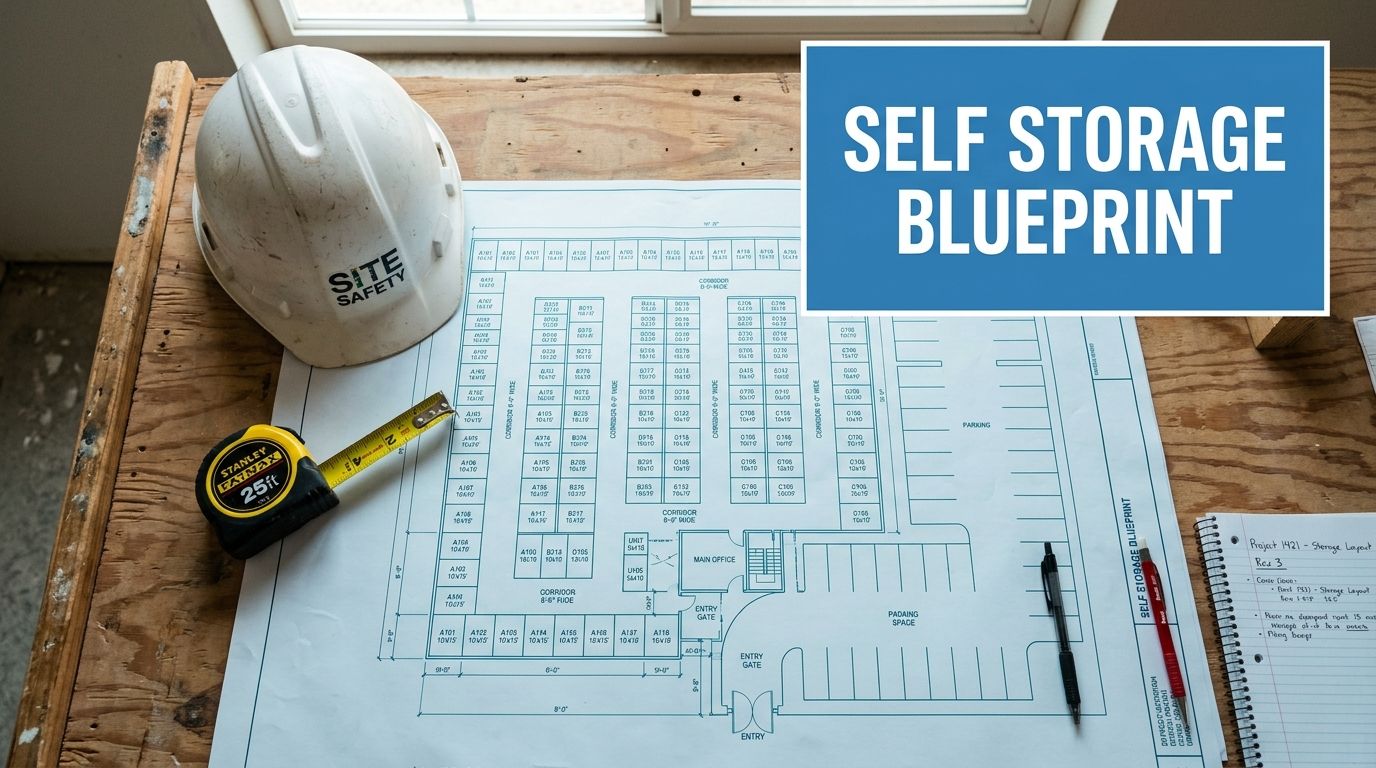
How to Design a Self Storage Site: Maximize ROI 2026
You're probably looking at one of two things right now. A plot that could take a purpose-built scheme, or an empty warehouse that feels underused and expensive to leave idle. In both cases, the same question matters more than any finish, cladding choice, or brochure rendering: will the site convert into rentable square footage efficiently enough to justify the capital?
That question matters even more in the UK than many developers first assume. The market still has a meaningful supply gap. The UK had 103 million net rentable square feet across 4,546 facilities in 2025, with only a 7.2% increase in total space over the prior year, far behind the US market's 2.6 billion NRSF and 69,400 facilities, according to Janus Europe's UK self-storage industry report 2025. That gap creates opportunity, but it also removes any excuse for wasteful design.
A profitable self storage facility is rarely the one with the most impressive planning pack. It's the one that handles land constraints, circulation, compliance, and unit mix in a way that keeps non-revenue space under control and opens for trade without expensive redesigns.
Your Blueprint for a Profitable Self Storage Facility
The first mistake developers make is treating self storage like a light industrial scheme with more doors. It isn't. A self storage site only works when the design, planning logic, customer journey, and operational model all support one outcome: as much lettable area as possible without making the building awkward, unsafe, or difficult to run.
In the UK, density isn't a nice extra. It's part of the commercial case. With the market still undersupplied relative to mature countries, every square metre lost to poor layout decisions hurts twice. You lose immediate income, and you reduce future optionality if you need to reconfigure the site later.
Three realities shape good schemes from the start:
- Land is tight in the strongest catchments. That pushes developers towards multi-level layouts, mezzanines, and conversion opportunities.
- Planning and compliance can derail weak designs. Drainage, fire protection, access, and use class assumptions all need to be addressed early.
- The right facility type depends on the asset. A new-build site gives control. A conversion can shorten delivery and capture value in the right location, but only if the shell is suitable for storage use.
Practical rule: Start with the revenue geometry of the site, not the architecture. If the grid, circulation, and service requirements don't work, no amount of aesthetic refinement fixes the return.
Designing a self storage site typically leads to a focus on floor plans. A decision process, however, is the fundamental requirement. That process starts before design drawings, runs through planning and construction, and ends only when the site is commissioned, secure, and ready for tenants.
The strongest projects are designed backwards from operation. You ask what the facility needs to do on day one, at stabilisation, and after future expansion. Then you shape the building around those answers. That applies whether you're developing from bare ground or inserting partitioning, mezzanines, lifts, and fire systems into an old retail or industrial shell.
The Foundation Site Selection and Feasibility
A developer agrees a purchase on what looks like the right building. The location is busy, the shell is cheap compared with a new build, and the appraisal works on a spreadsheet. Six weeks later, the scheme is under pressure because the slab loading is unclear, the access geometry is poor for vans, and the planning position is less straightforward than the agent suggested. That is how storage projects lose margin before design is properly underway.

Test the catchment before you test-fit the building
A site visit can create false confidence. Feasibility starts with demand, local competition, and the type of storage product the catchment will absorb.
Review nearby operators, visible occupancy signals, local housing churn, business density, and the quality of competing stock. A town with active domestic demand may still be weak for premium indoor storage if the existing market is dominated by low-cost drive-up space. The reverse also happens in tighter urban areas where land is scarce and customers will pay for clean, secure indoor space with good access.
If you are screening multiple locations, BatchData for sourcing real estate markets is a useful reference point for a more disciplined first pass. It does not replace UK self-storage judgement, but it helps narrow the field before time is spent on surveys, concept layouts, and consultant fees.
The commercial question stays the same in every appraisal. Does this catchment support the unit sizes, pricing level, and operating model the asset can realistically deliver?
New-build and conversion projects fail for different reasons
A UK-focused approach matters. Generic storage advice often assumes abundant land, simple zoning, and purpose-built facilities. Many UK developers are choosing between a constrained urban infill plot and an obsolete retail, trade counter, or light industrial building that may or may not convert efficiently.
New build gives control. The structural grid, floor levels, loading strategy, drainage design, service yard, and fire approach can all be set around the storage model from day one. That usually produces a cleaner operational result, but it can come with a longer planning route, more exposed build cost, and tougher viability in high-value locations.
Conversions can work extremely well in the right town. They can shorten delivery, reuse an underperforming asset, and place storage close to rooftops and small businesses. They also carry more hidden risk. I have seen schemes that looked attractive at acquisition stage become expensive once strip-out exposed roof defects, uneven slabs, awkward columns, poor clear heights, or service routes that cut straight through the most valuable lettable area.
A practical feasibility review should compare both routes against the same questions:
| Factor | New Build | Commercial Conversion |
|---|---|---|
| Structural grid | Set to suit corridor lengths, unit depths, and circulation | Existing columns and spans can reduce lettable efficiency |
| Floor loading | Designed for storage use | Must be verified, especially above ground floor and at mezzanine locations |
| Fire strategy | Built into the initial design | Often constrained by existing stairs, compartment lines, and escape distances |
| Planning position | More freedom on form, subject to local policy | Existing envelope may help, but use, façade changes, servicing, and neighbours still matter |
| Programme risk | More predictable once design is fixed | Hidden conditions can change cost and scope quickly |
| Location quality | Often weaker where land is scarce | Often stronger in infill, roadside, and town-centre settings |
For developers weighing layout efficiency in either route, this guide to an optimal self storage facility floor plan is a useful companion to early feasibility work.
Check the constraints that usually appear too late
Poor schemes rarely fail because one issue was impossible to solve. They fail because several manageable issues were missed at the same time.
Drainage is a common example. Surface water strategy, finished floor levels, and yard falls need proper engineering review early, particularly on sites with tight boundaries or reused external yards. Access needs the same discipline. A drawing can show vehicles entering and turning, but live operation is less forgiving when customers arrive in vans, trailers, or at peak weekend periods.
Planning also needs a hard-headed view. In the UK, storage proposals can run into questions around use, traffic impact, servicing, external appearance, flood risk, and neighbour amenity. Assumptions made in the acquisition phase should be tested with planning advice, not carried into the appraisal as fact.
On conversion projects, investigate the shell properly:
- Roof and envelope condition: Water ingress and deferred maintenance can turn a quick conversion into a major remedial job.
- Slab quality and levels: Storage fit-out tolerates less irregularity than some industrial uses.
- Clear height: The gross volume may look generous, but soffits, services, and transfer structures can reduce usable stacking and mezzanine options.
- Service capacity and routes: Power supply, fire water, drainage runs, and comms all affect cost and layout.
- Access and loading: Customer convenience and operational safety depend on more than a compliant drawing.
A tired warehouse with the wrong geometry can cost more to adapt than a clean new-build shell on a harder site.
Good feasibility work narrows the brief before design starts. It tells you whether the project should be a multi-storey urban facility, a simple drive-up scheme, a conversion-led indoor offer, or a hybrid built around the constraints of the asset and the realities of the local UK market.
Maximising ROI Through Layout and Unit Mix
The quickest way to lose profit in self storage is to draw a building that looks efficient but isn't. You don't earn from corridors, oversized lobbies, awkward dead ends, or circulation that customers hate. You earn from lettable space that's easy to access and easy to understand.

The 70 30 rule is where layout discipline starts
A reliable design benchmark is that 30% of the total site footprint should be allocated to non-letable space such as drive aisles, circulation, and access, leaving 70% as potential rentable floor area, according to this industry layout benchmark. That same benchmark notes that standard building separations often need 23–28 feet for turning radii, and tighter layouts can damage accessibility and operations.
That benchmark matters because many first-pass layouts look profitable only by cheating circulation. They assume narrow aisles, perfect reversing, and zero friction at busy times. Real customers don't move like that.
Design circulation for use, not for CAD neatness
A good circulation plan does three jobs at once. It keeps vehicles moving safely, makes loading intuitive, and avoids wasting frontage on unusable pockets.
For external layouts, draw from actual vehicle behaviour. Vans don't turn like hatchbacks. Customers pause, unload, and hesitate when they're new to the site. If the drive aisles are technically possible but operationally irritating, occupancy and customer retention suffer.
For internal schemes, pay attention to:
- Lift position: The lift should sit where upper-floor users can find it immediately, not after crossing half the building.
- Reception sightlines: Staff should be able to observe entry, loading areas, and key internal routes.
- Corridor legibility: Straightforward runs lease better than confusing internal mazes.
- Door rhythm: Consistent unit module widths simplify both build and future reconfiguration.
If you're reviewing potential layout options, this guide to an optimal storage facility floor plan is a useful reference for how rentable area, circulation, and customer flow need to work together.
Unit mix should follow local demand
There's no universal perfect unit mix. The right balance depends on who's likely to rent at that location. Dense residential catchments often support a larger share of smaller internal units and lockers. Trade-led areas may justify more mid-sized and larger units with easier vehicle access.
The mistake to avoid is overloading the scheme with one category because it looks tidy on a plan. A floor full of tiny units can underperform if the local market really wants practical mid-size spaces. The opposite is also true. Rows of larger units can suppress yield if local demand skews smaller.
A sensible way to think about mix is by user type:
- Domestic movers and declutterers usually need straightforward, mid-range unit sizes.
- Students and short-stay users often prefer smaller spaces and simple access.
- Small business occupiers value loading convenience, security, and regular rectangular units that store stock properly.
- Archive and specialist users care more about internal environment, access control, and operational reliability than frontage.
Design note: Don't finalise unit mix from a spreadsheet alone. Walk competitor sites if you can. The fastest way to spot planning mistakes is to see which unit types are easy to let and which ones sit in awkward corners.
Use the third dimension properly
In the UK, high-yield schemes often depend on vertical efficiency. That can mean mezzanine floors inside a conversion, full additional storeys in a new build, or a hybrid of internal lockers and standard units that monetises height rather than just footprint.
Vertical design works well when it's coordinated early. It fails when a developer decides to “add a mezzanine later” without resolving stairs, lifts, loading routes, fire separation, and floor loading. Those decisions aren't add-ons. They shape the whole building.
A profitable layout usually has these traits:
| Layout choice | What works | What doesn't |
|---|---|---|
| Corridor planning | Short, legible routes with clear destination points | Long dead-end runs that create dark or confusing areas |
| Vertical access | Lift and stair cores located near loading and reception | Upper floors reached through hidden or awkward routes |
| Unit geometry | Regular modules that can be resized later | Irregular leftover spaces turned into weak units |
| Front-of-house | Compact reception with strong visibility | Oversized office areas consuming prime floorplate |
Good self storage design is really a series of refusals. Refusing wasted corners. Refusing oversized service areas. Refusing layouts that look elegant but compromise revenue.
Core Structural and System Requirements
A self-storage scheme starts losing money the moment the structure forces operational compromises. I see this most often in UK conversions, where a building looks viable on a viewing day, then starts fighting the brief once the surveys come in. Uneven slabs, awkward column grids, limited headroom, poor loading doors, and inherited services can all erode net lettable area if they are not handled early.

Partitioning and the value of flexibility
Internal partitioning should be specified as part of the operating model. It affects how quickly the facility can be installed, how easily unit sizes can change, how well the building wears over time, and how credible the product feels to a customer walking the corridors for the first time.
That matters in both new-build and conversion work, but for different reasons. A new-build gives you cleaner geometry and better coordination with services. A conversion usually gives you more constraints and more upside if you design around them properly. Older industrial and retail buildings often contain irregular bays, non-standard wall lines, redundant plant areas, and structural intrusions that need a disciplined system rather than ad hoc infill.
The best specification questions are practical:
- Can the unit mix be adjusted later without stripping out large sections?
- Will the system coordinate cleanly with mezzanine edges, soffits, and fire-stopping?
- Does the finish match the rent level you want to achieve?
- Are lead times and installation sequencing realistic for the programme?
For developers assessing integrated supply and installation, self-storage construction materials from PSL show the typical components used for partitions, doors, mezzanine structures, and associated fit-out packages.
Mezzanines, floors, and load paths
Extra floor area only improves return when customers can use it comfortably and the structure can support it without expensive correction works. Mezzanines are often right for constrained sites, especially in the South East where land values put pressure on yield, but they need proper coordination from the start.
In a new-build, the frame, slab, stair cores, and goods movement can be set up around the storage operation. In a conversion, the first question is whether the existing building is suitable for a second level. Headroom, slab condition, structural capacity, column spacing, and loading routes all need to be checked before upper-floor income goes into the appraisal. I have seen schemes overvalue mezzanine space that later proved awkward to access, dark, or too constrained for easy customer use.
Foundations and slab performance deserve the same attention. Even where the final design is being handled by local engineers, broader references on commercial concrete foundation construction are useful for checking assumptions around tolerances, base preparation, and long-term floor performance.
Fire, stairs, and compliance are design drivers
Fire strategy sets hard limits on how efficiently you can plan the building. In UK projects, especially larger facilities and multi-storey conversions, protected stairs, compartmentation, service penetrations, alarm interfaces, and possible sprinkler requirements can all affect net lettable area and build cost.
The sequence matters. Agree the likely fire approach early with the design team and approving bodies. Fix escape stairs and protected routes before locking in partition runs. Coordinate sprinkler heads, lighting, detectors, shutters, and soffit conditions with the unit layout before procurement starts. If that work happens late, the usual result is lost units, awkward ceiling zones, or expensive rework.
A badly positioned stair enclosure can wipe out the value of an otherwise efficient floor plate.
MEP and operational durability
Most self-storage buildings do not need complicated building services. They need services that are easy to maintain, easy to isolate, and appropriate for long trading hours. Lighting, ventilation, CCTV, access control, fire alarms, gate systems, and data routes all have to work reliably without eating into revenue space.
This is one of the clearest differences between a paper exercise and a buildable scheme. New-build projects usually allow cleaner service distribution and fewer surprises. Conversion projects can hide expensive MEP problems in ceiling voids, roof penetrations, obsolete plant rooms, and legacy electrical infrastructure. If those issues are not surveyed properly, the fit-out package starts competing with the building fabric for space and budget.
The strongest facilities are technically straightforward. Staff can access plant and controls without disrupting customers. Contractors can maintain systems without opening up finished areas. Future reconfiguration stays possible because the building was designed as an operating asset, not just a fitted-out shell.
Designing for Access Security and Operations
A modern storage facility is part property asset, part operating business. If the building is hard to enter, hard to get around, or hard to trust, customers notice immediately. That affects move-ins, staff workload, complaints, and ultimately pricing power.
Security starts at the perimeter, but it doesn't end there. A facility needs layered protection. Perimeter fencing and gates deter casual intrusion. Reception placement, lighting, access zones, CCTV coverage, and internal movement control do the rest. If you're comparing perimeter options, a practical reference is this complete guide to commercial security, which is useful for thinking through how fencing and gate design fit into wider site operations.
Access should feel controlled, not complicated
The best access systems reduce friction while keeping clear records of movement. That usually means gate entry, coded or app-based access, timed permissions, and controlled internal doors where required. The exact technology varies by business model, but the principle stays the same: tenants should understand the journey on their first visit without staff intervention.
Design the approach in layers:
- Arrival layer: Entry gate, clear signage, and enough stacking space so vehicles don't block the road.
- Transfer layer: Loading bays, trolleys, lifts, and door widths that support real use.
- Internal layer: Controlled movement into storage zones, with visibility and audit trails.
- Exception layer: Out-of-hours access, emergency override, and simple procedures for lockouts or faults.
Security design and brand positioning
A facility that feels safe can support a more premium offer. That doesn't mean overbuilding every security feature. It means placing the right ones where customers experience them.
Visible CCTV at key decision points matters more than cameras hidden everywhere. Good lighting in loading areas matters more than decorative fittings in reception. Staff sightlines matter because people behave differently when a site feels observed and organised.
Customers rarely describe a facility by its partition gauge or fire rating. They describe whether it felt secure, simple, and professional.
Operational design saves cost every day
Plenty of sites look acceptable at handover and become frustrating within weeks because no one designed for routine operation. Think about staff routes, lock checks, cleaning, waste handling, alarm response, and maintenance access while the plan is still fluid.
Operationally strong schemes usually include:
| Operational area | Good design choice | Common mistake |
|---|---|---|
| Loading | Dedicated bays with easy trolley movement | Shared space that becomes blocked by parked vehicles |
| Upper floors | Safe stairs, practical lift access, clear wayfinding | Relying on customers to guess routes |
| Reception | Compact, visible, and defensible | Oversized desk area with poor sightlines |
| Maintenance | Accessible plant and service zones | Equipment hidden behind unit runs or inaccessible ceilings |
The sites that run smoothly aren't necessarily more complex. They're better thought through.
Phasing Construction and Modelling Your Return
Construction sequence has a direct effect on return. If trades overlap badly, internal systems get damaged, commissioning drifts, and opening dates move. Every lost week delays income while finance, rates, and contractor costs keep running.

Build in a sequence that protects the asset
Self storage projects benefit from disciplined phasing. The building envelope should be secure and weather-tight before sensitive internal components go in. Major structural works need to finish before partitioning, access systems, and final electrical coordination.
A practical sequence usually looks like this:
- Groundworks and structure
- Envelope and weatherproofing
- Primary MEP and fire infrastructure
- Mezzanines, lifts, and stairs
- Partitioning and doors
- Security, access control, lighting, and commissioning
- Operational setup and staged opening
When that order gets compressed carelessly, problems multiply. Partitioning gets installed before service routes are final. Fire interfaces get redesigned late. Finished surfaces get damaged by follow-on trades.
Use phasing as a commercial tool
Not every facility needs to open in full from day one. On the right project, phased delivery can reduce initial capital strain and let the operator open income-producing sections while later stages continue.
That approach works especially well where demand is clear but the full build-out would overextend cash at the start. It also helps in large conversion projects where part of the shell can be stabilised and commissioned ahead of the remainder.
The UK pipeline supports that disciplined thinking. 82 new self-storage sites are expected to be developed or acquired by 2026, up from 70 sites in 2024, while rental rates per square metre across Europe grew by 5.4% to €312.56. The same projection set notes a projected UK market valuation of USD 2.4 billion by 2034 at a CAGR of 6.02%, according to Statista's UK self-storage development outlook.
Those figures don't guarantee any individual scheme will perform. They do support a clear point: developers entering this market need designs that prioritise return, speed to revenue, and the ability to scale.
Model return from the building you can actually deliver
A proper appraisal should be based on the actual design, not the optimistic sketch. If the fire strategy removes rows of units, if the lift core takes more area than expected, or if circulation expands to solve access, the revenue model needs to reflect that immediately.
Build your return model around these inputs:
- Net rentable area based on actual coordinated drawings
- Likely leasing pattern by floor and unit type
- Opening strategy, including phased availability if relevant
- Operational staffing and system requirements
- Capital timing, not just capital total
If you're stress-testing project viability, a specialist cost reference such as self-storage construction costs can help frame realistic budgeting discussions around build scope, fit-out components, and phasing options.
Commercial insight: A scheme doesn't become low risk because the shell is cheap to buy. It becomes low risk when the route from acquisition to lettable area is clear, coordinated, and financeable.
Developers often focus on headline construction cost and miss the more important issue: how quickly the site can become a functioning storage business. A faster, cleaner route to opening can outperform a nominally cheaper build that spends months in redesign or partial completion.
The Final Mile Handover and Operations Checklist
The last stage is where capital projects either become operating businesses or stay half-finished in practical terms. Handover needs structure. If it doesn't, the site opens with unresolved snags, confused staff, and systems that haven't been tested under live conditions.
Commission every critical system
Before opening, every operational system should be tested as a connected whole, not in isolation. That includes access control, CCTV, alarms, lighting controls, fire interfaces, lifts, shutters, and any remote management tools.
Use a formal handover checklist that covers:
- Life safety systems: Fire alarm cause-and-effect, emergency lighting, stair protection, and any sprinkler integration
- Access and security: Gate controls, keypad or app permissions, CCTV recording, and audit logs
- Building fabric: Doors, seals, drainage performance, wayfinding, and final snagging
- Trading readiness: Reception systems, unit numbering, pricing setup, customer documentation, and lock sales
Train the operating team in the real building
Even a highly automated site still needs people who understand the facility. Staff should know how customers move through the building, where operational pinch points sit, how to respond to access issues, and what to do during an alarm, power issue, or out-of-hours call.
Don't limit training to software. Walk the site. Test move-in scenarios. Run a loading exercise. Check upper-floor access with a real trolley. Make sure the team can manage the building you've delivered, not the one described in a design meeting months earlier.
Open with discipline
A professional launch is usually quieter and more controlled than developers expect. It's better to open with tested systems and clear procedures than to chase a date with unresolved details. Final permits, certifications, O&M information, maintenance responsibilities, and defect procedures should all be tied down before the first tenant arrives.
Good handover protects the investment. It also protects the brand. Customers notice the difference between a facility that feels finished and one that still behaves like a construction project.
If you're planning a UK self storage development, Partitioning Services Limited can support the process from layout planning and compliance coordination through manufacture, installation, commissioning, and handover for partitioning, mezzanine flooring, lockers, garage units, and related self-storage systems.

Self Storage Planning Permission: Your 2026 Guide
You secure a site that looks commercially sound. It has decent visibility, workable access, and enough space to make the layout stack up. Then the planning position starts to bite, and a scheme that looked profitable in a spreadsheet begins to absorb time, consultant fees, and avoidable risk.
That is the point where return on investment is either protected or eroded.
The early mistakes are predictable. Buyers assume containers are temporary and therefore outside the planning system. Land is purchased or leased before anyone checks whether the proposed operation amounts to a material change of use. A modest planning budget is set, then transport input, flood risk work, ecology, landscaping, drainage, and application amendments start pushing the cost higher.
The sector is still active, with industry forecasts pointing to around 82 new self storage sites being developed or acquired by 2026. That matters for two reasons. Competition for the right sites is tighter, and local planning authorities are becoming more familiar with these proposals, which means weaker applications get tested harder.
In practice, self storage schemes rarely come unstuck because demand was misread. They fail because the planning strategy was too thin, too late, or based on the wrong assumptions. The job is not just to secure permission. It is to secure it on a timescale and cost base that still leaves the project worth doing.
At PSL, we treat planning as a commercial risk exercise from the outset. That means identifying what could slow approval, what could trigger expensive technical work, and what should be resolved before a client commits too much capital. Done properly, planning is not an administrative hurdle. It is one of the main controls on programme, capex, and exit value.
Your Essential First Step in Self Storage Development
The first useful question isn't “How fast can we install units?” It's “What exactly is the planning authority being asked to approve?”
That sounds obvious, but it changes everything. A site can look perfect operationally and still be poor planning stock. I've seen sites with strong road frontage and plenty of hardstanding turn into awkward propositions because turning movements weren't convincing, neighbouring uses were sensitive, or the planning narrative was muddled from day one. A weaker-looking site can outperform if the planning logic is clean.
Start with the land, not the units
Most clients arrive focused on layout. They want to know whether container rows fit, whether a drive-up format works, or whether a multi-level internal scheme yields more lettable area. Those questions matter, but they come after the planning position is understood.
Your first pass should test four things:
- Current lawful use: What is the land or building already authorised to do?
- Context: What sits around it? Housing, open countryside, retail, heavy industrial uses, protected land?
- Access reality: Can customers, service vehicles, and emergency vehicles move safely without causing a planning headache?
- Constraint profile: Are there obvious issues around flood risk, ecology, visual impact, or local policy resistance?
If any one of those points is weak, the project needs a different strategy before drawings start.
Practical rule: A site isn't “good for self storage” because units fit on it. It's good when the planning case, access strategy, and operating model support one another.
The commercial stakes are front-loaded
Developers often underestimate how many later decisions are locked in by early planning assumptions. If you choose the wrong route at the start, you can end up redesigning access, changing the unit mix, reducing stacking, or accepting operational conditions that weaken revenue.
A disciplined first review should answer questions such as:
| Question | Why it matters commercially |
|---|---|
| Is the intended use clearly defined? | Unclear applications invite objections and requests for revisions. |
| Does the layout support safe circulation? | Weak circulation can trigger redesigns and reduce usable space. |
| Are neighbours likely to object? | Objections can slow decisions and push restrictive conditions. |
| Is the project viable under planning constraints? | Some approvals look positive until conditions reduce how the site can trade. |
The point isn't to predict every council comment. It's to remove avoidable uncertainty before you commit serious capital.
Understanding Use Class and Change of Use
A developer secures a yard, prices the container layout, and assumes the planning risk sits in fencing, lighting, or appearance. The bigger risk usually sits in one earlier question. What use is the council being asked to approve?

Why B8 matters
Self storage commonly falls within B8, the class used for storage and distribution. That point sounds straightforward, but it affects the whole planning strategy. If the authority accepts the proposal as storage-led, the discussion usually centres on policy fit, traffic profile, servicing, neighbour impact, and how the site will operate day to day.
Problems start when the proposed use is described too loosely. A scheme that is presented as a few containers on spare land can look informal or temporary. A scheme described properly as a managed self storage operation gives the officer something clearer to assess. That usually improves the quality of the conversation and reduces the risk of late-stage requests for revisions.
What actually triggers consent
The key issue is usually material change of use. Councils are assessing the activity on the land, not just the presence of containers, partitions, or buildings.
That distinction affects return on investment. One container used by an occupier to store its own tools may sit within the existing lawful use, depending on the facts. A site arranged as multiple units for paying customers is different. It creates a public-facing storage business with its own traffic patterns, security arrangements, hours of access, signage, and management requirements. In practice, that often needs planning permission even where the physical works look modest.
Projects often lose time. Applicants focus on the structures because they are visible and easy to draw. Officers focus on the operational change because that is what drives planning impact.
The classification point that shapes the whole application
Use class is not a box-ticking exercise. It influences how you should frame the proposal from the start.
For example, a warehouse subdivision for internal self storage can sit more comfortably within an existing industrial context than an open yard with externally accessed containers and frequent customer visits. Both may point toward storage use, but the planning arguments are not the same. The first may turn on internal alterations, parking, and fire strategy. The second often attracts closer scrutiny on visual impact, access, drainage, boundary treatment, and neighbour amenity.
Developers considering conversions should review the wider design and operational implications alongside the planning position. PSL's guide to warehouse and self-storage development considerations is useful for that reason.
Ownership and occupation still need checking
Planning status is only part of the risk profile. Site control documents can undermine a viable-looking scheme.
Before detailed design work starts, check whether the lease or title supports the proposed use. A landlord may permit storage in broad terms but restrict customer access, external alterations, signage, or security infrastructure. Shared access routes can create another problem if the legal rights are narrow but the business model depends on regular customer vehicle movements. If the site is leasehold, it also helps to compare land leases and land-use rights before capital is committed.
A practical review should cover:
- Permitted use under the lease or title: Does it allow self storage as a primary commercial activity?
- Customer access rights: Can visitors, delivery vehicles, and emergency services use the access as proposed?
- Physical alterations: Are fences, lighting columns, gates, signage, and container placement permitted?
- Ancillary or primary use: Is storage secondary to an existing occupier, or is it the main business?
- Future trading flexibility: Would the legal position support expansion, reconfiguration, or a denser operating model later?
The commercial trade-off is simple. Early clarity on use class and change of use can shorten the planning route and protect the operating model you underwrite. Getting it wrong can still produce a consent, but with conditions or layout changes that reduce usable space, restrict access, and weaken income.
The Application Process Deconstructed
Good applications don't just contain the right forms. They manage the order of decisions so that the council never has to guess what the scheme is trying to achieve.

What happens before submission
The strongest applications are shaped well before they are uploaded. That usually starts with pre-application engagement. You present the broad proposal, test the authority's main concerns, and identify which technical reports will carry the most weight.
This stage is where weak assumptions get exposed. A developer might think the major issue is appearance, while the officer is far more concerned about access geometry, flood vulnerability, or biodiversity. It's much cheaper to hear that before the full submission is assembled.
A sensible pre-app agenda usually covers:
-
Use and policy fit
Confirm how the authority is likely to classify the scheme and whether the proposed use aligns with local policy. -
Site constraints
Ask directly about Green Belt, flood risk, ecological matters, natural setting sensitivity, and heritage context if relevant. -
Operational profile
Explain customer visits, delivery patterns, staffing, security, hours, lighting, and whether the site is container-based or within an existing building.
What councils expect in the live application
Once the project moves to full application, the emphasis shifts from concept to evidence. The council wants drawings that are coherent, reports that answer foreseeable objections, and a site layout that looks operationally credible.
The usual path includes validation, consultation, officer assessment, and then a decision. On paper the statutory period can feel manageable, but real-world programmes often stretch when supporting information is incomplete or key constraints surface late. For commercial self-storage sites, Cleveland Containers' planning guidance notes that delays can extend to 6 to 12 months where issues such as Green Belt status or flood risk aren't addressed early.
On-site reality: Councils rarely object to a well-defined self storage concept as strongly as they object to uncertainty around traffic, visual impact, drainage, and ecology.
A realistic project manager's sequence
| Stage | What you should be doing |
|---|---|
| Pre-app review | Pressure-test the use, layout, and likely objections |
| Technical scoping | Commission only the reports the site genuinely needs, but don't under-scope |
| Submission | Present one clear operating model, not a vague mix of possibilities |
| Consultation | Respond quickly to officer queries and neighbour concerns |
| Decision phase | Review conditions commercially, not just legally |
The final point is often missed. A consent with restrictive conditions can still be a bad commercial outcome if it limits access hours, stacking, signage, lighting, or future layout changes.
Assembling Your Technical Document Arsenal
A self storage application can look polished and still stall because the documents do not answer the authority's real concerns. The strongest planning packs do more than satisfy a validation checklist. They remove doubt early, shorten the back-and-forth with officers, and reduce the risk of expensive redesign after submission.

Each document should resolve a specific planning risk
Developers lose time when reports are commissioned as a box-ticking exercise. I see it regularly. The architect produces one story, the transport consultant assumes another, and the planning statement tries to hold the package together after the fact.
A better method is to define the risk each document is there to deal with.
- Site location and block plans show how the scheme fits the plot, how close activity sits to boundaries, and whether vehicle circulation works in practice.
- Design and Access Statement explains why the layout, scale, frontage treatment, and customer movement make sense for that site rather than for a generic industrial yard.
- Transport information addresses whether the proposed access, turning, parking, and delivery activity are acceptable on the local road network.
- Drainage and flood material shows how surface water will be controlled and whether the site remains workable during heavy rainfall.
- Environmental reports deal with issues such as ecology, contamination, arboriculture, or visual impact where those constraints apply.
- Noise assessments matter where residential edges, schools, or other sensitive neighbours sit close to access roads, loading areas, or external units.
The point is simple. Every report needs a job.
Coordination matters as much as content
Authorities notice contradictions quickly. If one document describes low-intensity customer visits but the swept-path analysis is built around frequent larger vehicle movements, confidence drops. If the drawings show planting along an edge that operations later need for reversing or security fencing, the scheme starts to look unresolved.
That is where cost creeps in. Officers ask follow-up questions. Consultants revise drawings. Consultation periods can stretch while the application is clarified. A cheap initial package often becomes the expensive option.
The planning set should be built around one clear operating model. Access, servicing, drainage, landscaping, fire strategy assumptions, and visual treatment all need to support the same version of the scheme.
The best technical packs feel coordinated before the case officer has to test them.
Leave late-stage compliance issues out, and the layout can unravel
Biodiversity is now a live planning issue on many self storage sites, particularly where hardstanding, boundary treatment, and external works dominate the design. If biodiversity net gain or habitat impacts are considered only after the layout is fixed, you can end up redrawing circulation space, bin stores, fencing lines, or green strips at the worst possible point in the programme.
The same applies to building control and fire planning. They sit in different approval regimes, but they are commercially linked. A layout that works on a planning drawing can become awkward if later technical design requires different separation distances, fire access, escape routes, or construction details. For that reason, many clients review building regulations requirements for self storage projects while the planning package is still taking shape.
That early coordination protects programme and margin. It also avoids a common trap. Consent is granted, then the technical team discovers the approved layout is harder to build or operate than it first appeared.
What a well-evidenced planning pack looks like
A submission that tends to progress more smoothly usually shares four traits:
- Site-specific reasoning. The reports refer to the actual constraints and neighbours, not generic wording recycled from another storage scheme.
- Operational clarity. Officers can see how customers arrive, where staff operate, how vehicles turn, and how the site functions on a normal day.
- Consistent drawings and narratives. The plans, planning statement, transport assumptions, and mitigation measures all line up.
- Mitigation that can be delivered. Planting, lighting controls, drainage features, boundary treatment, and acoustic measures are practical to install and maintain.
That is the difference between a file that just enters the system and one that gives an officer confidence to support it.
Common Planning Conditions and Mitigation Strategies
Permission doesn't end the risk. Conditions often decide whether the approved scheme still works as a business.
The conditions that reshape operations
For self storage, common conditions usually deal with hours of operation, external materials, boundary treatment, landscaping, lighting, drainage, and site management details. None of those are unusual. What matters is how they interact with your operating model.
A restriction on hours can affect remote access plans or reduce appeal to commercial tenants. A detailed landscaping condition can consume circulation space if the layout was drawn too tightly. A lighting condition can improve neighbour relations but also affect security design if left unresolved until after consent.
The smart approach is to pre-empt likely concerns
Developers often react to draft conditions after the decision notice arrives. That's late. A better tactic is to build mitigation into the application itself so the officer sees a managed scheme rather than a risky one.
If the site sits near homes, show acoustic thinking early. That could mean fencing, layout orientation, or limiting activity near sensitive boundaries. If visibility is an issue, present a cleaner frontage treatment and controlled signage strategy from the start. If ecology is delicate, don't force the authority to imagine your mitigation. Put it clearly into the plans and narrative.
Consider this basic comparison:
| Reactive approach | Proactive approach |
|---|---|
| Wait for noise concerns to appear | Design boundary treatment and activity zones early |
| Leave lighting to a condition | Submit a lighting concept aligned with security and neighbour impact |
| Treat landscaping as decorative | Use it to soften visual impact and support the planning argument |
| Accept vague management wording | Define how the site will function in practice |
Conditions are easier to shape before approval than to loosen afterwards.
Protect flexibility where it matters
Not every condition is worth fighting. Some are routine and manageable. The ones that deserve close attention are the ones that affect trading flexibility, future expansion, stacked layouts, customer access, and the ability to adapt the site as demand changes.
That's where experienced project management earns its keep. The planning outcome needs to be read through an operational lens. A consent that looks clean in planning language can still underperform if it subtly narrows the business model.
Protecting Your ROI with Advanced Tactics
Most planning guides stop at forms, drawings, and timelines. That's not enough if the objective is to protect return on investment.
Challenge assumptions that cost money
One of the least understood issues in container-based self storage is how some councils assess planning fees for dual-stacked sites. The legal point is important. Permission generally turns on the use of land, not the total volume created by stacking units.
That's why fee calculations can go wrong. A frequently raised issue in the sector is that while the standard change-of-use fee is around £650, some councils have charged up to £10,000 for double-stacked schemes by calculating against container floor area rather than the land use basis, as discussed in this industry video on self-storage planning fee calculations. If nobody checks the basis, that overpayment lands straight in your development cost.
What to do when the fee looks wrong
Don't assume the authority's first figure is beyond challenge. Check the description of development, the planning unit being assessed, and whether the proposal is being treated as a land-use application or as something broader than the law requires.
The commercial discipline is simple:
- Ask for the fee basis in writing: You need to see how the authority reached the figure.
- Review the development description: Poor wording can invite the wrong calculation.
- Check stacked schemes carefully: Vertical arrangement can confuse fee treatment.
- Escalate early and politely: It's easier to correct before validation drags on.
That isn't just a technical win. It preserves budget for the parts of the project that increase value, such as access improvements, drainage, fit-out quality, and fire strategy.
The cheapest planning mistake is the one you catch before the application is validated.
Speed comes from fewer surprises
The other advanced tactic is less dramatic but just as valuable. Applications move faster when stakeholders feel consulted before they feel threatened. Nearby occupiers, estate managers, landlords, and even ward-level local interests can become friction points if they first encounter the project through a formal notice.
Early engagement doesn't guarantee support, but it often narrows the objection range. It also gives you time to refine site management details before they harden into formal criticisms.
Insurance thinking belongs in this same early-risk category. UK projects need UK-specific advice, but it's often useful to see how operators in other jurisdictions frame operational risk, customer goods, and site liability. For broader context, Coverage Axis Virginia self-storage policies show the kind of practical risk issues serious operators examine alongside planning and development.
Case Examples and Pan-European Considerations
A planning strategy that works for one self-storage scheme can fail badly on another. I have seen urban sites stall over servicing details that looked minor on paper, while simpler rural proposals ran into refusal because the commercial intent was not stated clearly enough from the start. The asset type changes the pressure points, the cost risks, and the quickest route to consent.
Three project types that behave differently
A city-centre multi-storey scheme is usually tested on scale, access, servicing, and impact on adjoining occupiers. The commercial case often depends on building upward, so every floor has to justify itself in planning and in operation. If the vehicle route is awkward, the frontage feels defensive, or customer movement is not clear, the authority may treat the proposal as overdevelopment even where demand is strong. The practical lesson is simple. Resolve the arrival sequence, service yard logic, and street presence early, because redesigning those items after submission burns time and consultancy budget.
A rural container scheme creates a different planning argument. The authority will look closely at visual impact, traffic on local roads, hours of activity, lighting, and whether the proposal still reads as part of a wider farm diversification strategy or as a standalone commercial depot. Trying to keep that distinction vague is a common mistake. A sharper planning statement, supported by realistic drawings and a credible operating model, usually does more for approval prospects than optimistic wording about limited impact.
An industrial retrofit often gives the cleanest route to value, but it still needs discipline. Existing access, estate character, and lawful use can make the principle easier to support, yet the project can lose margin later if fire separation, loading patterns, unit mix, and customer circulation are treated as separate decisions. Developers taking that route often benefit from settling the operating model first through practical guidance on starting a self-storage business in the UK, then testing whether the building can support it without expensive compromise.

Working across Europe changes the detail, not the discipline
European projects vary in terminology, approval routes, fire standards, and the level of detail expected by local authorities. The investment logic does not change. The operator still needs certainty on lawful use, a layout that works commercially, technical information that matches the scheme being priced, and planning conditions that do not subtly erode revenue after consent.
That matters most where investors assume a permission in one country can be repeated with minor edits in another. It usually cannot. Parking ratios, façade expectations, transport assessments, environmental studies, and neighbour consultation can all shift the programme and cost base. The hidden risk is not only refusal. It is securing consent on terms that reduce net lettable area, restrict hours, add off-site works, or trigger design revisions late in procurement.
Partitioning Services Limited handles design, manufacture, installation, and project management for self-storage schemes across the UK and Europe. That joined-up role helps keep planning strategy tied to buildability, fire protection, programme control, and rentable-area efficiency, rather than letting approval work drift into a separate paper exercise.
If you are assessing a site and need a clear view on self storage planning permission, Partitioning Services Limited can support the process from early feasibility through layout planning, compliance coordination, manufacture, installation, and commissioning. The value is practical. Planning-aware design input at the front end helps prevent mistakes that cut into programme certainty and return on investment.
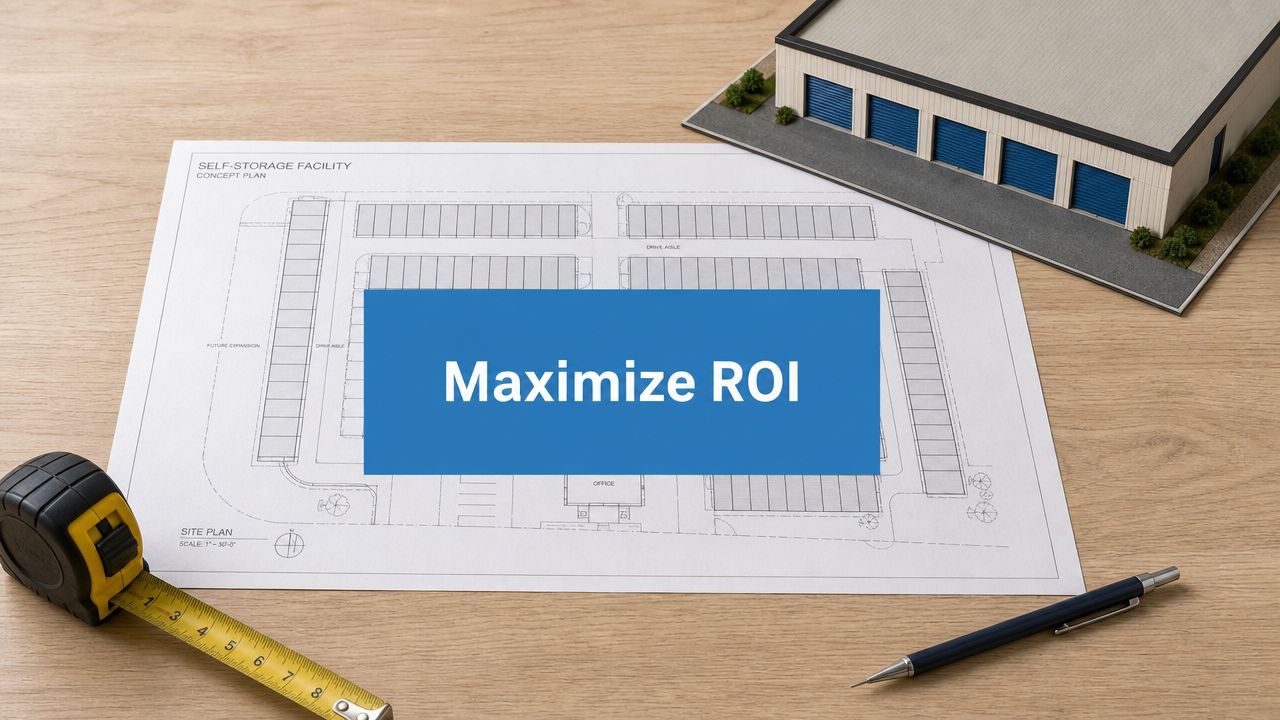
Self Storage Unit Layout Planning: Maximize UK ROI
A layout can look efficient on a drawing and still underperform from the day you open.
I've seen schemes lose money in places that looked minor during design. Trim a drive aisle too hard and you may squeeze in a few more units, then spend years dealing with awkward van movements, slower access, scuffed doors, and frustrated customers who do not come back. Put the office where staff cannot see the gate line clearly and payroll starts covering problems that better positioning would have prevented. Build the wrong unit mix and you end up with square footage that is lettable on paper but discounted in practice.
That is the commercial reality of self storage unit layout planning. The layout decides how much of your build cost turns into income, how much staffing the site needs, how quickly customers can move in and out, and how many avoidable operational issues your team handles every week.
Small choices carry long tails. An extra metre of corridor or a slightly oversized plant area may not look expensive during planning, but multiplied across the scheme it can remove rentable area for the life of the asset. The reverse is also true. Pushing density too far can cut service quality, increase damage risk, and slow lettings. Good layouts balance yield with usability, because poor customer flow shows up later as lower occupancy, more discounting, and higher management time.
Developers who get this right treat the layout as a financial model in physical form. They test circulation, visibility, unit mix, loading access, and expansion potential before they fix walls and doors. Teams using modern AI workflows for commercial blueprints can review those options faster, but the judgement still comes down to a simple question. Does each layout decision increase durable revenue without creating avoidable operating cost?
That is the standard worth using from the first sketch.
Laying the Groundwork Your Site and Its Constraints
A developer takes on a former trade yard, sees enough acreage for a healthy unit count, and pushes ahead. Six months later, the drainage design has cut across the preferred building line, the entrance cannot handle two vans passing cleanly, and the retaining works have swallowed a chunk of the contingency. The site still gets built. It just costs more, lets slower, and carries lower yield than the appraisal suggested.
That usually starts with reading the site as empty space instead of constrained commercial ground.

Start with what the land will let you do profitably
The first draft should come from the survey, access review, planning position, drainage strategy, and utility constraints. Unit lines come later. If the site falls away hard to one boundary, or if the drainage outfall sits in the wrong corner, those facts shape the build far more than any early sketch of corridors and doors.
Slopes matter because they affect more than construction cost. They can force awkward finished floor levels, longer ramps, stepped thresholds, and water management problems that show up later as maintenance calls and customer complaints. A cheap-looking layout on paper can become an expensive one once retaining walls, extra surfacing build-up, and revised service routes are priced properly.
I always want four things tested before the footprint is treated as fixed:
- Levels and earthworks: Identify where cut and fill starts driving cost above the value of the extra lettable area.
- Drainage and surface water routes: Keep runoff away from loading areas, entrances, and slab edges.
- Vehicle movement: Check real van turning paths, not idealised car movements.
- Planning and legal constraints: Confirm setbacks, easements, visibility splays, rights of way, and service corridors early.
If circulation only works with tight turns, blind reversing, or awkward waiting positions at the gate, the problem is the layout.
Site geometry decides long-term operating efficiency
Developers often focus on whether buildings fit. The better question is whether customers, staff, deliveries, and contractors can use the site without friction every day.
A narrow frontage can be more damaging to income than a smaller total plot if it creates queuing at the entrance or weak visibility from the road. An irregular boundary can leave expensive scraps of unusable land between buildings. A corner that looks harmless on the title plan may become dead space once fire access, fencing offsets, and service trenches are added. Those losses are permanent. They reduce net rentable area for the full life of the asset.
This is why early option testing matters. Teams using modern AI workflows for commercial blueprints can compare circulation, building orientation, and service placement faster, but the value comes from better decisions, not prettier drawings.
For a useful reference point on how experienced suppliers approach these trade-offs, this guide to an optimal storage facility floor plan shows how layout choices affect usable space and day-to-day site function.
Treat access and servicing space as revenue decisions
Access widths, turning heads, bin areas, plant zones, and fire routes are not leftover planning items. They are part of the income model because they decide how much space can be sold without creating service problems.
Inexperienced schemes encounter problems because they chase density, squeeze the drive aisles, then discover the site is harder to insure, harder to manage, and less attractive to the customers who bring in stable revenue. On the other hand, overgenerous circulation can subtly remove a meaningful amount of lettable area. The right answer is rarely the maximum building footprint or the maximum open yard. It is the balance that keeps the site easy to use while preserving enough net rentable space to justify the land and build cost.
Drive-up layouts make that trade-off especially clear in the UK market. They are simple to understand and easy to sell, but they consume land quickly because access space does a lot of the work. On tighter or higher-value sites, that can weaken returns unless the rent premium and local demand sufficiently support the lower density.
Place the office where it reduces staff time and customer friction
The office should control the site, not hide inside it.
If the reception point sits beyond the gate or off to one side with poor sightlines, staff spend more time handling avoidable access issues, move-ins take longer, and first impressions suffer. Good office placement shortens the path between arrival, enquiry, ID check, payment, and move-in. It also improves visibility over the entrance, loading activity, and customer flow, which cuts small operational problems before they become regular staff tasks.
A practical layout sequence usually works best:
- Fix the immovable constraints first. Survey data, drainage, planning lines, utilities, and fire requirements come before unit planning.
- Test entry and circulation with real vehicles. Include vans, removal vehicles, and conflict points near the gate.
- Set the office for visibility and control. Customers should find it immediately on arrival.
- Optimise buildings after the site logic works. Rentable area only has value if the site can operate cleanly and cost-effectively.
That is the groundwork. Get it right, and the rest of the layout has a chance to make money. Get it wrong, and the project spends years carrying avoidable cost.
Crafting a Profitable Unit Mix and Sizing Strategy
A storage scheme can be full and still underperform.
That usually happens when the unit mix was built around a generic template instead of local demand. Too many large units and you slow letting velocity. Too many small units and you cap revenue potential for business customers, movers, and longer-stay tenants. Good self storage unit layout planning turns market demand into inventory, not just area into rooms.
Build the mix around who will actually rent
Start with the catchment, then work inward to unit sizing. A city-edge scheme near flats, student housing, and small traders needs a different product from a suburban site serving house moves and family storage. The right question isn't “How many units can fit?” It's “Which unit types can this location absorb consistently?”
I usually separate demand into practical user groups:
- Urban household overflow: Smaller lockers and compact rooms for people short on domestic space.
- Life-event storage: Mid-sized units for moves, renovations, probate, and temporary transitions.
- Business use: Regular-access units that suit stock, tools, documents, or trade supplies.
- Bulky domestic storage: Larger spaces for furniture-heavy moves and longer-term household use.
If you want a non-operator's view of what business renters weigh up before signing, this piece on tips for selecting business storage is useful because it reflects the practical concerns commercial customers bring to site access, security, flexibility, and day-to-day convenience.
Don't maximise unit count. Maximise useful inventory
The temptation is to squeeze in as many doors as possible. That approach often creates too much of the least flexible stock.
A better method is to sketch several mix scenarios and pressure-test each one against likely demand, operational ease, and reconfiguration potential. Early-stage layout references such as this guide to an optimal storage facility floor plan are helpful because they force you to think in terms of circulation, dead ends, and conversion efficiency rather than unit count alone.
A facility doesn't earn from variety for its own sake. It earns from having the right sizes available when local customers ask for them.
Here's a practical example framework.
| Unit Size (ft) | Percentage of Total Area | Target Customer | Notes |
|---|---|---|---|
| 25 sq ft | 15% | Flat dwellers, students, archive users | Good for high-turn, entry-level demand |
| 35 sq ft | 20% | Short-term domestic users | Often a strong bridge between locker and mid-size demand |
| 50 sq ft | 20% | Couples, small house moves, online sellers | Flexible stock that suits both personal and business use |
| 75 sq ft | 15% | Family storage, renovation overflow | Useful where suburban households dominate |
| 100 sq ft | 15% | Trades, inventory, larger moves | Needs convenient access and clear loading routes |
| 150 sq ft | 10% | Business occupiers, full household contents | Fewer units, but can anchor stronger revenue per tenancy |
| 200 sq ft+ | 5% | Specialist commercial or bulk domestic use | Keep limited unless local evidence supports more |
Example Unit Mix for a 50,000 sq ft Suburban Facility
The exact percentages should come from your local letting assumptions, but the pattern matters. Smaller and mid-sized units usually provide the broadest demand base. Larger rooms still matter, though, because they support longer stays and business use. The mistake is letting one category dominate because it was easier to draw.
Plan for flexibility where demand can change
New facilities rarely get the first mix perfectly right. That's why your layout should leave room to merge or divide selected runs later. Straight corridors, consistent structural bays, and modular partition logic make it easier to alter inventory without ripping apart the whole floor.
When developers ignore flexibility, they trap themselves. A weak unit type stays weak because conversion is awkward, disruptive, or too expensive to justify. A stronger layout gives you options. That matters more than theoretical efficiency on opening day.
A profitable unit mix has to satisfy three tests at once:
- It matches local demand instead of copying another town's layout
- It protects access and visibility so units are easy to let
- It can be adjusted later without major reconstruction
If a proposed mix looks clever in a spreadsheet but creates awkward corners, poor corridor rhythm, or too many niche unit types, simplify it. Boring inventory usually outperforms over-engineered inventory.
Designing for Efficient Flow and Accessibility
A layout usually gets exposed on a wet Saturday at 11am. Two customer vans are trying to unload, a first-time visitor stops in the wrong place to read the signs, and one blocked turning point holds up the whole site. That is not a customer service problem. It is a layout problem, and it keeps costing money every week.

Aisle width affects income, staffing, and customer retention
Developers often try to win back lettable area by narrowing drive aisles or tightening turning heads. On paper, that can look efficient. In operation, it often does the opposite.
If a customer in a Luton van needs multiple shunts to reach a unit, loading takes longer. If one vehicle blocks the route, the next customer waits. If staff keep stepping in to direct traffic, answer complaints, or sort minor scrapes, payroll absorbs a problem created in design. Over a year, those delays reduce the practical value of the extra square footage you gained.
The same trade-off shows up indoors. Corridors that are technically compliant but awkward for trolleys, sofas, archive boxes, or pallet loads slow move-ins and increase frustration. A layout should be tested against real use, not just a clean CAD drawing.
A simple rule helps. If your best located units are awkward to reach, they will not perform like premium stock.
Review the full journey from gate to unit
Walk the route as a new customer would. Then test it again as a removals crew, a tradesman with stock, and a staff member dealing with peak-hour traffic.
Check the details that affect daily operation:
-
Arrival
Can drivers find the entrance early enough to position properly? Is there enough stacking space before the gate so waiting vehicles do not back onto the road? -
First turn and route choice
Can a larger van make the first turn cleanly? Are the primary routes obvious, or does every new customer hesitate and slow down? -
Loading position
Can a customer stop near the unit without blocking through traffic? Are there obvious bays or lay-bys where short-term unloading can happen sensibly? -
Exit
Can vehicles leave without crossing awkwardly against incoming traffic or reversing in front of pedestrian routes?
Small geometric decisions affect ROI. An extra metre in the wrong place can be wasted. An extra metre at a choke point can protect customer experience, reduce staff intervention, and keep premium units easier to let.
Upper floors only work if access feels easy
Mezzanine space can improve returns, but upper-level units must still be convenient to reach. Hidden stairs, narrow landings, or trolley routes that feel secondary will usually depress take-up upstairs, especially for business users and older domestic customers.
For developers assessing upper-floor expansion, this guide to a self-storage mezzanine install in the UK is a useful reference for how structural decisions affect access, loading patterns, and day-to-day usability.
Lifts matter too. If the lift is undersized, badly placed, or reached through a pinch point, customers treat upper-floor units as discounted stock even if the dimensions look attractive on your rate card. That gap between nominal value and achievable rent is where poor planning shows up financially.
Accessibility needs to work in practice, not just on drawings
Accessible design is not a box-ticking exercise. It affects who can use the site comfortably, how long check-in takes, and how often staff need to step in.
Entrances, doors, thresholds, lifts, parking bays, and route widths should work together. A facility can meet individual dimensional requirements and still feel awkward if the accessible parking is too far from reception, the door approach is tight, or the path to the lift is indirect. Those problems create friction for customers and inefficiency for staff.
This also overlaps with wider site systems. If you are planning access control, CCTV coverage, and monitored entry routes together, specialist providers of security solutions for South Wales businesses often highlight a practical point developers miss. Good visibility and clear circulation improve both accessibility and security performance.
Layout choices that usually pay off
| Layout choice | Usually pays off | Usually costs you later |
|---|---|---|
| Main vehicle routes | Straight runs with clear priority and enough turning room for larger vans | Tight bends that depend on reversing accuracy |
| Loading areas | Short-stay stopping points near popular units and entrances | Ad hoc unloading that blocks passing traffic |
| Building numbering | Large, early-visible signs readable from a vehicle | Small signs only visible once a driver has already stopped |
| Upper-floor access | Obvious stairs, sensible lift position, direct trolley routes | Access hidden at corridor ends or behind doors |
| Internal corridors | Predictable routes with few dead ends and good sightlines | Repetitive layouts that force customers to stop and ask for directions |
Good circulation is an operating margin issue. Every awkward turn, blocked aisle, confused arrival, and staff-assisted unload adds time, creates friction, and chips away at the income your layout looked set to produce on day one.
Integrating Security and Operational Systems
A secure facility doesn't come from buying cameras late in the project. It comes from designing sightlines, access control, lighting, and staff workflow as one system.
Often, many layouts become disjointed. The gate is designed by one party, CCTV by another, office placement by another, and software integration gets discussed near handover. The result is predictable. Blind spots, awkward keypad positions, poor visibility from reception, and operational routines that depend on staff compensating for design weaknesses.
Plan control points before finalising circulation
Your gate line does more than stop unauthorised entry. It sets the pace of the whole site. If vehicles queue badly at the keypad, they can spill back to the road or trap outbound traffic. If pedestrian entry routes aren't obvious, people start using vehicle lanes in ways you never intended.
Map each control point around actual behaviour:
- Entry keypad: Close enough for drivers to reach without leaning out dangerously or stopping at an angle.
- Gate threshold: Enough run-on space so one vehicle clearing the gate doesn't immediately obstruct the next.
- Reception line of sight: Staff should be able to understand who is arriving, not discover them after they're already inside.
- Internal access doors: Position them where movement is natural, not where leftover wall space exists.
CCTV works best when the layout helps it
You don't need a forest of cameras. You need camera positions that match the building geometry.
Long straight corridors are easier to monitor than broken corridors with recesses and deep shadows. Loading bays, lift lobbies, stair landings, bin areas, and gate approaches deserve special attention because they collect activity and create natural dwell points. If the unit plan creates too many corners and hidden pockets, the security package becomes more complex and more expensive.
For operators thinking through a joined-up approach to surveillance, alarms, and controlled access, these security solutions for South Wales businesses are a useful example of how integrated systems are specified around real operational environments rather than as isolated hardware purchases.
Security should feel effortless to the customer and obvious to the operator.
The office has to support management, not just administration
A manager's office is part customer service point, part control room, part oversight position. If it only functions as a desk with a screen, you've missed the operational side of layout planning.
The office should support:
- Visual supervision of the entrance and key movement routes
- Fast intervention when a gate, lift, or unit access issue arises
- Customer handling without forcing visitors deep into controlled areas
- Storage of operational equipment such as trolleys, spare locks, and move-in packs in sensible locations
This is one area where a specialist fit-out partner can materially affect performance. Partitioning Services Limited provides layout design, partitioning, mezzanine integration, and commissioning support, which is useful when the physical plan and the operational system need to be coordinated rather than procured as disconnected packages.
A practical security-first layout feels calm because it has fewer conflict points. Staff can see more. Customers ask fewer questions. Incidents are easier to review. That's not just better risk management. It lowers day-to-day operating friction.
Modelling Construction Costs and Maximising ROI
A layout can look efficient on paper and still leave money behind for the next 20 years. I have seen schemes saved by shaving a corridor, standardising a run of units, or reducing an oversized office that was eating into lettable stock.
If the drawing does not show how gross area becomes income, the appraisal is still incomplete.

Start with NRSF, not gross building area
Net Rentable Square Footage (NRSF) is what pays the bills. Gross internal area matters for planning, construction, and valuation, but customers do not rent lift lobbies, wall thickness, dead ends, plant rooms, or awkward leftover corners.
That sounds obvious. It still gets missed in early feasibility work.
A scheme with a lower headline build cost can produce a weaker return if too much of the building is tied up in circulation and non-income space. A more expensive fit-out can outperform it if the layout converts more of the footprint into units that are easy to let and easy to manage. That is why cost planning has to sit alongside layout planning from the start, not after the drawing is fixed. A practical benchmark is this guide to self-storage construction costs, which breaks the budget down into the components that move with design decisions.
Small layout decisions have long financial tails
Developers often focus on cost per square foot at practical completion. The stronger question is what each decision does to revenue, staffing pressure, and future flexibility once the site is trading.
| Design choice | Immediate effect | Long-term effect |
|---|---|---|
| Wider circulation | Reduces area available for units | Improves trolley movement, cuts customer friction, and lowers pinch points at busy times |
| More complex corridor geometry | Helps fit an awkward shell | Increases partition waste, creates dead space, and makes wayfinding harder |
| Larger office and back-of-house | Gives more staff space | Can consume prime frontage that would earn more as lettable units |
| Modular partition logic | Keeps sizes more standardised | Makes later reconfiguration faster and cheaper if local demand shifts |
| Too many niche unit sizes | Expands the brochure offer | Can leave slow-moving stock that complicates pricing and occupancy management |
A 150 mm increase in corridor width across multiple floors does not sound dramatic during design review. Across the whole building, it can remove several lettable units. If those lost units would have been easy-to-let 25 sq ft and 35 sq ft lockers near the entrance, the revenue sacrifice is not one-off. It repeats every month.
The same applies to awkward geometry. Dog-leg corridors, triangular leftovers, and overcomplicated partition runs usually enter the drawing as a way to rescue a difficult corner. They often survive into construction as extra steel, extra labour, more waste, and less lettable stock. Then operations inherit the problem through confusing wayfinding and units that are harder to price cleanly.
Model three commercial cases, then test them against operations
A single appraisal usually flatters the preferred design. It does not expose where the scheme becomes inefficient.
Run at least three versions of the layout and cost model:
- Base case: Standard circulation, balanced unit mix, and conservative assumptions on conversion
- Density case: Higher NRSF target with tighter planning of corridors and support space
- Operations case: Simpler geometry, slightly more generous access, and easier day-to-day management
Then compare more than build cost. Test each option against likely occupancy ramp-up, ease of letting, staffing load, maintenance access, and how expensive future reconfiguration would be.
In practice, the densest option is often not the strongest commercial choice. It can look good in a spreadsheet and underperform once customers start moving in. If access feels tight, loading causes queues, or the unit mix overcommits to obscure sizes, the site works harder for lower yield. The middle option often wins because it protects enough NRSF without creating operational drag.
ROI comes from conversion quality, not just cost control
UK schemes have room to capture demand, but that only helps if the building is set up to convert space into rentable, usable, sensibly priced stock. As noted earlier, the market still has scope for growth. That makes poor layout decisions more expensive, not less, because wasted space is lost capacity in a market that may well absorb it.
Good ROI modelling is disciplined. Strip out every non-rentable square foot. Price the consequences of wider corridors, extra cores, irregular partitions, and oversized support areas. Check whether the resulting unit mix matches the local catchment, not an abstract template.
The cheapest square foot to fix is still the one on the drawing. Once built, every inefficient metre becomes a permanent drag on income, operations, or both.
Your Pre-Launch Commissioning Checklist
A surprising number of layout problems are still fixable right before opening. That's why commissioning matters.
By this stage, the drawings are finished, the partitions are installed, and the systems are live. What you need now isn't another design meeting. You need a structured walk-through that checks whether the built facility matches the commercial intent of the scheme.

Walk the site as if you're the first customer
Don't start in the plant room. Start at the road.
Drive into the entrance slowly. Read the signs. Stop at the keypad. Park where a new customer would park. Carry a box into the building. Use the lift or stairs. Find a unit from signage alone. If anything feels vague, awkward, or slow, it will feel worse on a busy day.
Check these points first:
- Arrival sequence: Entrance signs, gate response, visibility, and visitor flow
- Wayfinding: Building numbering, corridor markers, and clear unit identification
- Loading practicality: Trolley locations, door widths, and obstruction-free routes
- Exit process: Easy egress without conflict or confusion
Verify the built geometry, not just the drawings
Contractors can deliver a facility that is technically complete but commercially off-spec. A slightly shifted wall, misplaced bollard, badly hung door, or awkwardly mounted keypad can have a daily operational impact.
Use a snagging list that includes:
- Unit count and size checks against as-built plans
- Door operation testing for every unit, not just a sample
- Corridor and aisle verification where movement feels tighter than intended
- Gate and access control testing under repeat use
- Lighting checks at dusk as well as in full daylight
Test systems under live conditions
Electronic systems often pass isolated tests and still fail in combination. Run the site as if it's open. Enter by code, trigger access points in sequence, review camera views during movement, and confirm the management platform recognises events correctly.
Pay special attention to:
- CCTV blind spots at corners, stairs, and loading areas
- Intercom or help-point response
- Alarm and fire system coordination
- Software syncing for access permissions and unit status
Opening day is the worst time to learn that a gate timer, camera angle, and keypad position don't work well together.
Finish with an operator's review
The last sign-off should involve the people who'll run the site, not only the project team. Managers and front-line staff notice practical flaws quickly because they think in terms of customer interruptions, not drawing compliance.
Ask them where they expect confusion, misuse, queues, or repeated support requests. If multiple people point to the same area, fix it before launch. Post-opening corrections always cost more, and they usually have to be done while customers are already on site.
Partnering for a Successful Self Storage Build
A scheme can look efficient on paper and still underperform for years. I have seen projects lose income because a loading area was set too tight for easy van movement, or because the office was placed where staff could not see the busiest part of the site. Those are layout decisions, but they become trading problems very quickly.
Good project support matters because the financial effect of small layout calls is rarely obvious at tender stage. A few feet given away to over-wide circulation, awkward corners, or a poor unit mix can reduce rentable area. A design that chases maximum density can create slower lettings, more customer queries, and higher staffing pressure. The right partner weighs those trade-offs early, before steel is ordered and before changes become expensive.
That partner should be able to handle the whole commercial picture in one pass. Site constraints, conversion of gross area into lettable space, partition specification, mezzanine loading, traffic flow, fire strategy, phasing, and handover all affect each other. Treat them as separate decisions and costs tend to show up twice. First in construction changes, then in lower occupancy, weaker rates, or operational friction after opening.
In the UK market, that joined-up thinking is what protects return on capital.
If you are planning a new facility, conversion, or expansion, Partitioning Services Limited can support the project from layout design through manufacture, installation, and commissioning, with a focus on turning available space into workable, rentable storage stock.
Self Storage Conversion Planning: A Developer's UK Guide
If you're holding a tired warehouse, a part-vacant trade counter unit, or an office block that no longer suits its original use, you're probably weighing the same options most developers weigh. Sell at a discount, spend heavily on a full repositioning, or sit on the asset and hope the local market catches up. In practice, that third option usually costs the most because empty or underused space drains value every month it stays idle.
Self storage often enters the conversation at exactly that point. Not because it's fashionable, but because it fits awkward, underperforming buildings better than many other uses. A broad footprint, decent access, clear height, and established services can turn a weak asset into an income-producing one faster than a ground-up scheme.
That speed matters. Converting an existing building into self-storage in the UK can remove 12 to 18 months from the timeline compared with a new build, which means less planning risk and a quicker route to income, according to JLL's analysis of self-storage development trends. For a developer, that changes the conversation from “can this site work someday?” to “how quickly can this asset start paying its way?”
The mistake I see most often is treating conversion as three separate jobs. First design, then planning, then construction. That siloed approach creates gaps between drawings, approvals, pricing, and buildability. The better route is integrated self storage conversion planning, where the layout, regulatory path, structural review, fire strategy, and fit-out sequencing are developed together. That's how you avoid redesigns, avoid dead space, and avoid finding out too late that the concept on paper won't pass building control or won't produce enough lettable area.
Developers looking at self-storage as part of a broader capital strategy sometimes also compare operating models and ownership routes. If you're weighing direct development against passive exposure, this breakdown of comparing REITs and syndications is useful context before committing to the hands-on route.
For buildings that suit the model, the opportunity is usually strongest when the conversion is planned around the asset from day one rather than forcing a generic storage layout into it. That applies whether you're adapting a shell for internal units, adding vertical capacity, or reviewing options for warehouse self-storage conversions.
Turning Underperforming Assets into High-Yield Storage
A typical conversion brief starts with a building that still has physical usefulness but no longer has a strong occupational story. The location may still work. The structure may still be sound. The problem is that the old use no longer supports the rent, the covenant strength, or the leasing velocity the owner needs.
What makes these assets attractive
Self-storage works well when a building already offers the bones you need.
- Open internal volume: Warehouses, light industrial buildings, and some large retail shells usually adapt better than heavily cellular buildings.
- Customer access: It doesn't need prime retail frontage, but it does need easy vehicle approach, sensible circulation, and straightforward loading.
- Existing structure: Retaining the frame, slab, envelope, and service entry points changes the economics of the job.
- Multiple future options: If designed sensibly, the asset can remain flexible for refinancing, sale, or later operational changes.
A good conversion isn't just a way to fill space. It's a way to convert residual value into operational income without waiting through the full cycle of a new development.
Practical rule: The best conversion candidates are rarely perfect buildings. They're buildings with enough structural logic and access to make adaptation more efficient than replacement.
Why integrated delivery changes the outcome
On paper, many teams can draw a storage layout. Fewer can connect that layout to planning risk, fire strategy, M&E upgrades, mezzanine viability, phasing, and launch readiness in one coherent programme. That's where projects either keep momentum or start slipping.
A fragmented team tends to produce familiar problems:
| Siloed approach | Integrated approach |
|---|---|
| Layout drawn before technical constraints are tested | Layout shaped by structure, compliance, and buildability from the start |
| Planning advice arrives after commercial assumptions are fixed | Planning risk informs the feasibility model early |
| Fit-out contractor prices someone else's concept | Build cost is considered while the concept is still adjustable |
| Security and operations are bolted on late | Operating model is planned into the facility before handover |
That integration is what usually protects margin. Not a single product choice, not one clever design trick. Just fewer disconnects between what you intend to build and what the building will support.
Conducting Your Initial Feasibility and Site Assessment
The first question isn't whether a building can physically hold storage units. Many can. The real question is whether the site can support a viable storage business after conversion, compliance work, and fit-out. That means testing demand, building suitability, likely unit mix, and early-stage economics together rather than one at a time.
The market backdrop is supportive. The UK self-storage market is projected to reach USD 1.35 billion in 2026, personal users account for 65.4% of the market, and stabilised occupancy rates average 85% to 88%, according to UK self-storage market projections. That matters because it points developers toward practical decisions: more emphasis on accessible internal units, a layout that serves household customers well, and a business plan built around realistic occupancy rather than speculative trade demand.
A quick visual framework helps at this stage:

Start with the trade area, not the building
Developers often fall in love with the asset first. That's understandable if you already own it. But self storage conversion planning starts better with the trade area.
Look at the area as an operator would:
- Who is likely to rent? In the UK, the strongest demand comes from personal users, so ask whether the surrounding catchment supports household storage needs.
- How easy is the site to find and use? Access, turning space, signage potential, and perceived safety all affect lettings.
- What already exists nearby? Competing stores don't automatically kill a project, but they force sharper thinking about unit mix and positioning.
- What kind of experience will the customer have? A site that works for lorries but frustrates domestic users may underperform.
Most weak schemes don't fail because the building is unusable. They fail because the business case was built around available space instead of proven local demand.
Then test the building honestly
A feasible site can still become a poor conversion if the structure or configuration fights the intended use. A disciplined survey, therefore, saves money later.
Focus on practical questions:
- Can customers move through the site without conflict? Arrival, unloading, circulation, and exit all need to work naturally.
- Does the internal geometry support storage rows efficiently? Irregular bays, intrusive columns, awkward cores, and poor vertical circulation can reduce lettable area.
- Are services present and upgradable? Power, lighting, ventilation, drainage, and fire systems should be reviewed early, not after the layout is fixed.
- Is the envelope sound enough for adaptation? Roof defects, damp, or neglected fabric issues can turn a cheap acquisition into an expensive conversion.
Build a first-pass viability screen
At feasibility stage, you're not producing a full operating model yet. You're deciding whether the site deserves the cost of deeper due diligence.
A useful first-pass screen looks like this:
| Feasibility area | What to check |
|---|---|
| Demand | Local customer base, competing facilities, likely personal storage demand |
| Access | Customer entry, loading convenience, parking, visibility |
| Building form | Span, column spacing, clear height, floor condition |
| Services | Electrical capacity, lighting, ventilation, fire upgrade needs |
| Constraints | Zoning position, title restrictions, environmental concerns |
If two or three of those categories are already weak, the project usually needs redesign, a different use, or a very disciplined acquisition price.
Navigating UK Planning Permissions and Regulations
Planning is where many otherwise workable conversions lose time. Not because self-storage can't be approved, but because teams assume an existing commercial building can be fitted out and opened. In reality, the planning route needs to be tested early and handled with the same care as the commercial appraisal.

The checks that should happen before design is fixed
A sensible regulatory review starts before detailed layout work. You need to know what the local authority is likely to support and what hidden restrictions sit behind the title pack.
The common trouble spots are usually these:
- Planning use: Self-storage is rarely something to assume. The planning position must be confirmed, not guessed.
- Conditional approvals: Some schemes need conditions discharged or use restrictions clarified before works proceed.
- Title matters: Covenants and easements can limit access changes, external works, servicing patterns, or use.
- Building regulations: Even where full planning permission isn't required, building regulation approval may still be.
The practical issue isn't just getting permission. It's preventing a design team from spending time and money on a layout that can't be lawfully implemented.
Compliance isn't only a planning matter
Planning and building regulations often get lumped together, but they affect different decisions. Planning addresses use, impact, access, appearance, and policy fit. Building regulations govern how the building performs once occupied. Both matter, and one doesn't replace the other.
For mezzanine-heavy schemes in particular, the regulatory detail can become technical quickly. Load assumptions, escape routes, guarding, stair geometry, and fire separation all have to align. Anyone considering vertical expansion should review the key issues around mezzanine floor regulations in the UK before assuming upper-level storage can be added later.
Approval risk drops when planners, building control advisers, designers, and contractors are working from the same assumptions. It rises when each party is filling in the gaps left by the others.
A practical checklist for de-risking the planning path
Rather than asking “do we need planning?”, ask better questions.
- What is the lawful current use of the building? Confirm it from the records and title documents.
- What external changes are proposed? New entrances, signage, plant, refuse arrangements, or facade changes can trigger additional scrutiny.
- Will traffic and servicing patterns change? Customer turnover, van access, and operational hours all matter.
- What sits around the site? Nearby residential uses, conservation constraints, and local design expectations can affect the route to approval.
- Has the authority seen a similar scheme locally? Pre-application engagement can reveal whether the concept is familiar or likely to be resisted.
The best planning strategy is usually plain, coordinated, and evidence-led. Present the conversion as a managed reuse of an existing building, demonstrate how the operation will function safely, and make sure the technical team can support every statement in the submission.
Optimising Your Layout for Maximum Rentable Area
Most of the financial upside in a conversion is designed in long before the first partition is installed. Developers often focus on gross internal area because that's what they can measure quickly. Operators care about net rentable area because that's what earns rent. The difference between the two is where layout discipline either protects return or erodes it.
A good conversion layout does two jobs at once. It gives customers a building that's easy to use, and it gives the owner a facility that doesn't waste floorplate on oversized corridors, dead corners, or unit types that don't match local demand.
The benchmark worth aiming for is clear. A successful conversion typically targets a 70% to 73% layout efficiency rate, and that is often achieved by placing larger units near entrances, smaller popular units deeper inside, and improving the plan with mezzanine structures, according to this self-storage conversion layout guide.
This comparison captures the issue well:

What efficient layouts actually do
An efficient storage layout isn't just “more units”. It is a structured response to movement, access, and demand.
A strong plan usually includes:
- Logical customer flow: Customers should understand where to go the moment they enter.
- Unit size hierarchy: Not every bay should be split the same way. Different sizes should reflect the likely renter profile.
- Controlled corridor width: Corridors need to work operationally, but extra width that serves no purpose is lost income.
- Use of height: Where clear height allows, mezzanine floors can create a second revenue layer within the same envelope.
Unit mix should follow demand, not habit
I often see generic mixes copied from another town, another operator, or another building type. That rarely produces the best result. A suburban former retail box, a town-centre warehouse, and an edge-of-estate industrial building won't all let the same way.
Smaller units often see strong demand because they suit household overflow, life-stage changes, and short-to-medium storage needs. Larger units matter too, especially near loading points, but they need to be placed where access makes them operationally sensible.
A simple planning table helps:
| Layout choice | Commercial effect |
|---|---|
| Larger units near entrances | Easier loading for bulky occupiers and reduced corridor conflict |
| Smaller units toward the centre | Better use of less convenient space for high-demand unit types |
| Mezzanine insertion | Adds lettable area where height is available |
| Flexible partitioning grid | Allows later adaptation as demand patterns become clearer |
Why vertical planning changes conversion economics
High eaves are often underused in first-pass concepts. Developers recognise the volume but don't always exploit it correctly. Mezzanines are not a decorative add-on. In the right building, they are a revenue tool and a layout tool.
Used properly, they can:
- increase lettable area within the existing shell
- improve circulation by separating unit zones
- create better unit variety without extending the footprint
- support phased growth where upper levels are fitted after initial lease-up
The key is that mezzanine planning must sit inside the wider design and compliance strategy, not outside it. Floor loading, escape routes, guarding, fire protection, and stair access all affect whether the added area is practically useful.
For developers refining concepts at this stage, this guide to an optimal storage facility floor plan is a practical reference for turning floor area into rentable stock rather than non-earning space.
A poor layout doesn't usually look disastrous on a drawing. It becomes expensive once the facility opens and you realise too much of the building is circulation, awkward corners, or the wrong unit sizes.
The integrated design advantage
Turnkey delivery proves its value. If designers optimise purely for unit count, they can create corridors that are awkward to build, escape routes that don't satisfy compliance, or partitions that fight the existing structure. If contractors price a layout they didn't help shape, they often discover waste and clashes after the budget is already committed.
An integrated team can test the plan against the structure, services, fire strategy, and installation method before it becomes expensive to change. That's the difference between squeezing a building and organising it.
Managing Structural M&E and Fire Safety Compliance
The layout may drive revenue, but the technical package determines whether the building is safe, compliant, and durable. This is where projects become real. Existing buildings nearly always need more intervention than the first appraisal suggests, especially once intrusive surveys begin.
The first discipline is structural honesty. Floors, frames, roof condition, openings, and any new mezzanine support strategy must be tested for the use you're proposing, not for the use the building had years ago. If the conversion depends on upper-level storage, you need verified floor loading and a clear understanding of where reinforcement may be needed.
This checklist is a useful way to frame the work:

The technical items that cannot be left until later
A conversion often starts with “the shell looks sound”. That isn't enough. The building has to perform as a self-storage facility under current requirements.
Key technical priorities usually include:
- Structural verification: Existing slabs, intermediate floors, and any support points for mezzanines need proper assessment.
- Electrical upgrades: Lighting, distribution, emergency systems, access control, and security all rely on dependable electrical capacity.
- Ventilation and environmental control: Some buildings need only straightforward ventilation upgrades. Others need a more considered approach to moisture, air movement, or climate-sensitive areas.
- Fire strategy implementation: Partitions, detection, suppression, alarm zoning, travel distances, and protected escape routes must work together.
M&E should support operations, not just compliance
Mechanical and electrical design often gets reduced to a code exercise. In storage, it also shapes staffing, energy use, customer experience, and future adaptability.
The better approach is to ask operational questions at the same time as technical ones:
- How will lighting support safe use and security monitoring?
- Will the access control system suit managed, semi-remote, or automated operation?
- Can the ventilation approach handle the realities of the building envelope through the year?
- Are service routes coordinated with partitions, ceilings, and fire stopping before installation starts?
For the access side in particular, developers who want a clear overview of system choices may find Networking2000's guide to business access control helpful when planning gated entry, smart locks, and monitored movement across the facility.
Good technical planning is rarely visible to the customer. Bad technical planning is visible every day in faults, callouts, delays, and compliance headaches.
Fire safety needs integrated decisions
Fire safety on a conversion is not a late-stage sign-off item. It affects layout, corridor lengths, compartmentation, partition specification, stair positioning, alarms, and emergency lighting. If those elements are designed separately, someone ends up redrawing the plan under time pressure.
This is also one of the few areas where a single coordinated delivery team has a real advantage. When the same programme aligns structure, partitions, M&E routing, and fire stopping, the handovers are cleaner and the approval path is usually less painful.
One practical example is the way specialist providers such as Partitioning Services Limited combine storage layout design with partition manufacture, mezzanine planning, and fire protection measures. That kind of joined-up scope helps when the commercial layout and the compliance package need to evolve together rather than in separate workstreams.
Budgeting Finance and Modelling Your Return on Investment
A conversion only works if the financial model is disciplined enough to survive contact with the building. Early appraisals usually look attractive because they count visible works and ignore hidden ones. The stronger model starts with feasibility spend, technical unknowns, and operational assumptions that are grounded in how storage assets stabilise.
The first budget line many developers understate is the pre-construction investigation. A thorough UK conversion appraisal should allow a minimum of £35,000 for initial feasibility and engineering studies, project stabilised occupancy at 85% to 88%, and apply a 7% CAP rate for future valuation, according to this guide to financially analysing a self-storage conversion. That early spend covers the kind of structural, HVAC, and electrical review that prevents a bad acquisition or a mispriced fit-out.
Where the cost plan usually goes wrong
The recurring error is treating conversion as “cheap build” rather than “complex reuse”. The shell may already exist, but the adaptation still has to solve for access, compliance, services, fire performance, and customer flow.
The main budget pressures typically come from:
- Hidden fabric issues: Roof defects, damp, outdated services, and neglected envelope repairs appear once works begin.
- Code-driven upgrades: Fire protection, emergency lighting, ventilation, and electrical upgrades are rarely optional.
- Structural adaptation: Openings, reinforcement, levelling, and mezzanine support can move quickly from minor item to major cost.
- Operational fit-out: Access control, security systems, software integration, signage, and customer areas affect launch quality.
Model the return with restraint
An ROI model for self storage conversion planning should be conservative enough that the scheme still works after a few unpleasant surprises. That means resisting the urge to force the result with aggressive assumptions.
A sensible underwriting framework looks like this:
| Model input | Practical treatment |
|---|---|
| Feasibility cost | Include the required early professional work from the outset |
| Occupancy | Use stabilised assumptions, not opening-month optimism |
| Valuation | Apply the cited CAP rate consistently |
| Growth assumptions | Keep revenue and cost growth disciplined and evidence-based |
| Contingency | Hold a genuine contingency for building surprises and scope creep |
Developers using debt or layered capital often benefit from looking beyond standard bank conversations. If you're comparing routes to fund acquisition, fit-out, or repositioning costs, this real estate investor financing guide gives a useful overview of common commercial funding structures.
Why integrated procurement protects the model
The fastest way to damage return is to discover late that the design, approvals, and installation strategy were never commercially aligned. Every redesign, delay, or unresolved interface issue adds cost and pushes income further out.
Integrated delivery improves the financial picture in three ways:
- it reduces design rework
- it exposes compliance and buildability issues earlier
- it allows the programme and cost plan to develop together instead of in parallel silos
That doesn't remove risk. It does make the risk more visible while there's still time to manage it.
Executing the Project and Preparing for Launch
Once the feasibility, planning path, layout, and budget are aligned, execution becomes a sequencing exercise. Many developers discover at this point whether the project team is set up to deliver a facility or a collection of packages. Storage conversions are less forgiving than they look because every delay has a knock-on effect. Partitions depend on final dimensions. M&E routing depends on final layout. Fire stopping depends on both. Access systems and software depend on the finished operational logic of the building.
Why fragmented delivery slows conversions
Using separate advisers and contractors can work, but only if someone is actively coordinating every dependency. Otherwise, the common pattern is familiar. The designer issues a plan that needs revision after structural feedback. The contractor prices an older drawing set. The fire strategy alters circulation. The access control package arrives after containment routes are already fixed.
A turnkey approach reduces those gaps because the same delivery structure is managing concept development, technical coordination, manufacturing, fit-out sequencing, and commissioning. The practical benefit isn't abstract. It means fewer disputes over responsibility, fewer programme breaks, and a cleaner path from shell condition to operational readiness.
The project launches faster when one team is accountable for the handoff between design intent and installed reality.
The milestones that matter most
A conversion programme usually runs best when the team treats launch readiness as part of construction, not something that starts after practical completion.
The milestones worth controlling tightly are these:
-
Pre-construction surveys complete
Structural findings, service capacity, envelope issues, and fire requirements must be settled early enough to lock the layout. -
Design freeze with compliance alignment
Unit plan, circulation, M&E routes, access control, and fire strategy should all be coordinated before procurement accelerates. -
Core building works and enabling upgrades
This includes repairs, service upgrades, openings, floor preparation, and any structural adaptation. -
Storage fit-out and system installation
Partitions, mezzanines, doors, corridors, lighting, alarms, CCTV, access control, and signage need sequencing that avoids rework. -
Testing, commissioning, and approvals
A storage facility isn't ready because the units are installed. It is ready when systems function together and approvals are in place.
Prepare the operation before the doors open
The final stretch is operational, not just constructional. Developers who leave this too late often open with a finished building and an unfinished business.
Get these items moving before launch:
- Management software: Unit inventory, customer records, pricing, payments, and reporting should be tested in advance.
- Access protocols: Entry permissions, lock procedures, code management, and out-of-hours handling need to be clear.
- On-site process: Reception workflow, move-in process, customer support, and complaint handling should be mapped.
- Marketing and lease-up: Signage, local visibility, web presence, and enquiry handling should start before practical completion.
The projects that lease up cleanly are usually the ones where the operator was involved while the facility was still being built. That doesn't require a huge staffing structure. It requires decisions to be made early enough that the building supports the way the business will run.
A self-storage conversion can be one of the most efficient ways to turn a stale asset into income. The schemes that perform best are rarely the ones with the flashiest concept. They are the ones where design, compliance, technical scope, commercial modelling, and execution were treated as one connected process from the start.
If you're assessing an underused building and want a practical view of whether it can become a viable storage asset, Partitioning Services Limited works on end-to-end self-storage projects across the UK, covering layout design, compliance coordination, manufacture, installation, and commissioning. A joined-up review at the start usually tells you quickly whether the asset should move forward, be redesigned, or be ruled out before more time and capital are committed.
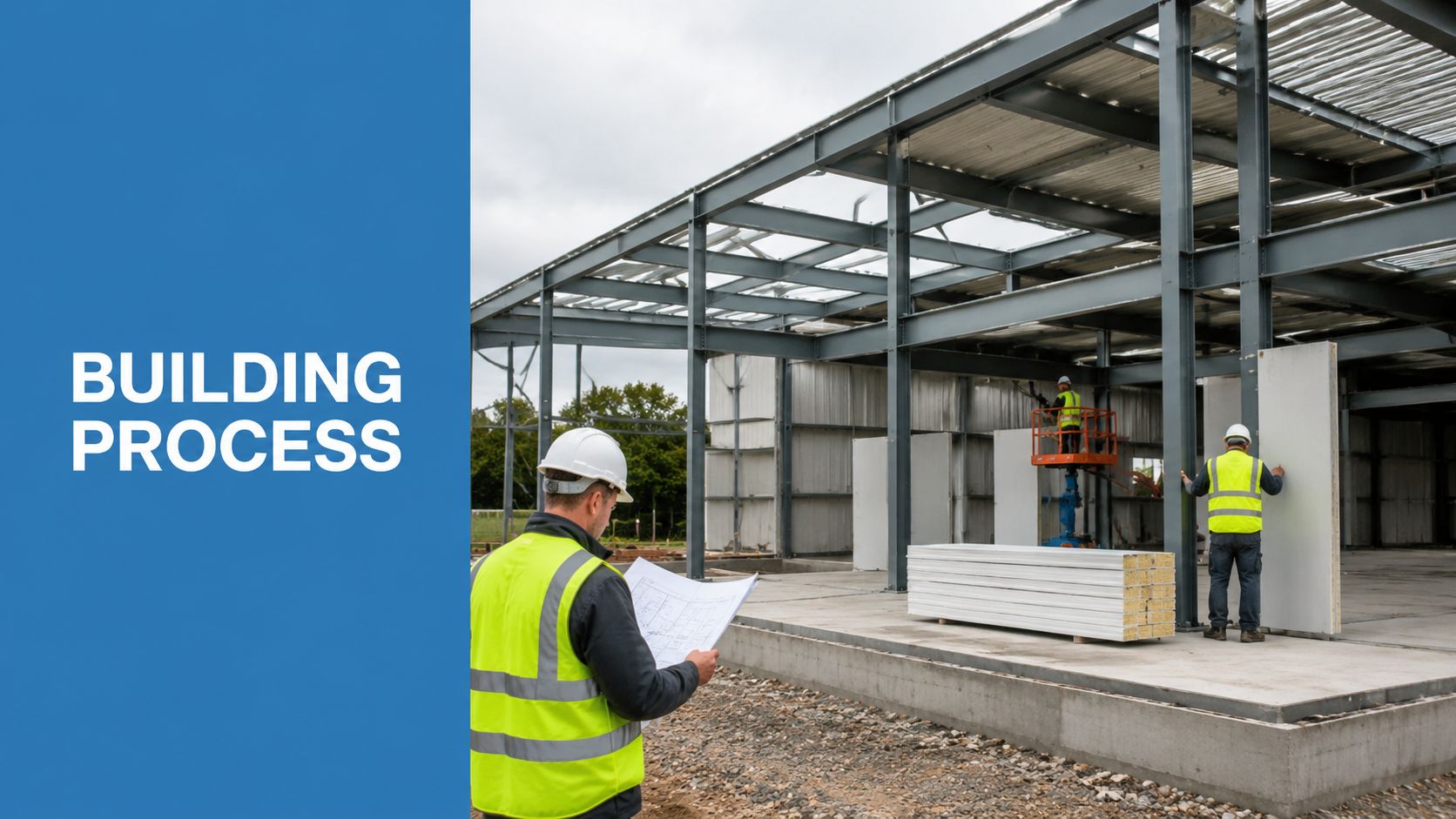
The Self Storage Facility Construction Process: A UK Guide
If you're looking at a plot, a planning pack, or an old industrial building and thinking self storage should be straightforward, this is usually the point where first-time developers underestimate the build. The business model is simple enough. The construction process in the UK isn't.
A self storage facility construction process succeeds when the early commercial assumptions, the planning route, the internal fit-out strategy, and the final compliance work all line up. If one of those moves late, the whole programme shifts. That's why experienced teams spend as much effort on sequencing and procurement as they do on steel and concrete.
In the UK, the full route from first planning work to opening commonly sits in the 12 to 24 month range, with permitting alone often taking 2 to 6 months, according to Mako Steel's self-storage construction cost guidance. For a new developer, the practical question isn't just how to build. It's how to avoid building the wrong thing, in the wrong order, under the wrong contract.
Phase One Feasibility and Site Selection
A first-time developer usually reaches this stage with a clear idea of the building they want. The better question is whether the site, local demand, and delivery model justify building it at all. In UK self storage, that answer often changes once you test planning risk, access constraints, utility capacity, and the fit-out standard needed to meet fire and operational requirements.
Start with the catchment, not the concept
Feasibility starts with demand, but broad demographics on their own are not enough. Check population density, household movement, local business stock, income profile, and the amount of existing storage already trading in the catchment. Then get more specific. A market dominated by low-cost external units behaves differently from one built around indoor, multi-level storage with higher security and longer dwell times.
That distinction affects the whole project. It influences the likely unit mix, the width of circulation space you can justify, whether upper floors will pay back, and whether a simple shell-and-fit model is sensible.

A sound first appraisal should test four things together:
- Build type: Single-storey and multi-storey schemes are different commercial products, not just different structures. Multi-storey can increase net lettable area on a tight site, but it also adds cost, design coordination, fire strategy complexity, and pressure on lift, stair, and escape layouts.
- Scale: Total floor area matters less than rentable efficiency. A larger box with poor circulation and weak unit mix can underperform a smaller scheme that has been planned properly.
- Land strategy: Site shape, gradients, access geometry, drainage outfalls, and neighbouring uses all affect what you can build and how efficiently it will trade.
- Fit-out route: Early on, decide whether the project is likely to suit a supply-and-fit package or a labour-only install. That choice changes risk allocation, programme control, and who carries responsibility for coordination between the shell, partitioning, doors, and fire stopping.
Practical rule: If the appraisal only works with optimistic occupancy, minimal contingency, and no allowance for planning delay or abnormal ground costs, the site has not passed feasibility.
What a workable UK site looks like
The best self storage plots are not always the cheapest or the most obvious. A former industrial site may look ideal, then lose margin fast once you price retaining works, service upgrades, surface water attenuation, or a difficult access arrangement. An existing warehouse can look like a shortcut, then turn into an expensive retrofit when column grids, slab condition, headroom, and fire compartmentation are checked properly.
I look for three things early. First, can customers get in and out without awkward vehicle movements or shared-yard conflict. Second, does the site allow an efficient internal layout with sensible corridors, unit depths, and reception positioning. Third, can the planning position support the operation you intend to run, not just the building you intend to construct.
Layout flexibility matters more than many new developers expect. An awkward boundary or pinch point can force dead space, reduce unit count, and make later integration of modular partitioning systems harder. That becomes a bigger issue in UK projects, where the partitioning package often needs to work closely with the fire strategy, alarm layout, and protected escape routes.
Check civil readiness before land commitment
Site selection also needs a ground-up review of what the land will require before the frame or fit-out package arrives. Drainage falls, slab levels, service entries, and formation quality all affect programme and cost. If those basics are wrong, every contractor after them inherits the problem.
Even if your scheme is not a farm building, the early groundworks principles are similar. If you want a practical reference on how poor preparation creates later cost and delay, prepare your pole barn site covers the kind of grading, drainage, and base issues that regularly show up in commercial builds as well.
Stress-test the numbers the way the job will actually be delivered
A site is only viable if the budget still works after real UK delivery conditions are added back in. That means testing shell works, fit-out, professional fees, utility upgrades, drainage, external works, fire protection measures, and contingency together, not as separate assumptions. It also means checking whether your procurement route suits the team you have.
For example, a supply-and-fit package can reduce interface risk for a new developer because one specialist controls manufacture, delivery, and installation of the storage system. A labour-only route can save money in the right hands, but only if drawings, tolerances, site conditions, and sequencing are tightly managed by the client team. If they are not, any apparent saving can disappear in variation costs and programme drift.
For a clearer breakdown of how those UK budget lines are usually structured, PSL's guide to self storage construction costs is a useful reference.
Good feasibility work does one thing well. It rules out the wrong site before you spend serious money trying to make it behave like the right one.
Phase Two Planning Permission and Due Diligence
Enthusiasm typically encounters the UK development system at this stage. A site that worked neatly in a spreadsheet can stall once planning policy, highways comments, environmental review, and land contract terms come into play.
Why projects slip here
According to the National Self-Storage Association UK, approximately 30% of new-build facilities experience schedule slippage beyond the standard 12 to 24 month window, mainly because of unforeseen ground conditions or delays in securing planning permissions and environmental assessments. That figure matters because it tells you something important. Delay isn't an exception. It's a known development risk.
The planning phase often becomes difficult when developers assume self storage is a simple warehouse use and submit on that basis. Councils don't look at it that casually. They will examine local use policy, access, traffic impact, drainage, neighbour context, appearance, and operational details.
What good due diligence looks like
The strongest due diligence period isn't passive. It should actively test whether the site can absorb the project you want to build.
Focus on these checks early:
- Ground conditions: Soil-boring reports and geotechnical findings affect foundations, drainage design, and budget resilience.
- Environmental position: A Phase 1 environmental assessment can change the risk profile quickly if it flags contamination or historical site issues.
- Planning fit: Review local zoning, use-class interpretation, design constraints, and likely planning objections before the application is locked.
- Contract protection: Land terms matter. If the planning route hardens against you, weak contract wording can turn a planning issue into a capital loss.
Secure the land deal as if the site still has to prove itself, because it does.
The due diligence period is also where too many developers leave specialist input too late. Planning consultants, civil engineers, and self storage design specialists should all be testing the same assumptions. If one adviser is pricing a simple scheme while another is designing around more demanding site constraints, the application and budget drift apart.
The contract clause people regret missing
One of the most practical protections in a land purchase is a conditional refund mechanism during due diligence. The verified data set notes guidance from the Institution of Civil Engineers that failure to secure a conditional 60-day deposit refund clause creates a 40% higher risk of financial loss when zoning changes or environmental stop-orders appear after signing. The lesson isn't just legal. It's operational. The earlier you preserve an exit route, the more thoroughly the team can investigate the site.
A clean planning strategy also needs realistic timing discipline. Chasing submission speed with incomplete surveys rarely saves time. In UK self storage, incomplete information usually comes back as delay, redesign, or both.
Phase Three Design Optimisation and Layout Strategy
A UK self storage scheme can look fine at shell stage and still lose money for years because the internal layout was never properly resolved. The usual pattern is familiar. Corridors end up too generous in the wrong places, mezzanine access cuts across unit rows, and the final unit mix reflects what was easy to draw rather than what the local catchment will rent.
Design for income per square foot, not just a clean drawing set
The test at this stage is simple. How much of the gross internal area will become lettable space once circulation, stairs, lifts, plant, fire protection, and access requirements are all accounted for?

Good layouts usually come from a few disciplined decisions made early:
- Corridor strategy: Main routes need to handle trolleys, passing traffic, and fire escape logic without wasting floor area on oversized circulation.
- Unit mix: A scheme stacked with one or two popular sizes often underperforms because real demand is usually spread across several price points and business uses.
- Vertical planning: Mezzanines improve returns only if stair positions, lifts, loading routes, and protected escape paths are resolved before the shell design is fixed.
- Sight lines and management: Blind corners and awkward dead ends create operational friction, increase supervision issues, and weaken the customer experience.
PSL's guide to an optimal storage facility floor plan is a useful reference because it deals with yield, access, and operating practicality together.
Multi-storey layouts fail at the interfaces
The recurring mistake on UK projects is not the mezzanine itself. It is the poor fit between the mezzanine frame, modular partitioning, stair locations, lift access, and the fire strategy.
That matters more in the UK than many generic guides suggest. A layout that works on paper can fail once Building Control, fire consultants, and the fit-out package are all working from detailed dimensions. If the partitioning system is treated as a late procurement item, unit widths drift, escape routes tighten, and stair enclosures start consuming rentable space that the appraisal assumed was available.
I have seen first-time developers approve shell drawings before the internal fit-out team has modelled the actual partition grid. That is where expensive redesign starts.
Rolling stairs, mezzanine openings, and transfer corridors all need to be set out around the chosen storage system, not added after the fact. The same applies to door swings, headroom under beams, smoke detection zones, and accessible routes. On a labour-only fit-out later in the programme, these interfaces are where disputes and delays tend to sit.
UK compliance should shape the layout from the first design pass
This is also the point where a UK scheme separates itself from US-led template advice. Internal layouts are not only a space-planning exercise. They have to work with UK fire compartmentation, means of escape, accessibility duties, and the practical limits of the building you have, especially on conversions.
Stairs are a good example. Their position affects customer flow, staff efficiency, trolley movement, and how naturally customers can find upper-floor units. Poorly placed stairs also create awkward travel distances and force compromises elsewhere in the plan. As noted earlier, mezzanine stair integration needs to be treated as part of the operating model, not a final access detail.
Electrical design also needs to be coordinated early, particularly around alarm interfaces, emergency lighting, access control, CCTV coverage, and future expansion zones. The same coordination discipline described by the best commercial electrical contractors Brisbane applies here as a general project lesson. Specialist packages perform better when they are designed around real site interfaces rather than left to site improvisation.
Fit-out design is part of project risk control
Developers sometimes push detailed partitioning decisions until after the shell package is settled. In self storage, that usually costs more than it saves.
If the building envelope is fixed before the internal system is coordinated, the team loses flexibility. Dead corners appear. Unit depths become inconsistent. Fire protection details start eating into the grid. Access routes no longer line up with customer behaviour or staffing patterns.
Partitioning Services Limited is one example of a UK specialist that designs, manufactures, and installs self storage partitioning and mezzanine systems. The practical lesson is broader than any one supplier. Get the fit-out specialist, fire consultant, structural engineer, and design team working from the same layout logic early, and a lot of avoidable cost never reaches site.
Phase Four Procurement Models and Manufacturing
Procurement decisions shape risk long before installers arrive on site. In UK self storage, the internal fit-out model affects programme control, HSE exposure, quality consistency, and who carries the burden when interfaces go wrong.
Supply-and-fit versus labour-only
Most developers end up comparing two routes. One is a supply-and-fit arrangement where the specialist provides the manufactured components and installs them. The other is labour-only, where the client sources materials and hires an installation crew separately.

A simple comparison helps.
| Model | Where it works | Main benefit | Main risk |
|---|---|---|---|
| Supply-and-fit | New builds, complex multi-storey schemes, projects with tight interfaces | Clear responsibility for manufacture and installation | Less flexibility if the client wants to split every package |
| Labour-only | Some retrofit jobs, experienced client teams with strong site controls | Lower upfront package cost in some cases | Interface failures, compliance gaps, and weaker accountability |
The labour-only option is attractive when a developer wants to strip cost out of a retrofit. Sometimes that decision is justified. Sometimes it creates a management problem the client team isn't resourced to control.
The UK risk hidden inside labour-only packages
A verified 2025 study from the Chartered Institute of Building found that 30% of UK retrofit projects using labour-only models incur penalties for non-compliance with HSE regulations due to uncoordinated teams. That's the key trade-off. Labour-only can reduce package cost, but it can also fragment responsibility on a live site where fire protection, access management, and safe sequencing all matter.
If you're retrofitting an operational facility, ask blunt questions before choosing labour-only:
- Who controls site safety interfaces?
- Who verifies that existing fire measures remain effective during works?
- Who coordinates follow-on trades if partitioning, electrics, and access systems overlap?
- Who signs off that the installation aligns with the approved design intent?
Cheap procurement becomes expensive when nobody owns the interface.
A similar principle applies to specialist services beyond storage fit-out. Even though the market context is different, this guide to choosing the best commercial electrical contractors Brisbane is useful because it highlights the same issue developers face everywhere: specialist trades need clear scope, accountability, and coordination, especially when compliance is part of the package.
Manufacturing discipline matters
Procurement isn't only a contract choice. It's also a manufacturing question. Internal systems such as partitioning units, mezzanine components, staircases, and garage units need dimensional consistency and proper integration with the approved design.
The more complex the scheme, the more benefit you get from manufacturing that has been aligned with the design team before site installation. If you want a practical overview of why off-site precision and coordinated fabrication can de-risk site work, PSL's page on modular construction benefits is a helpful reference.
For first-time developers, the rule is straightforward. If the project has difficult interfaces or live-site constraints, buy certainty before you buy apparent savings.
Phase Five Construction Sequencing and Installation
Construction becomes predictable when the sequence is disciplined. It becomes expensive when trades are asked to improvise around missed decisions.
The shell build sets the pace
In the UK, an experienced five-person crew can erect approximately 5,000 square feet of single-storey steel building per week, excluding roll-up doors and interior hallways, according to PSL's self-storage construction benchmark. The same verified data notes that 60% of new UK storage projects are single-storey, which reflects how often developers still favour simpler structural programmes.
That weekly erection rate is useful, but only if you apply it properly. It covers the steel-framed shell, not the entire operational building. Developers often overread shell productivity and then underestimate how long internal packages, compliance work, and final snagging will take.
Sequence the site in the right order
A workable build sequence usually looks like this:
- Groundworks and drainage first. If levels, access roads, and below-ground services are unresolved, the rest of the programme becomes unstable.
- Foundations and slab package next. Errors at this stage become expensive because internal systems depend on dimensional accuracy.
- Steel frame and envelope. Once the shell is weather-tight, the project starts to feel fast. Don't mistake that for being close to opening.
- Primary services and structural interfaces. M&E routes, fire strategy elements, and support details must be in place before internal fit-out accelerates.
- Mezzanine installation. On schemes using mezzanine floors, this package has to be coordinated with access and fire planning, not dropped in after the fact.
- Partition walls, doors, and corridors. These need to follow the agreed layout exactly. Late changes here usually trigger rework elsewhere.
- Security and operational systems. Access control, CCTV, alarms, and user flow technology should be installed against a tested commissioning plan.
Weather matters more in UK programmes than many developers assume. Rain can stretch site preparation and vertical construction, particularly where drainage or slab readiness is marginal. The practical answer isn't optimism. It's contingency in the programme and tight management of early civils.
Fit-out delays are usually self-inflicted
The internal installation phase is where poorly coordinated projects lose momentum. Teams start competing for the same space. One trade blocks another. Openings don't align. Access routes are used as storage areas. Then snagging multiplies.
The best site teams keep the fit-out sequence boring. That means clear handover zones, signed-off dimensions before manufacture lands on site, and no casual design changes after partition runs start. Self storage build-outs don't need heroic recovery measures when the sequence is right. They need disciplined preparation before installation begins.
Phase Six Fire Protection and Final Commissioning
A facility isn't ready when the building looks finished. It's ready when the fire, security, access, and operating systems have all been tested together and signed off without unresolved conflicts.
Why fit-out planning decides the finish line
The verified UK data is blunt here. Internal fit-out costs now account for 35% of total project spend in UK commercial storage, and a British Property Federation report states that 40% of UK multi-storey projects face fit-out delays because of poor sequencing and failures to meet Part B Fire Safety requirements.
That tells you where developers should focus at the end of the programme. Not on cosmetic completion, but on the technical closure of the internal package.
Fire protection in self storage isn't a bolt-on. It affects partition specifications, corridor strategy, door sets, alarms, protected routes, and the way mezzanine areas are integrated into the final building. If these items are coordinated late, approval becomes harder and remedial work becomes likely.
What must be commissioned properly
The final commissioning phase should be treated as a controlled process, not a snagging afterthought. At a minimum, the team needs to verify that:
- Fire-rated elements match the approved strategy. Partitioning, access routes, and any protected areas must align with Part B intent.
- Security systems are calibrated correctly. Access control, perimeter coverage, and CCTV zones need to work as an operating system, not as separate installations.
- Climate-controlled areas perform as designed. HVAC isn't just an engineering package. It changes customer offer and affects insurance and operational standards.
- Doors, corridors, and circulation routes work in use. It's not enough for components to be installed. They need to function safely under day-to-day traffic.
The verified data also notes that 15 to 20% of project timelines can be lost in punch list delays where access control, CCTV, and HVAC integration drag beyond practical completion. That usually happens because individual systems were installed, but not commissioned as one coordinated whole.
Most opening delays happen in the handover gap between "installed" and "working together".
Insurer expectations can delay opening
Security compliance can also hold up handover. The verified data notes that 35% of UK self storage facilities face initial operational delays because security systems aren't calibrated to meet the Grade 2 certification required by major insurers, which can also lead to higher premium costs. That doesn't mean every project needs the same solution. It means the insurer conversation should happen before final commissioning, not after the contractor has left site.
A strong handover process closes every open loop. Fire sign-off, system testing, documentation, staff training, and defect ownership all need named responsibility. If that feels overly formal, that's exactly the point. Formal close-out is what turns a constructed facility into an operational one.
Your Self Storage Construction Checklist
Good project management isn't about remembering everything. It's about making sure nothing critical gets lost between disciplines. For a first-time developer, the safest way to manage the self storage facility construction process is to work from a live checklist that follows the asset from concept to opening.

Use this as a live project control sheet
- Confirm the demand case. Validate local need, competitor positioning, catchment suitability, and whether the planned facility type matches the market.
- Stress-test the site. Check access, visibility, servicing, planning fit, drainage implications, and whether the plot supports an efficient layout.
- Protect the land position. Make sure the contract leaves room for proper due diligence and a viable exit if the site fails investigation.
- Complete technical investigations early. Bring in geotechnical, environmental, planning, and design input before the scheme is overcommitted.
- Lock the layout before manufacture. Finalise unit mix, mezzanine intent, corridor strategy, and access routes before ordering internal systems.
- Choose procurement with eyes open. Decide whether supply-and-fit or labour-only matches the project's complexity, site conditions, and management capacity.
- Coordinate the build sequence. Align civils, shell, services, mezzanines, partitions, doors, and systems so each trade works on released fronts.
- Run commissioning as a formal programme. Test fire, security, HVAC, and access systems together. Assign ownership for unresolved items.
- Close out documentation before launch. Handover isn't complete until the operator has records, certifications, operating guidance, and a live defect route.
The practical checks that save trouble
The most useful checklist items are the ones that force a decision early. If an item can sit in "to be confirmed" for too long, it usually becomes a delay later.
Use questions like these in project meetings:
| Checkpoint | Question to ask |
|---|---|
| Feasibility | Does the business case still work with real UK planning and fit-out constraints applied? |
| Planning | Are all supporting reports complete enough to avoid resubmission risk? |
| Design | Has the internal layout been tested for operation, not just for drawing compliance? |
| Procurement | Is accountability clear across manufacture, installation, and HSE compliance? |
| Construction | Are follow-on trades receiving clean, signed-off work areas? |
| Commissioning | Can the operator open without temporary workarounds? |
What experienced developers do differently
They don't treat the job as a linear build. They treat it as a chain of approvals, interfaces, and risk transfers. That mindset changes everything. It pushes contract review earlier. It gets fit-out specialists involved sooner. It stops shell completion being mistaken for project completion.
If you're building your first facility, keep the checklist visible and current. The project doesn't need more moving parts. It needs fewer assumptions.
If you want a practical partner for a UK self storage project, Partitioning Services Limited provides design, manufacture, installation, and project support for self storage fit-outs, including partitioning, mezzanine flooring, staircases, garage units, and fire protection measures. For developers balancing programme risk, rentable efficiency, and compliance, that kind of joined-up delivery can make the construction process easier to control.

UK Self Storage Development Consultants a Developer's Guide
You're probably in one of two positions right now. You've either got a site under review and you're wondering whether self storage stacks up better than trade counter, industrial or mixed-use, or you've already decided the sector looks attractive and now you're trying to avoid an expensive mistake.
That's where most self-storage schemes either tighten up or drift. The difference usually isn't enthusiasm. It's whether someone is looking at the project as an operating business from day one, not just as a building to get through planning and construction. That's the primary job of self storage development consultants in the UK and Europe.
Why You Need a Self Storage Development Specialist
The UK self-storage market gives developers a strong reason to pay attention, but it also leaves less room for loose assumptions. National average occupancy reached a record 94.5% in early 2026, and by April 2026 there were 2,560 self-storage properties across the UK in all stages of development according to the verified market data summarised from industry market reporting. Strong demand is good news. It also means more competition for the right sites, tighter planning scrutiny and less tolerance for poor layout decisions.

A lot of developers ask the wrong first question. They ask whether they can save money by handling early work in-house. The better question is whether they can afford to carry planning risk, design inefficiency and funding friction into a specialised operating asset.
Demand is only half the story
High occupancy doesn't automatically make a site viable. A weak entrance arrangement, poor unit mix, awkward circulation, overbuilt back-of-house space or slow planning path can turn a promising location into a mediocre facility.
That's why a specialist matters. A proper consultant doesn't just say yes or no to the scheme. They test whether the local catchment can support your pricing, whether the layout can deliver enough rentable area, whether the build route fits the capital stack, and whether the planning strategy matches the local authority's reality.
Practical rule: If self storage is being treated like a generic commercial conversion, the project is already under-analysed.
What a specialist changes
A self storage development specialist acts as a commercial filter before you commit too much capital. In practice, that usually means they help you:
- Screen bad sites early so you don't spend months on a location that was never going to trade properly
- Align design with operations so the building works for customers, staff, fire strategy and future revenue
- Reduce preventable cost by identifying planning, compliance and fit-out issues before they become site problems
- Present a more credible scheme to lenders and investors because the project is built around operating logic, not just square footage
Feasibility work in this sector often costs £5,000 or more based on verified market guidance, which is modest compared with the cost of correcting a flawed brief after planning or construction has started. In other words, the consultant fee usually isn't the expensive line item. The expensive line item is getting the building wrong.
What Do Self Storage Consultants Actually Do
The easiest way to think about self storage development consultants is this. They're the architect of the business model, not just the building.
A general project team can draw a compliant facility. A specialist consultant works out whether that facility will trade well, lease efficiently and justify the capital deployed. That's a different discipline.

Market viability
This starts with the blunt question developers need answered early. Is this a good self-storage site, or just an available one?
A competent consultant looks at the local customer base, nearby competition, access routes, surrounding uses and likely demand profile. In UK practice, feasibility studies routinely analyse customers within a one- to five-mile radius of the proposed site, together with local demographics, competitor mapping and financial projections. They're also expected to understand the local area properly, often through direct regional familiarity and industry referrals.
If a consultant can't explain why this site works for this catchment, they're guessing.
Project execution
Specialists earn their keep by collaborating with planners, architects, contractors, and building control. They translate a viable concept into something that can be approved, built, and operated.
That covers issues such as:
- Planning and zoning context at the site
- Operational layout logic for loading, reception, circulation and access control
- Technical coordination across partitioning, mezzanine levels, fire protection and accessibility
- Construction sequencing so the fit-out isn't fighting the shell or M&E package
A self-storage facility that looks efficient on a drawing can still fail operationally if access, visibility and circulation haven't been tested from the customer's point of view.
Financial optimisation
This is the part many non-specialists underestimate. Revenue in self storage is shaped by detail. Unit mix, corridor width, stair placement, partitioning method, mezzanine strategy and phased opening all affect how quickly the building starts earning.
A strong consultant helps answer questions like:
| Commercial issue | What the consultant should resolve |
|---|---|
| Too much non-revenue space | Rework the layout to improve rentable area |
| Weak lender confidence | Produce evidence-backed feasibility and risk framing |
| Slow lease-up assumptions | Match unit mix and access strategy to local demand |
| High upfront capital pressure | Consider modular or phased approaches that support earlier income |
Good consultants don't operate in isolation either. They coordinate with specialist suppliers, project managers and fit-out teams so the commercial model survives contact with the actual build.
From Concept to Completion The Consultant Lifecycle
A self-storage project usually looks simple from the outside. Find a site, get consent, fit it out, open the doors. In reality, the value is created or lost in the handovers between those stages.

Feasibility and site acquisition
Disciplined consultants save the most pain. They test catchment demand, local competition, visibility, access and planning context before the deal hardens.
Verified UK guidance shows consultant-led site selection can combine GIS-based market analysis, transport accessibility indexing and competitor density mapping within a 5 to 10 km radius to identify underserved catchments with 90%+ certainty of high occupancy potential, often looking for 15,000+ residents per 5 km zone in the process according to technical site selection benchmarks for UK self-storage projects.
That sounds technical because it is. But the practical takeaway is simple. The consultant should be able to show why the catchment supports the scheme, not just say it feels right.
Design and planning
Once the site looks viable, the consultant shifts from market logic to buildable layout. This stage covers unit mix, circulation, loading, customer journey, fire strategy, accessibility and what can realistically get through local planning.
The best consultants treat planning as a commercial process, not an admin task. They understand that a small design choice can trigger a bigger operational problem later. A stair in the wrong place, an over-generous corridor, or a poor loading route can weaken both customer experience and net rentable area.
That's also where digital coordination matters. Developers trying to reduce friction between concept, design and delivery often benefit from understanding how AI streamlines project planning, especially when multiple technical inputs need to be aligned before procurement starts.
Finance and procurement
This phase is often messier than developers expect. Lenders want confidence in the operational model, not just the capex schedule. Contractors want clarity. Specialist suppliers need decisions early enough to avoid redesign and delay.
A consultant adds value here by packaging the project in a way other parties can trust. That includes realistic phasing, buildability, programme logic and a fit-out strategy that matches the intended launch profile.
If you're mapping delivery responsibilities in detail, a specialist view of storage facility project management is useful because self storage has more moving parts than a standard CAT A or industrial shell scheme.
Construction and pre-launch
During construction, the consultant's role becomes more practical and less theoretical. They protect the original commercial intent. That means checking that on-site decisions don't erode the revenue model.
Typical pressure points include:
- Design drift when contractors simplify details that affect future lettable space
- Late compliance changes that push rework into fit-out
- Procurement substitutions that look cheaper but create operational compromises
- Pre-opening readiness for signage, access systems, wayfinding and staged occupancy
The project isn't finished when the building is complete. It's finished when the first customers can move in without the team improvising around design mistakes.
Handover and early trading
Good consultants don't vanish at practical completion. They review whether the delivered layout, operational setup and launch assumptions are performing as intended. Early feedback matters because first-phase leasing often exposes issues that spreadsheets hid.
The schemes that start well usually had operational thinking embedded all the way through. The ones that stumble often treated consultancy as a front-end report rather than an end-to-end discipline.
Maximising Your ROI Key Value Drivers
Consultancy only makes sense if it moves the numbers. In self storage, that usually happens in four places. Layout efficiency, compliance discipline, programme control and finance readiness.
Layout efficiency drives revenue
A self-storage building makes money from rentable area, not from gross floor area. That distinction matters more than many first-time developers realise.
Verified technical guidance shows consultants can calculate effective rentable area ratio by optimising partitioning layouts to achieve 85 to 90% utilisation of gross floor space, with a corresponding 12 to 15% uplift in annual revenue per square metre when layouts are handled properly. The trade-off is straightforward. More rentable area usually requires tighter coordination around partitions, mezzanine access, stair locations, corridor widths and fire strategy.
If you're reviewing these decisions in detail, this guide to an optimal storage facility floor plan is a useful companion because layout mistakes are often baked in long before fit-out starts.
Compliance done early protects capital
Early regulatory review is one of the least glamorous and most profitable parts of the process. Verified UK data shows consultants who require early-stage compliance reviews covering Part B fire safety and Part M accessibility reduce post-construction rework by 30 to 40%, saving £150,000 to £250,000 on a typical 5,000m² facility according to UK project performance benchmarks on compliance and commissioning.
That saving doesn't come from magic. It comes from preventing expensive late fixes to circulation, compartmentation, escape routes, accessibility details and physical fit-out conflicts.
Commercial view: Rework is rarely just a construction cost. It also delays launch, distracts the team and weakens lender confidence.
Programme control accelerates income
The same verified benchmark data shows consultant-guided projects can achieve commissioning within 18 to 24 months, compared with 30+ months for ventures without that specialist lead, based on the same UK project performance benchmarks on compliance and commissioning.
That matters because time is part of return. A facility that opens sooner starts generating income sooner, stabilises faster and gives the operator more room to refine pricing and occupancy strategy.
Programme acceleration usually comes from fewer late design changes, clearer procurement sequencing and better alignment between planning, technical design and fit-out.
Finance structuring affects viability
This point often gets missed because it sits between consultancy and capital raising. For modular builds in particular, finance structure can decide whether a viable concept gets delivered.
A practical consultant should be able to present the scheme in lender-friendly terms, explain how phased fit-out supports cash flow and coordinate with specialist suppliers on what can be delivered now versus later. In some projects that also means bringing in experienced delivery partners early. Partitioning Services Limited, for example, provides partitioning, mezzanine flooring, rolling staircases, fire protection and structured finance packages for self-storage schemes in the UK and Europe. That sort of supplier input can be useful when the commercial model depends on opening capacity in a staged, finance-aware way.
Selecting the Right Development Consultant
The market doesn't need more generic advisers with a slide deck and a few operator buzzwords. It needs people who can explain, in plain English, how your site becomes a profitable self-storage asset.
The fastest way to separate real expertise from noise is to ask questions that expose depth. A top-tier consultant should be comfortable discussing planning friction, catchment logic, unit mix, phasing, compliance and rentable area yield without hiding behind vague optimism.
What to prioritise
Start with three filters.
- UK planning literacy: They should understand local authority behaviour, not just policy wording.
- Operational layout knowledge: They need to think beyond shell conversion and into actual customer use, circulation and revenue density.
- Evidence-led commercial judgement: They should be able to show how they test viability and where they've seen projects go wrong.
One issue deserves special attention. Verified UK guidance identifies a serious gap around modelling rentable area yield lost to partitioning and circulation. The UK Self-Storage Association reported that 28% of new UK facilities underperformed on ROI due to unoptimised partitioning in the verified data set. That means your consultant needs a credible way to model the commercial effect of fit-out decisions, not just a rough sketch and a comfort statement.
Consultant interview checklist
| Question Category | Question to Ask | What a Good Answer Looks Like |
|---|---|---|
| Catchment analysis | How do you decide whether a site has enough local demand? | They talk about local catchment, competition, access, demographics and real travel behaviour. |
| Planning strategy | What planning or zoning risks would you test first on this site? | They identify likely consent issues early and explain how they'd de-risk them. |
| Layout performance | How do you model rentable area yield lost to corridors, stairs and partitioning? | They give a specific method, not a guess, and can explain trade-offs clearly. |
| Fire and accessibility | When do you review Part B and Part M issues? | They say early, before design hardens, and tie that to avoiding rework. |
| Procurement | How do you coordinate shell, M&E and self-storage fit-out packages? | They describe sequence, interfaces and who owns each technical decision. |
| Finance | How do you support lender conversations on phased or modular builds? | They can explain risk mitigation, delivery logic and how the scheme starts earning. |
| Local experience | Who do you usually work with in this region? | They show real familiarity with local planners, brokers, contractors or consultants. |
Red flags you shouldn't ignore
Some warning signs show up quickly.
- They talk mostly about construction cost, not operating income
- They can't explain unit mix logic for your catchment
- They treat partitioning as a late supplier issue rather than a core design variable
- They promise a smooth planning path without discussing local authority constraints
- They avoid detailed questions on funding, phasing or launch readiness
A good consultant won't pretend every site can be made to work. Sometimes the smartest advice you'll get is to walk away.
Understanding Consultant Costs and Engagement Models
Developers often expect consultancy fees to be either opaque or inflated. They don't have to be. What matters is matching the engagement model to the project's risk profile.
Where costs usually start
Verified market guidance shows self-storage feasibility studies often cost £5,000 or more. That's typically the first formal spend, and it's usually money well spent if the consultant is providing an honest assessment of viability rather than dressing up a preferred answer.
After that, fees vary by scope. Some developers only need market validation and planning input. Others need a consultant involved from acquisition through handover.
Common ways to engage
Here are the models that tend to work in practice:
- Feasibility-only engagement: Best when you need a go or no-go decision before committing further capital.
- Phase-specific support: Useful if you already have an architect or project manager but need specialist input on layout, planning or fit-out coordination.
- Full development support: Strongest option for first-time entrants or more complex schemes where the operating model needs protecting all the way through.
- Advisory retainer: Sensible for operators expanding through multiple sites and wanting strategic continuity.
The right fee structure depends on how much execution risk you're carrying internally. If your team knows mainstream commercial development but not self storage, buying deeper specialist input early is usually cheaper than correcting assumptions later.
For budgeting context around the wider build, this breakdown of self-storage construction costs helps frame where consultancy sits relative to the full capital stack.
What good scoping looks like
A solid proposal should define deliverables, decision points and who owns what. If the consultant can't explain scope clearly, expect confusion later. Ambiguity usually shows up first in design coordination, then in cost.
Your Next Steps for a Successful Development
If you're serious about developing self storage, don't start by shopping for drawings. Start by testing the business case properly.
A practical sequence that works
- Assess the opportunity internally. Clarify whether you're pursuing a conversion, a new build, an extension or a modular rollout.
- Gather the basics. Site constraints, planning status, access, surrounding uses, local competition and likely customer profile.
- Shortlist consultants using hard questions. Focus on local planning experience, layout modelling and finance awareness.
- Commission a feasibility study first. That gives you a grounded basis for design, funding and acquisition decisions.
- Bring specialist delivery partners in early where needed. That's particularly important on modular and partition-heavy schemes where fit-out drives the revenue model.
Verified UK and European guidance shows 40% of developers struggle to secure pre-operational funding for modular projects, which is why finance structuring shouldn't be left until after design is settled. The consultant, lender and specialist supplier need to be looking at the same commercial picture.
Build the information stack before you build the facility
This part is underrated. Developers who organise site, contact and deal data cleanly from the start usually make faster decisions later. If you're managing multiple opportunities or investor conversations at once, a platform built for real estate CRM for property developers can help keep the pipeline, stakeholders and project history in one place.
Start with viability. Then move to planning and layout. Then align finance and delivery. That order saves more projects than any clever late-stage fix.
The developer who does well in self storage usually isn't the one who moved fastest at the start. It's the one who committed capital in the right order and used specialist input before the hard costs landed.
If you're weighing layout options, phased fit-out, mezzanine strategy or modular delivery, Partitioning Services Limited works alongside developers, operators and consultants on the design, manufacture and installation of self-storage systems across the UK and Europe. Their scope includes partitioning, mezzanine floors, rolling staircases, fire protection and project support where the commercial performance of the fit-out needs to be considered early.